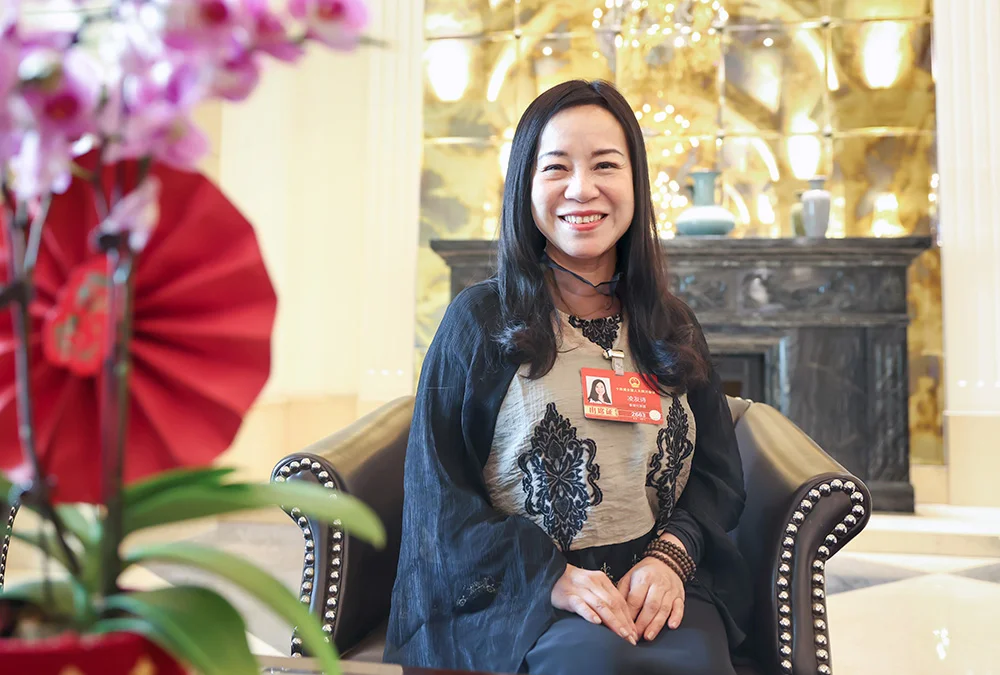

Professor Ling Youshi has advocated for increased support for Chinese language education among overseas Chinese.
As China’s Two Sessions convened, Ling Youshi, a professor at the Hong Kong Institute for Public Administration and a deputy to the NPC of the Hong Kong Special Administrative Region of China, submitted a proposal advocating for “increased support for Chinese language education among overseas Chinese”.
Once Parents’ Language, Now a Useful Tool
Ling stated that her proposal stemmed from extensive exchanges with overseas Chinese communities over the years.
Through her work, she frequently interacts with presidents of overseas Chinese associations. They have shared their profound concerns with her about the current state of Chinese language education. The most pressing challenges, she noted, are a shortage of teaching materials and qualified teachers.

Over the past two to three decades, Chinese language education overseas has received limited attention. Today, however, the situation has changed. She noted that with China’s rise, the Chinese language has become a useful tool, and overseas Chinese youth are developing an interest in Chinese culture and a stronger sense of cultural identity.
Yet many overseas Chinese youth in Europe and elsewhere still view Chinese as merely a ‘parents’ language,’ seeing few career benefits in learning it. Ling suggests the country could integrate vocational education with Chinese language education. For instance, incorporating Chinese cultural elements into fields such as architecture and design. This approach positions Chinese not only as a vehicle for cultural transmission but also as a tangible, marketable skill.
Hong Kong as “Backing”
Ling particularly emphasised Hong Kong’s unique role in advancing overseas Chinese language education. She noted that six of Hong Kong’s universities rank among the world’s top 100, with many possessing Chinese, History and Philosophy departments boasting profound expertise in Chinese studies.
Ling is currently facilitating the distribution of textbooks on Chinese etiquette and ritual-music civilisation, compiled by Professor Peng Lin of Tsinghua University, across Hong Kong, Macau, Taiwan and overseas. She thus pointed out that this will enable more overseas Chinese youth to access systematic education in Chinese culture.
In addition, she noted that Hong Kong youth can simultaneously become both participants in and beneficiaries of Chinese language education.
AI Helps while Human Connection Matters
As the AI era dawns, Ling is optimistic about how AI and similar technologies can be applied to Chinese language education. She stated that this is much needed, as there are 60 million overseas Chinese and nationals worldwide, and it is impossible to have that many Chinese teachers.
She believes that many contemporary communication methods are helping Chinese language education reach wider and further. For instance, through AI-powered VR technology, cultural treasures such as the Along the River During the Qingming Festival scroll can be rendered in vivid three-dimensional detail, enhancing the appeal of learning.
However, Ling cautioned that the essence of Chinese culture lies in “inspiration through human connection”, necessitating practical elements such as reciting classics, practising calligraphy, and learning martial arts. She stressed that when planning Chinese education, one must ensure that Chinese language education integrates culture into students’ daily lives.
Calling for Concerted Efforts
By September 2025, 86 countries worldwide had incorporated Chinese into their national education systems. In Europe, countries such as the United Kingdom, Ireland, Hungary, and France have designated Chinese as an optional subject for higher education entrance examinations.
In response to the growing enthusiasm for Chinese studies overseas, Ling recommends that the country should focus on compiling textbooks from classical Chinese texts such as the Confucian classics, histories, and philosophical works. Simultaneously, she advocates incorporating calligraphy, martial arts, and Chinese etiquette into local Chinese language education systems.
Regarding funding and support, Ling proposes establishing a dedicated Chinese language education department within the Ministry of Education to coordinate textbook compilation and teacher training, while also mobilising social capital. She emphasised that only through such concerted efforts can Chinese language education truly take root and flourish.
Written by Hannah, all photos by Ge Bian.
If you liked this article, why not read: Guochao Trend Seen as Bridge to Young Overseas Chinese