
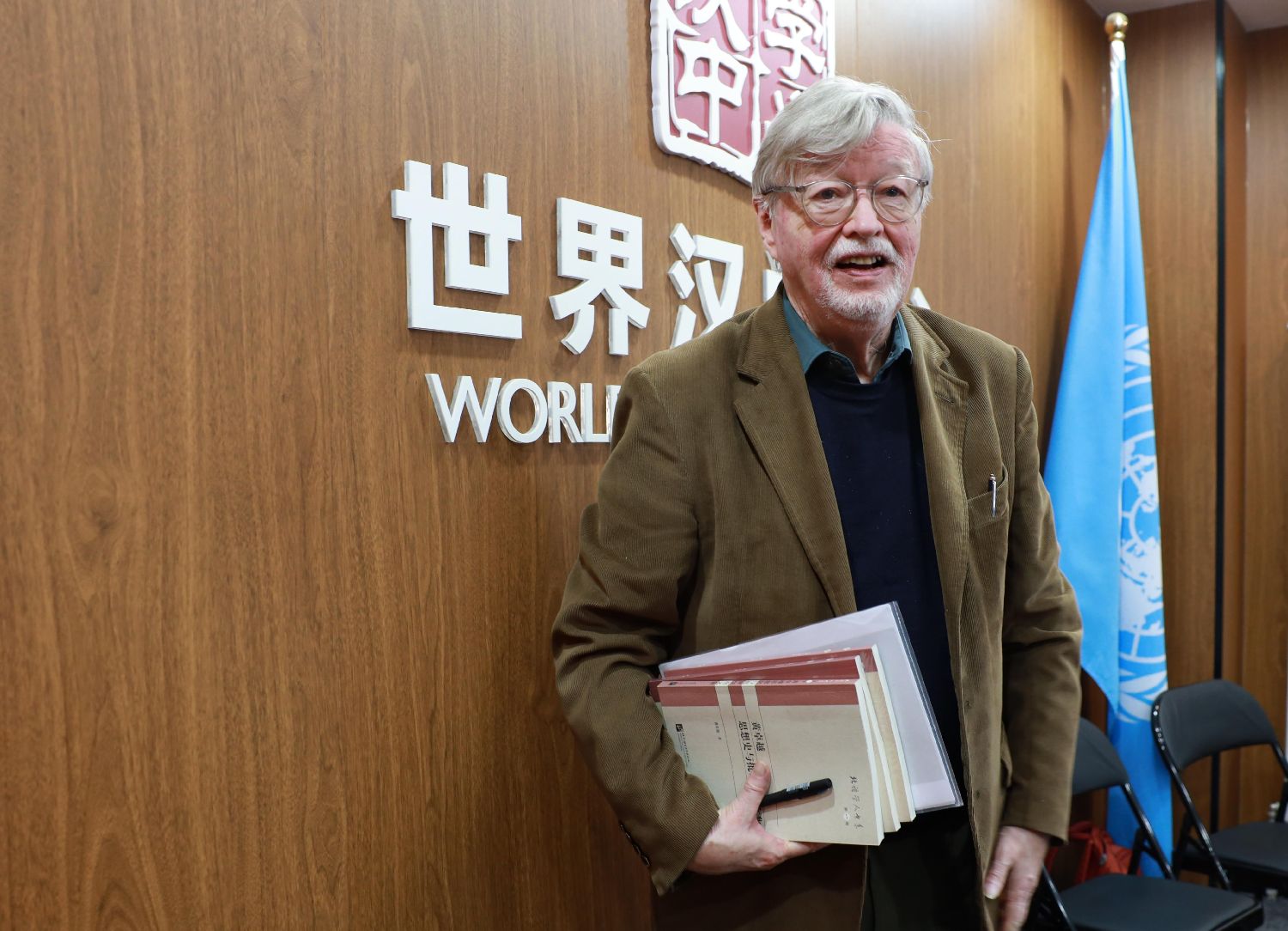

European sinologist Torbjörn Lodén delivered a keynote lecture, exploring the mission of Sinology in an uncertain era.
Invited by the World Sinology Centre at Beijing Language and Culture University, European sinologist Torbjörn Lodén delivered a keynote lecture themed “The Mission of Sinology: Advancing Cross-Cultural Understanding” on March 26th.
As a Swedish scholar long devoted to the study of Chinese intellectual history, Lodén does not regard Sinology as merely “knowledge about China.” Instead, he believes that Sinology is becoming a future-oriented field of study.
“Humanity faces numerous global crises, including climate change, environmental challenges, and geopolitical tensions,” Lodén noted at the start of his lecture. He pointed out that, in such a context, cross-cultural dialogue and mutual understanding have become particularly urgent, and that this has become a responsibility that Sinology and sinologists cannot avoid.
Lodén then raised a simple yet profound question: Can Sinology make even a small but meaningful contribution to improving understanding between East and West?
His answer was yes. By reviewing the 300-year history of Swedish Sinology, Lodén pointed out that Sinology, in a broad sense, is not merely the study of language or classical texts. Rather, it is a comprehensive approach to understanding Chinese history, institutions, thought, society, and ways of life.
When discussing cultural differences between China and the West, Lodén specifically responded to German sociologist Max Weber’s classic assertion that traditional Chinese thought lacked “ethical tension.” He rejected this view, arguing that Chinese intellectual history also contains tensions between ethical ideals and the limitations of human nature.
He further noted that, throughout European intellectual history — from Aristotle and Montesquieu to Karl August Wittfogel — stereotypes have continuously shaped Europe’s framework for imagining China. In the history of Swedish Sinology, China’s image has likewise swung between idealisation and demonisation.
“One of the tasks of sinologists is to move beyond this swing and present a fact-based and internally diverse China,” he said. Quoting Confucius’ idea that “the gentleman seeks harmony but not uniformity,” Lodén argued that Sinology is, above all, a discipline that resists extremity. It does not pursue sameness, but instead values harmony amid differences.
“Chinese culture and Western culture certainly differ in many ways,” Lodén said. “But in my view, these are not essential differences. They can complement one another, and many of these differences can also be understood as different expressions of similar themes.”
On this basis, he further proposed that a consensus on “global ethics” should be sought to enhance communication through cross-cultural understanding.
He defined “global ethics” as values and norms regarded as universally valid, particularly in guiding behaviour on a global scale. In his view, humanity has always sought to establish value systems with universal applicability, and such principles should serve as norms guiding countries on the international stage.
What intellectual resources can Chinese cultural traditions contribute to building such a consensus? Lodén cited examples including the Confucian tradition of self-cultivation, the Doctrine of the Mean as a way of avoiding extremism, the ecological philosophy of harmony between humanity and nature, and the balancing of freedom and responsibility.
At the end of the lecture, Lodén said that Sinology is not only a way of understanding China, but also a way of understanding the world. In his view, Sinology is evolving from an academic field into a platform for dialogue among civilisations.
“Understanding itself is the most fundamental foundation for cross-cultural cooperation,” he said.
If you liked this article, why not read: East Meets West | Helwig Schmidt-Glintzer: Enhancing Mutual Understanding – How Can Europe and China Move Towards Each Other?


