
China’s commercial space industry has had a robust start this year, making “commercial space” the new year’s buzzword.
“I’m honoured to be a space tourist. I’ll board China’s own spacecraft and reach the sea of stars.” On January 22nd, Chinese actor Huang Jingyu became one of China’s first space tourists.
Huang is China’s No. 009 first commercial space tourist for Interstellar’s Transcender-1 (CYZ1). The company has opened ticket pre-sales, each ticket priced at 3 million yuan, with a 10% deposit required to secure a seat. To date, more than a dozen paying customers have signed up. Transcender-1 (CYZ1)’s first crewed missions are scheduled for 2028.
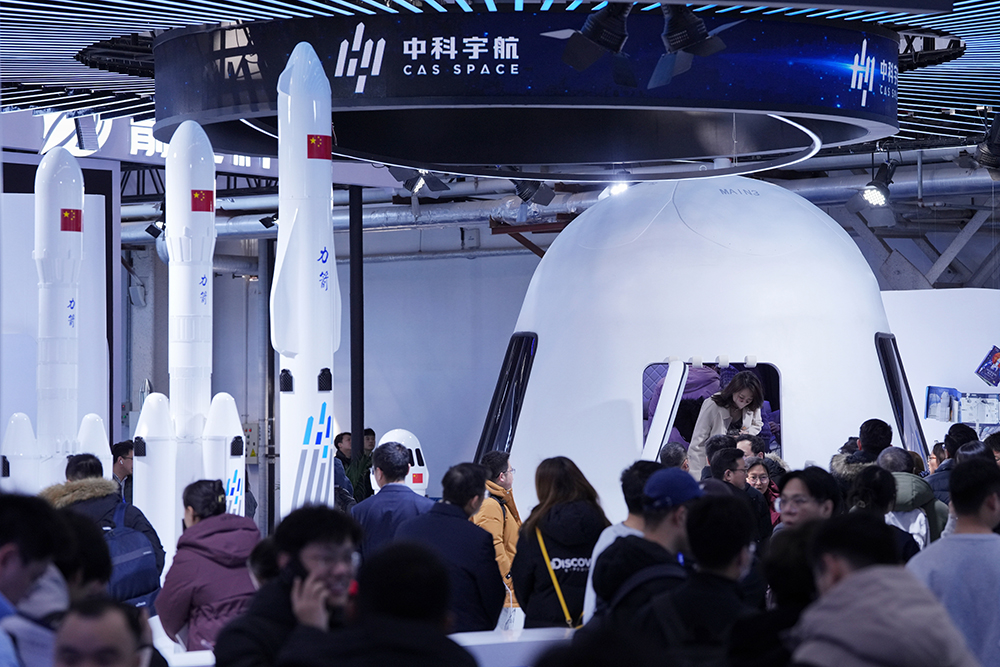
China’s commercial space sector has made a strong start this year, with key milestones achieved. In January, the Lihong-1 Y1 completed China’s first commercial suborbital parachute recovery mission. Meanwhile, China has established its first Interstellar Navigation school.
With a string of achievements rolling out, “commercial space” has emerged as the buzzword of the new year.


Decade of Developments
In 2015, China explicitly encouraged social capital to enter the commercial launch sector. Thus, 2015 was widely recognised as the first year of China’s commercial space industry.
Over the past decade, the sector has achieved remarkable results. Data shows that in 2025, China’s commercial space sector will have completed 50 launch missions, accounting for 54% of the total space launches over the year.
The Hainan commercial spacecraft launch site began regular operation, with 9 launch missions throughout the year.
Overall, 311 commercial satellites were sent into orbit in China in 2025, accounting for 84% of the annual total. Meanwhile, major constellations, including China Satellite Network Group and Qianshan Constellation, have launched over 200 satellites in total.
The accelerated deployment of low-Earth orbit (LEO) constellations has emerged as the core driving force: major constellations, including China Satellite Network Group and the Qianshan, or Spacesail, have launched over 200 satellites in total.
Amid a global surge in deploying low-Earth orbit (LEO) satellite constellations, China has filed plans for more than 200,000 satellites with the International Telecommunication Union(ITU). Experts noted that this scale is not only a strategic layout for seizing space resources but also a forward-looking plan for future application scenarios.
Mass satellite production is breaking traditional models. The Satellite Super Factory in Hainan is designed with an annual production capacity of 1,000 satellites. The satellite assembly base in Jinan, Shandong, cut the manufacturing cost to 100,000-200,000 yuan per kg. And LandSpace in Zhejiang has reduced the component outbound time from 3 minutes to 30 seconds.


Challenges and Developments
Despite its rapid development, the commercial space sector faces challenges and risks. Experts noted that the industry’s biggest bottleneck is poor alignment between demand and production capacity. Though satellite, rocket and launch site infrastructure is in place, AI and digital technologies must be integrated to achieve commercialisation of space services, not just infrastructure.
To seize key development opportunities, multiple Chinese local governments have introduced targeted policies to boost the growth of the commercial space industry. For example, the 2025 Beijing Municipal Government Work Report sets out to prioritise the cultivation of future-oriented sectors, including commercial space. Notably, Yizhuang has become home to over 300 high-tech enterprises in this field, making it the most concentrated cluster of commercial space companies in China.
Written by Sha Liu, chart by Di Wang, additional reporting by Ecns.cn and Xinhua.
If you liked this article, why not read: Beyond the Taste: Shenzhou-20 Astronaut Unfolds “Space Barbecue” Story