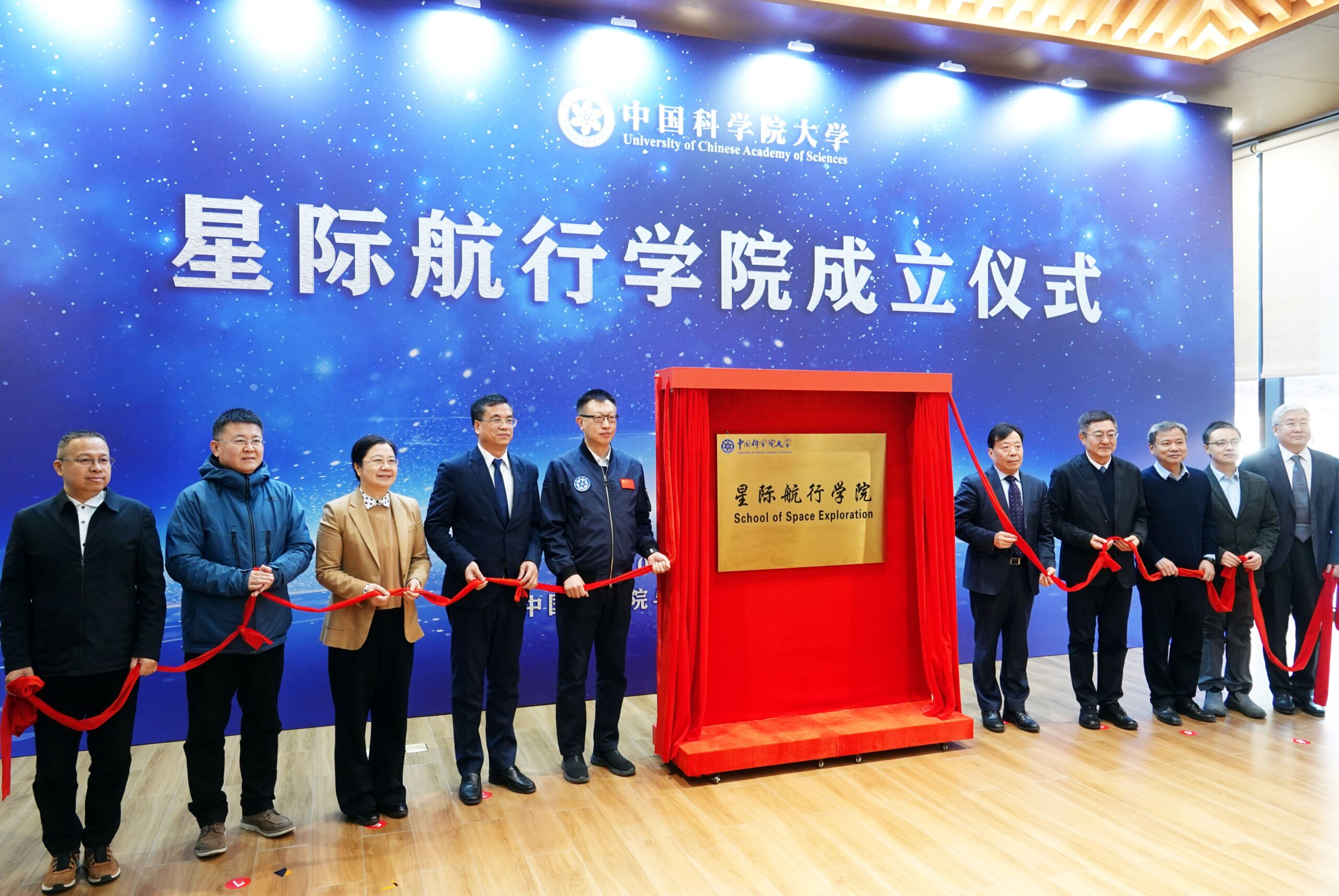

China’s University of the Chinese Academy of Sciences has opened a new School of Interstellar Navigation to advance space science education and research.
The University of the Chinese Academy of Sciences (UCAS) opened a new School of Interstellar Navigation in Beijing on January 26th, expanding its efforts in space science education and research, according to HKCNA.
At the inauguration ceremony, Zhu Junqiang, an academician of the Chinese Academy of Sciences (CAS), was appointed dean of the new school.
Interdisciplinary Curriculum and Core Courses
Earlier, in November 2025, UCAS announced its decision to establish the School of Interstellar Navigation. The school will develop a curriculum framework covering 14 major disciplinary and professional fields, including aerospace science and technology and planetary science.
In addition, the program will broaden its course offerings. Based on 97 existing courses, UCAS will introduce 22 new core courses. These courses will focus on frontier topics such as interstellar propulsion principles, space environment perception and utilisation, planetary dynamics and habitability, and interstellar sociology and governance. Together, they aim to strengthen links between scientific research, technological development, and practical application.
Specialized Hands-on Training Platforms
Meanwhile, practical training will play a central role in the new school. Drawing on existing research platforms in Huairou Science City, the school will develop six specialised teaching and innovation platforms. an unmanned aerial vehicle intelligent patrol simulation platform, a full-process teaching practice platform for space science satellites, and a space-ground collaborative experimental teaching and innovation platform. The facilities are designed to provide students with immersive, hands-on learning experiences.
In 1957, renowned Chinese scientist Qian Xuesen first proposed the idea of a school for interstellar navigation. Shortly after, the CAS held China’s early academic discussions on space exploration. These discussions laid the groundwork for future developments.
Experts note that the next 10 to 20 years will be a critical period for advances in interstellar navigation, driven by progress in fundamental research and key technologies.
If you liked this article, why not read: 31 New Projects: China Space Station Progress in 2025