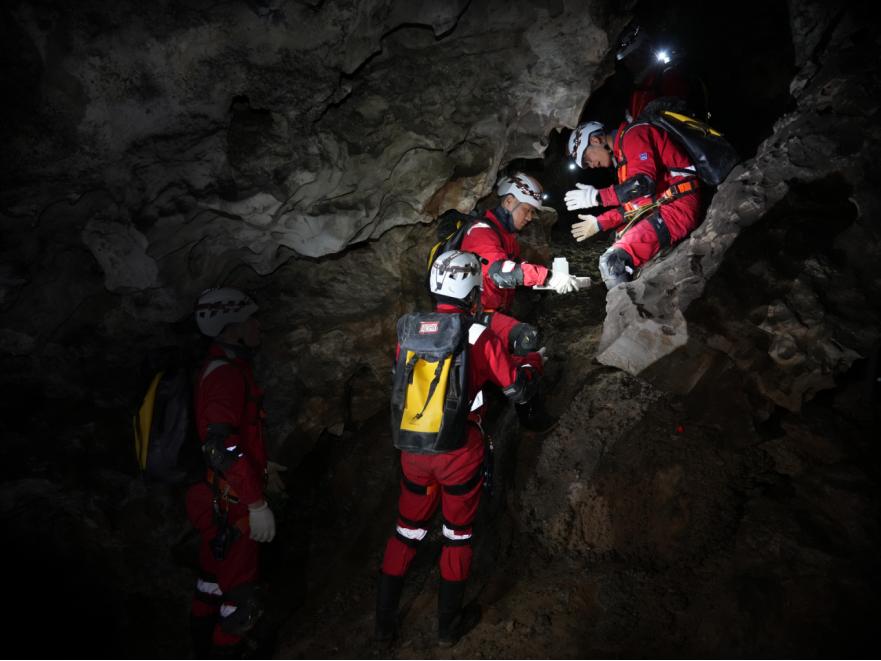

China’s first astronaut cave-training mission has successfully concluded in southwestern Chongqing municipality.
Organised and led by the China Astronaut Research and Training Centre, training covered more than 10 subjects, including environmental monitoring, cave mapping, simulated space-to-ground communications and team-focused psychological training.
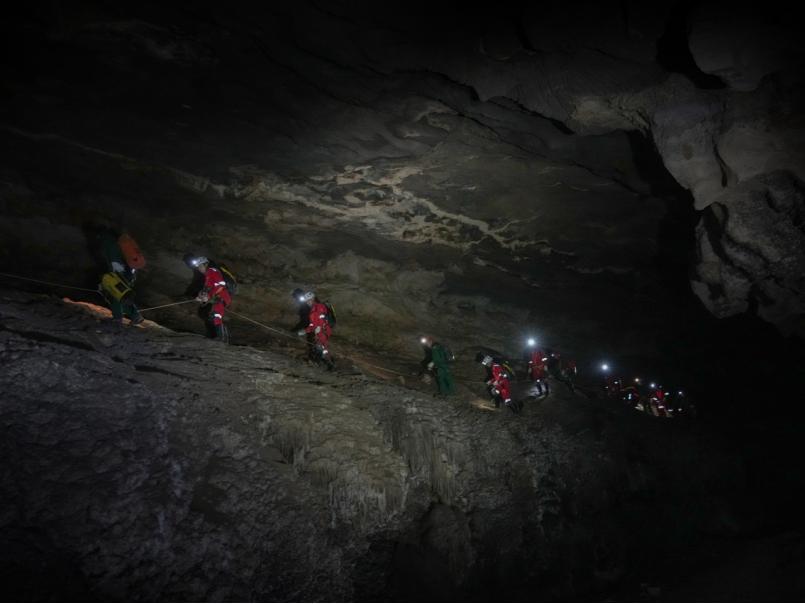
During the training, a total of 28 taikonauts completed six days and five nights of cave training. The astronauts followed real space mission schedules, carrying out more than a dozen intensive tasks.
Prepare for Future “Upward” Journeys
Far from a routine expedition, the exercise was designed as a highly realistic simulation of space missions. The cave environment shares similarities with the extreme conditions in space, such as isolation, confinement, and high risks.
Wu Bin, deputy chief designer of the Astronaut System for China’s Manned Space Program, explained that the training requires astronauts to complete designated tasks, including cave exploration, scientific research, material management, and life support.
“The purpose of this training is to enhance astronauts’ abilities in risk response, independent work, team collaboration, emergency decision-making, scientific investigation, physical endurance, and psychological resilience in extreme environments,” Wu said. “It also serves as a comprehensive assessment of the astronauts.”
From deep underground to outer space, this “downward” exploration was conducted to prepare for future “upward” journeys. The training enhanced astronauts’ ability to cope with unknown risks, providing valuable experience for long-term space station missions and future crewed lunar exploration.
Previously, Taikonaut Ye Guangfu and five other prospective astronauts from Japan, Russia, Spain and the US spent six nights in Sardinian caves from July 1th to 7th, 2016, simulating a mission to another planet, during the European Space Agency (ESA) underground training course CAVES.
Written by Sha Liu, additional reporting by Xinhua, CGTN and Global Times.
If you liked this article, why not read: China’s Tianwen-1 Mars Orbiter Captures Rare Interstellar Object