
She Power is rising across China’s science and technology landscape, as women scientists, engineers, and innovators drive breakthroughs.
China’s space program has entered a bold new era, and this time, women are leading the way. With courage, skill, and determination, a group of new women space explorers has written their own legends among the stars, including Liu Yang, Wang Yaping, and Wang Haoze. Each one inspires new generations of dreamers.
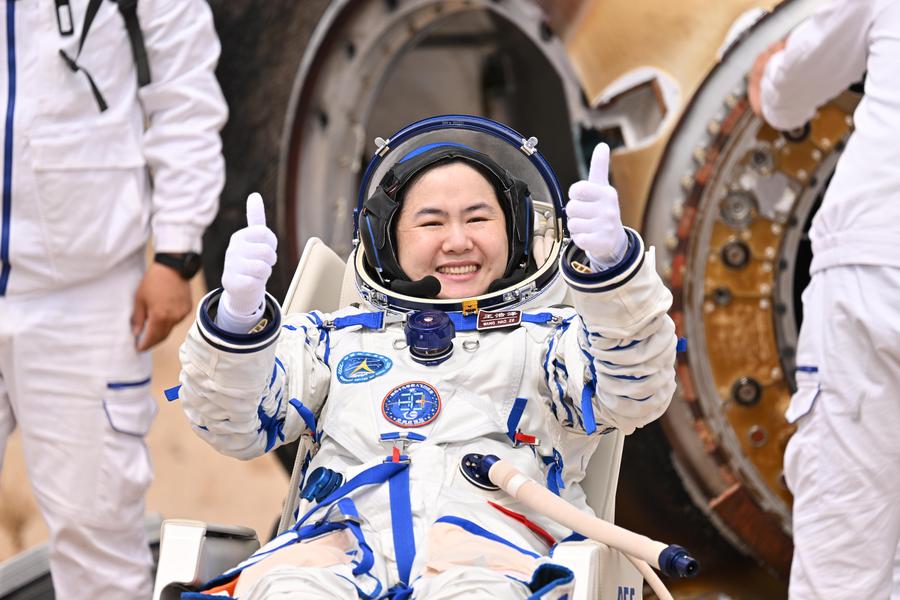
Wang Haoze, the third Chinese woman to fly a manned space mission, faced intense challenges. She trained in deserts with scorching heat, endured tight-space tests, and braved violent sea drills. “The sea spray cut my ears like knives,” she said.
Even so, she never gave up. Instead, she pushed forward. Her mission is clear: to advance Chinese science and to show the world the brilliance of women.
“The universe is filled with stars, each one a tiny point, like the flames in my heart,” she wrote after her 183-day Shenzhou XIX mission.
Earlier, Wang earned a master’s degree and worked in rocket engine research. Later, she joined the astronaut program and became the only woman in China’s third astronaut group.
Today, she represents over 40 million women in China’s science and technology fields. Together, they drive progress in space, rail, aviation, medicine, and AI. Step by step, they are shaping the nation’s future.
For example, Liang Jianying, chief scientist at CRRC, leads breakthroughs in rail technology. Under her guidance, China developed the 600 km/h maglev train, the CRH380A, and the Fuxing series. “We must aim for the best,” she said. “Our country’s size and speed demand it.”
At the same time, more women are pushing into new scientific frontiers. In cryptography, Professor Wang Xiaoyun from Tsinghua University earned global recognition at the 2025 L’Oréal-UNESCO For Women in Science Awards.
At first, progress came slowly. For nine years, Wang studied hash functions with few results. Then, everything changed. She cracked two global encryption algorithms — MD5 and SHA-1 — shaking the world of cybersecurity. Since then, she has led her team into post-quantum cryptography, building stronger digital defences for the future.
Likewise, in health care, Dr Zhang Wen from Peking Union Medical College Hospital has dedicated over a decade to studying a rare immune disease called IgG4-related disease. She helped write China’s first treatment guidelines and contributed to the global standard. “We must not only care for the trees,” she said. “We must nurture the forest.”
Together, these women are pushing boundaries, breaking barriers, and lighting the way for generations to come. Step by step, they prove that progress has no limits — and neither do they.
If you like this article, why not read: Shenzhou-19 astronauts start journey to China’s space station