
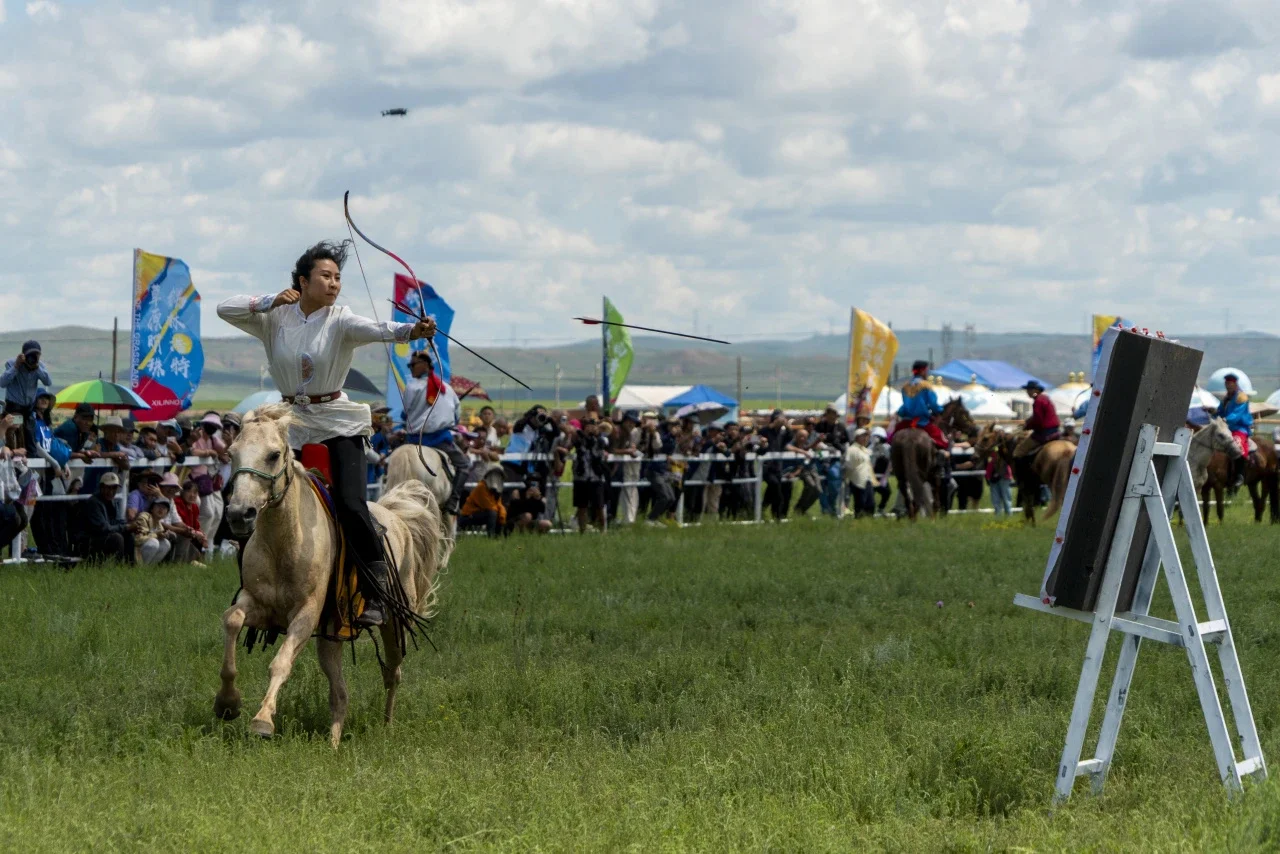

Female archers, riders and judges are playing a growing role at Inner Mongolia’s Naadam Festival, blending tradition with a new generation of participation.
On the grasslands of Xilin Gol, Inner Mongolia, the sound of arrows flying and horses galloping fills the summer air.
At the 36th Inner Mongolia Tourism Naadam Festival, more women stepped into the arena, competing in events once dominated by men. From archery fields to horse tracks, female athletes are bringing new energy to one of the most iconic celebrations of Mongolian culture.
Naadam, which means “entertainment” or “games” in Mongolian, is a traditional gathering held every year when the grasslands turn green, and livestock thrive. It features competitions such as wrestling, horse racing and archery, along with cultural performances and community celebrations.
Around 100,000 people attended the festival on the morning of its opening ceremony alone. Besides traditional events, organisers also introduced activities such as Mongolian costume experiences, bonfire gatherings and cultural exhibitions.
But beyond the excitement of the festival, a quiet change is taking place: more women are becoming active participants in Naadam.
Finding Strength Through the Bow
For female archer Sanqiri, holding a bow is not just about strength. “You cannot rely on brute force. You need technique, and more importantly, a strong mindset,” she said.
Sanqiri has taken part in dozens of archery competitions. Over recent years, she has noticed more women joining the sport.
“There are more female participants every year, and the competition keeps getting stronger. I am happy to see that,” she said.
Archery is one of Naadam’s three traditional sports, alongside wrestling and horse racing. Today, more Naadam competitions have created separate categories for female athletes, giving women more opportunities to compete and showcase their skills.
Xiuyun, who has worked as an archery judge at local Naadam events since 2018, has witnessed this change. “More women are entering the arena because of their passion. At the same time, social development and improved living conditions have given them more chances to pursue their dreams,” she said.
Xiuyun also runs a horse archery club. Among more than 40 members, about 40 per cent are women.
A Bond Between Riders and Horses
For many female riders, horse riding is not only a competition. It is also a connection built on trust.
Female rider Wang Hongjian once shared a lesson with young rider Madashuai: “A horse can sense kindness and only approaches someone it trusts.” As Wang gently stroked the horse’s neck, the animal calmly moved closer, creating a quiet moment of understanding between human and horse.
On the grasslands, trust between rider and horse is seen as an essential part of horsemanship.
Female riders also have some natural advantages in endurance horse racing. Their lighter body weight can be an advantage in endurance racing, reducing the physical strain on horses over long distances. With more experience, riders improve their skills, physical condition and communication with their horses.
Tradition Continues with New Faces
Today’s Naadam is no longer limited to traditional competitions. Alongside wrestling, horse racing and archery, the festival also features Mongolian chess, shagai games, cultural performances and modern activities that attract younger generations.
Women’s growing participation does not replace tradition. Instead, it shows how traditions continue to evolve with society.
As night falls, the grassland lights up with music and bonfires. After the rain, the sky turns purple and golden over the vast prairie. People gather, sing and dance, celebrating the simple joy of summer.
On this ancient land, Naadam continues to tell stories of courage, skill and connection — with more women helping carry its traditions forward.
If you like this article, why not read: Anda Union Brings the Sound of Inner Mongolia to London


