

Why are Chinese readers still buying physical books in a digital age? At Beijing’s Ditan Book Fair, original editions and printed online novels offer some answers.
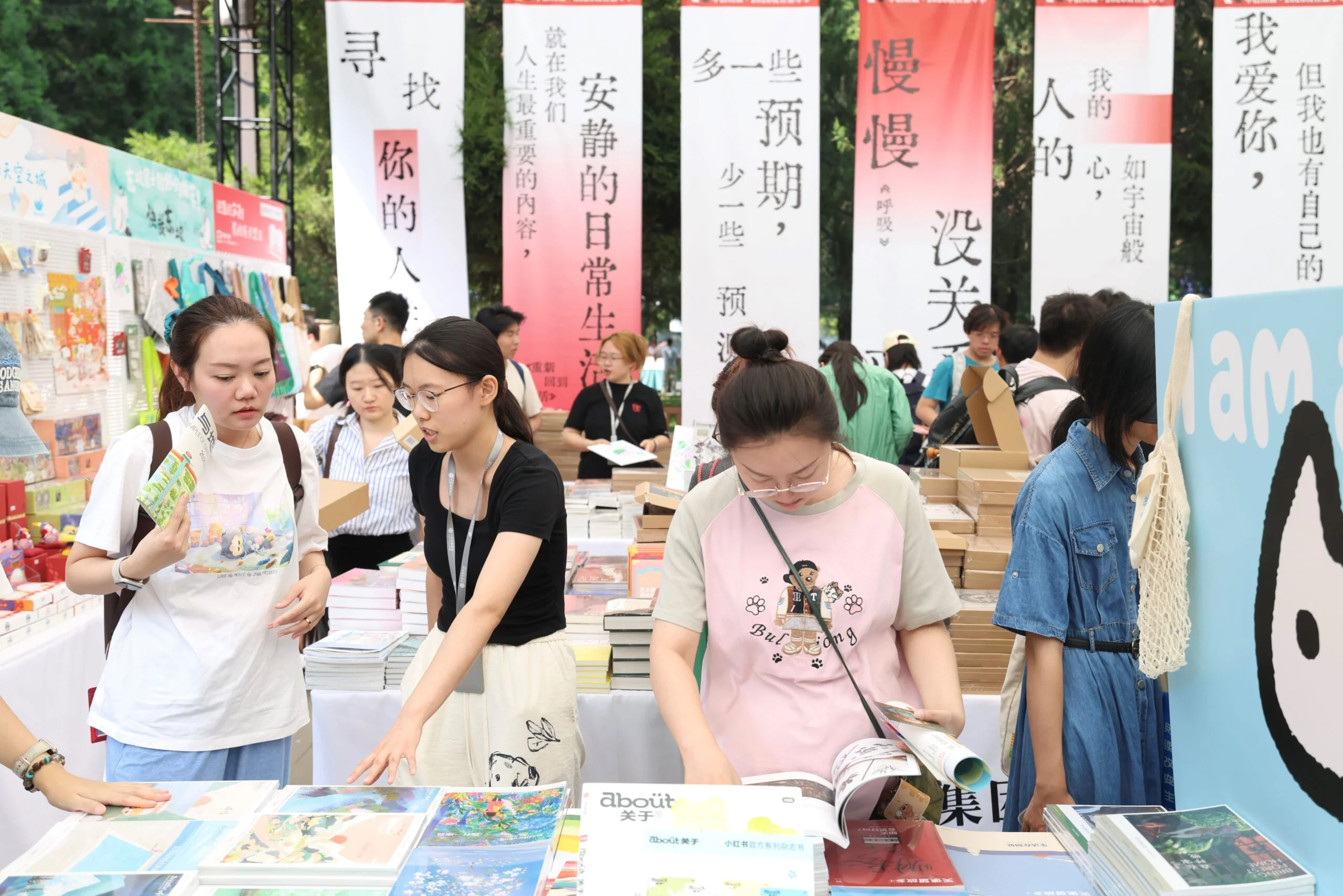
Beijing’s Ditan Park was already crowded soon after the gates opened on September 17th. The 2026 “I and Ditan” Beijing Book Fair had just begun, and readers were moving between book stalls with shopping bags and small trolleys.
From Digital Screens to Book Stalls
The 11-day fair brings together more than 400 publishers, publishing organisations and independent bookshops. More than 500 stalls cover over 20,000 square metres at Ditan Park, making this the largest edition in the fair’s history.
Yet the most interesting part of the fair may not be its size. It is what readers are choosing to put in their bags.
Last year, about 550,000 visits were recorded during the fair. This year, the event is also being held at Beijing Book Building and Wangfujing Bookstore. It will later extend to Baoding in Hebei Province and Tianjin, linking the three areas through a series of book-related activities.
At Ditan Park, books account for about 80% of the stalls. The fair has nine themed sections, covering new titles, second-hand books, independent bookshops and foreign-language editions.
The foreign-language section has expanded this year. It offers about 8,000 titles, covering children’s books, literature, social sciences and art books. Original editions from dozens of international publishers, including Penguin Random House, are also on display.
Why Original Editions Still Matter
For 18-year-old Liu Li, the answer came in the form of two familiar titles: Peter Pan and The Little Prince.
She chose the English editions at the foreign-language book section. Liu already liked the two stories, but the covers, illustrations and book design also caught her attention. She planned to keep the books as part of her collection and intended to look for more English-language literature before leaving.
Her approach reflects a change noticed by staff from the Beijing Foreign Languages Bookstore, which has a stall at the fair.
Readers are becoming more selective, according to a representative of the bookstore. This year, almost half of its original-language books are new additions. In the social sciences category, the figure is about 85%.
In the past, readers tended to focus on best-selling novels and literary classics. Now, their interests cover a wider range of subjects, including history, investment and economics, photography, painting, interior design and fashion.
“Readers have quite diverse interests now, and they also want more depth,” the representative said. The bookstore also adjusts its selection based on requests from readers.
So, why buy an original edition when translations are widely available?
Yang Tiantian, who is in charge of a pop-up project by China National Publications Import & Export Corporation, said some aspects cannot always be fully reproduced in translation.
Language is one reason. She encourages children to read at least some books in the original language. A translation can convey the content, she said, but the rhythm of the original language, its expressions and its cultural context are not always easy to carry across languages.
For children learning a foreign language, regular exposure to original texts can also help develop a feel for the language.
Design is another factor. Yang pointed to children’s books such as The Gruffalo by Julia Donaldson. In well-established children’s publishing, words, illustrations, colours and page layouts can all shape the reading experience.
For some readers, therefore, buying a physical original edition is about more than simply getting the story.
When Online Stories Become Books
The same idea can be seen in a different part of the fair.
For the first time, the event has a dedicated section for printed editions of Chinese online literature. Books such as Zhu Yu (Pursuit of Jade), Quan Qiu Gao Kao (Global Examination) and Sa Ye ( Run Wild) are displayed together at the stand of Qingdao Publishing Group’s Yue Du Ji.
China’s online literature first developed through internet platforms. Readers followed stories online, commented on new chapters and discussed them with other fans. Many works have since moved into print and, in some cases, into television, film and animation.
Li Daoyong, a representative of the Yue Du Ji stand, said the main readers of online literature are secondary school and university students. Many have already finished reading the stories online.
So why buy the book?
“For online novels, readers have already paid for the digital version. When they buy the physical book, it is more about the packaging, collecting it and the gifts,” Li said.
That means young readers are not choosing only a story. The page edges, cover, illustrations and gift boxes can all influence a purchase. Some books also feature illustrations by artists familiar to younger readers. In some cases, Li said, readers buy a book specifically because they like a particular illustration.
The trend also shows how online literature is changing the traditional publishing business.
Printed books as a whole face pressure from digital reading, Li said. However, the data collected by his company show growth in the youth literature category.
The new section also reflects this change. Online literature titles that were once scattered across different publishers’ stalls now have their own space at the fair.
A Book Fair for a Changing Reading Culture
The fair also has sections devoted to Beijing-themed books, ancient and second-hand books, and cultural activities. One exhibition, “The Twenty-Four Solar Terms in Classical Books”, brings together dozens of ancient books related to China’s traditional seasonal calendar.
Meanwhile, bookshops are experimenting with new ways to present reading. CITIC Press Group has brought a CITIC Bookstore-style space to the fair, combining books with coffee and cultural products. Another shop, Bian’an Bookstore, turns book content into hand-drawn cards to encourage readers to explore the books.
The changes are taking place against a highly digital reading environment. According to the 23rd National Reading Survey, 80.8% of Chinese adults engaged with digital reading in 2025. At the same time, 45.9% said they still preferred reading a paper book.
The two figures help explain what is happening at Ditan Park.
Additional reporting by Li Ziwei.
If you liked this article, why not read: 2026 Beijing Book Fair Showcases Harry Potter Magic Experience


