
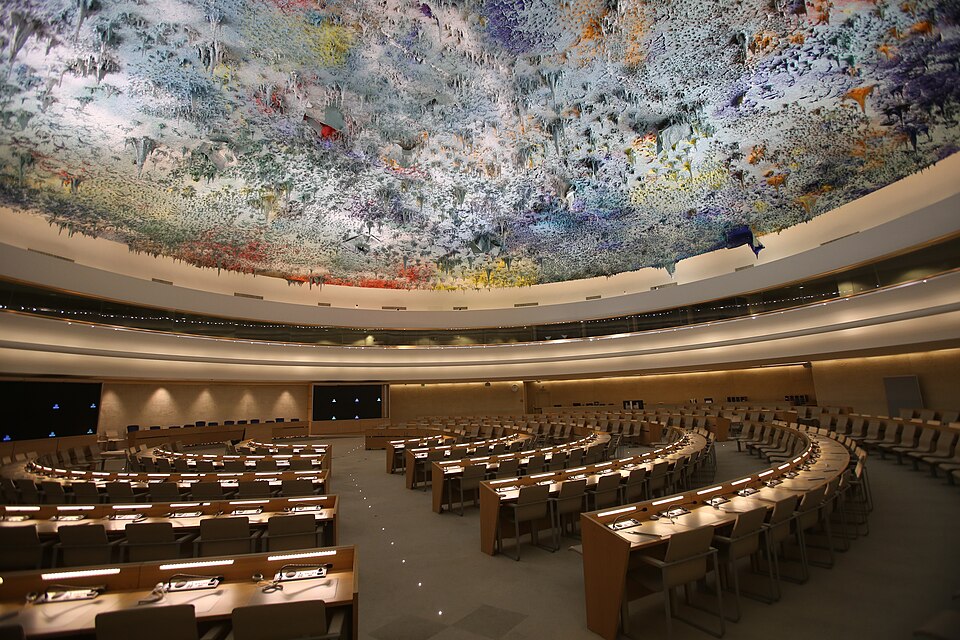

Twenty years into the Human Rights Council, it finds itself at a peculiar crossroads. Humanity faces a stark choice between breakdown and breakthrough.
As this fractured world reshapes the paradigm of development, there is an urgent need to unite to preserve the leave-no-one-behind principle. In reports such as the UN 80 initiative, four main polarisations have been identified by which the leave-no-one-behind principle may confront challenges more critical than ever. These are power, poverty, capacity building, and the right to development.
Artificial Intelligence (AI) is widening the polarisation in power, empowerment and participation toward a common agenda of development for everyone. The emphasis of leaders has moved from driving performance, the short-term resilience to sustained productivity and long-term impact, powered by technology and AI at the core of transformation.
On March 11th, Elon Musk confirmed the expected biggest IPO in history. SpaceX is going public in 2026 with an estimated $1.5 trillion valuation. Musk has hopes to raise over $30 billion through the IPO, beating Saudi Aramco’s $29 billion record from 2019. This goes beyond space, as Musk, through SpaceX, has expanded into the AI race.
Economic polarisation is once again identified as the most interconnected global risk over the next decade, fueling other global risks. According to the statistics published by the UN, an estimated 808 million will be living in extreme poverty, up from the previous estimate of 677 million. This will affect one in ten people. It is an urgent challenge faced by the world that global daily starvation deaths have doubled in a year. The poorest people in the world are not only undernourished but also lack access to basic services and suffer from poorer health. As economic polarisation accelerates, poverty will continue to define the space for the poorest people to have access to economic growth, education, resources, and other support necessary for personal fulfilment in the years ahead.
The trend toward the polarisation of capacity building driven by AI has become a global problem. According to McKinsey’s The State of Organizations 2026, 55 percent of leaders admit that successfully building AI capabilities in employees will bring exponential productivity gains. AI agents and human employees need to collaborate. That means redefining capability requirements and building human engagement with technology must be put at the top of their list of developmental mandates. The new demand for capacity-building is increasingly defining career progression and, therefore, is pressuring the workforce, particularly the younger generation, who require clear development pathways.
No doubt, sustainable development and the right to development are indispensable. As the progress on the UN’s 2030 Sustainable Development Goals is faltering, the inequality in the right to development deepens. The UN’s The Security We Need identifies that only one in five targets is on track to be achieved by 2030, and the annual financing gap for the 2030 Sustainable Goals now stands at $4 trillion. In the meantime, global military spending has surged to unprecedented levels. In 2024, it reached an all-time high of $2.7 trillion. As a sustainable and peaceful future has reached a pivotal juncture, development has become fragile, and that will bring uncertainty to the protection and promotion of the right to development. The lack of resources essential for the right to development, in particular, social investment, poverty reduction, education, health, environmental protection and infrastructure has been undermining progress on nearly all the UN’s 2030 Sustainable Development Goals. The polarised right to development is victimising, in the first place, vulnerable groups. For example, female extreme poverty has hovered at around 10% since 2020. If current trends continue, over 351 million women and girls could still live in extreme poverty by 2030 (8.2%).
To bridge the divides on the road toward a better future where everyone can thrive, especially to help the underrepresented groups to be involved fairly in the world’s development, the world needs to work together and share experiences accumulated and lessons learned. For example, the AI Capacity-Building Action Plan for Good and for All proposed by China aims to ensure the Global South benefits equitably from AI developments, propel international development cooperation, pursue true multilateralism, and promote the implementation of the U.N. 2030 Agenda for Sustainable Development. This would be achieved through North-South, South-South and triangular cooperation. It would be based on the principles of sovereign equality, development orientation, people-centred, shared benefits and inclusiveness, and multi-party coordination and cooperation. As the world’s second-largest economy with significant connections for developing regions, for exam China-Africa trade volume reached US$295.6 billion in 2024 setting a new record high and creating around 4,500 jobs, China’s initiatives of this sort are good for upholding the leave-no-one-behind principle. To that end, more efforts from across the world are needed.
The UN has made clear since its very outset in 1945 the importance of human rights; it was mentioned seven times in the UN’s founding Charter. There are only two ways to deal with development: dream it or live it. In a fractured world, being a developer of opportunities for leave-no-one-behind is not about doing great and beautiful deeds. It’s doing what one does with beauty and greatness.
This is an opinion article by Liu Chen. Views reflect the author and not the website. Liu Chen is a professor of Public Administration and Cultural Studies at Beijing Foreign Studies University. She is a Harvard Kennedy School Mason Fellow, Postdoctoral Fellow, Graduate School of Arts and Sciences, Harvard. Her research focuses on policy, practice, leadership, and culture and international cooperation.


