
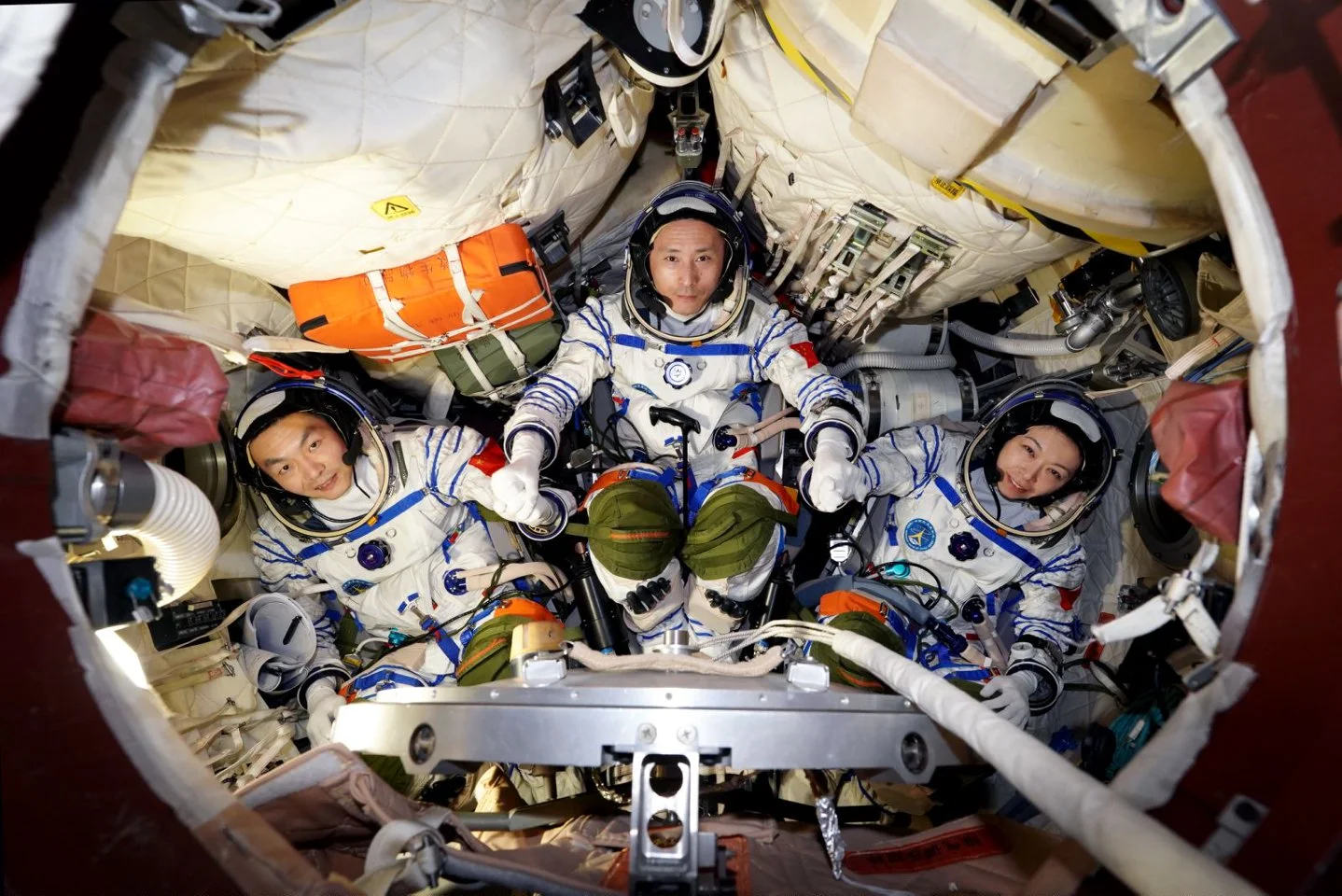

China’s Shenzhou-23 mission will launch the country’s first year-long spaceflight experiment, advancing research on long-duration human life in space.
China is set to launch the crewed Shenzhou-23 mission on Saturday night, opening a new chapter in the country’s long-duration space research.
According to China News Service, the spacecraft is scheduled to lift off at 11:08 p.m. Beijing time on May 24th. Astronauts Zhu Yangzhu, Zhang Zhiyuan and Lai Jiaying will travel to China’s space station, with Zhu serving as mission commander.
This mission carries special significance. For the first time, China will conduct a year-long in-orbit human spaceflight experiment.
Chinese officials said one crew member will stay in orbit for about a year as scientists study how the human body responds to long-term exposure to microgravity and the isolated conditions of space.
According to the China Manned Space Agency, the mission will support the country’s first comprehensive in-orbit human research program. Scientists hope to collect long-term physiological and medical data that could improve astronaut health protection and medical support systems.
Officials said the experiment is not simply an extension of two six-month missions. Instead, it marks a new stage in China’s effort to prepare for deeper and longer space exploration in the future. The research could also support technologies needed for lunar bases and other long-duration missions beyond low-Earth orbit.
Meanwhile, the Shenzhou-23 crew will carry out more than 100 scientific experiments and technology tests aboard China’s space station. The projects cover areas including space medicine, life sciences, materials science and microgravity physics.
Several experiments will focus on how living organisms develop in space. Researchers plan to study zebrafish embryos, mouse embryos and stem-cell-based “artificial embryos” to understand better how microgravity affects biological development.
In another experiment, scientists will attempt to grow a second generation of rice entirely in orbit for the first time on China’s space station. The research aims to reveal how long-term space conditions affect the genetic stability of plants and could contribute to future space agriculture.
The mission will also carry perovskite solar cells for testing in space. Scientists want to study how the technology performs under radiation and extreme temperature changes. They say the findings may help future satellites, deep-space missions and lunar energy systems.
At the same time, Chinese officials acknowledged the growing risks facing long-term space operations.
According to program spokesperson Zhang Jingbo, the Shenzhou-23 spacecraft has received upgraded protection against orbital debris, including improvements to its windows. The upgrades follow lessons learned from China’s first emergency launch mission earlier this year.
As more satellites enter low-Earth orbit, concerns over space debris continue to grow worldwide.
Against that backdrop, China is increasingly using its space station not only for routine missions, but also as a platform to study how humans and technology might one day sustain human life beyond Earth.
If you liked this article, why not read: Shenzhou-20 Astronaut Unfolds “Space Barbecue” Story


