
Discover how China’s ancient wooden buildings have endured for centuries through innovative design and modern preservation, showcasing the enduring wisdom of traditional architecture.
For more than a thousand years, wooden towers, halls, and pavilions have shaped China’s built landscape. Created without steel or concrete, many of these structures have survived earthquakes, wars, and extreme weather. Their survival reflects not luck, but a long-standing tradition that treats wood as a flexible and resilient building material.
From 2026, China will begin a nationwide, multi-year survey of ancient wooden buildings, HKCNA reported. Over four years, researchers will document the materials and preservation conditions of more than 500 historic structures. They will record wood species, construction methods, structural health, and environmental factors. A shared digital platform will follow, supporting conservation, research, and future restoration.
The survey spans regions across northern and southern China and includes buildings dating from the Tang to the Qing dynasties. Temples, homes, pavilions, bridges, and towers are all part of the effort. More than a technical project, the initiative reflects a shift in perspective. Ancient wooden buildings are increasingly seen not as static monuments, but as living structures shaped by time, climate, and human care.

Yingxian Wooden Pagoda: How Timber Reached for the Sky
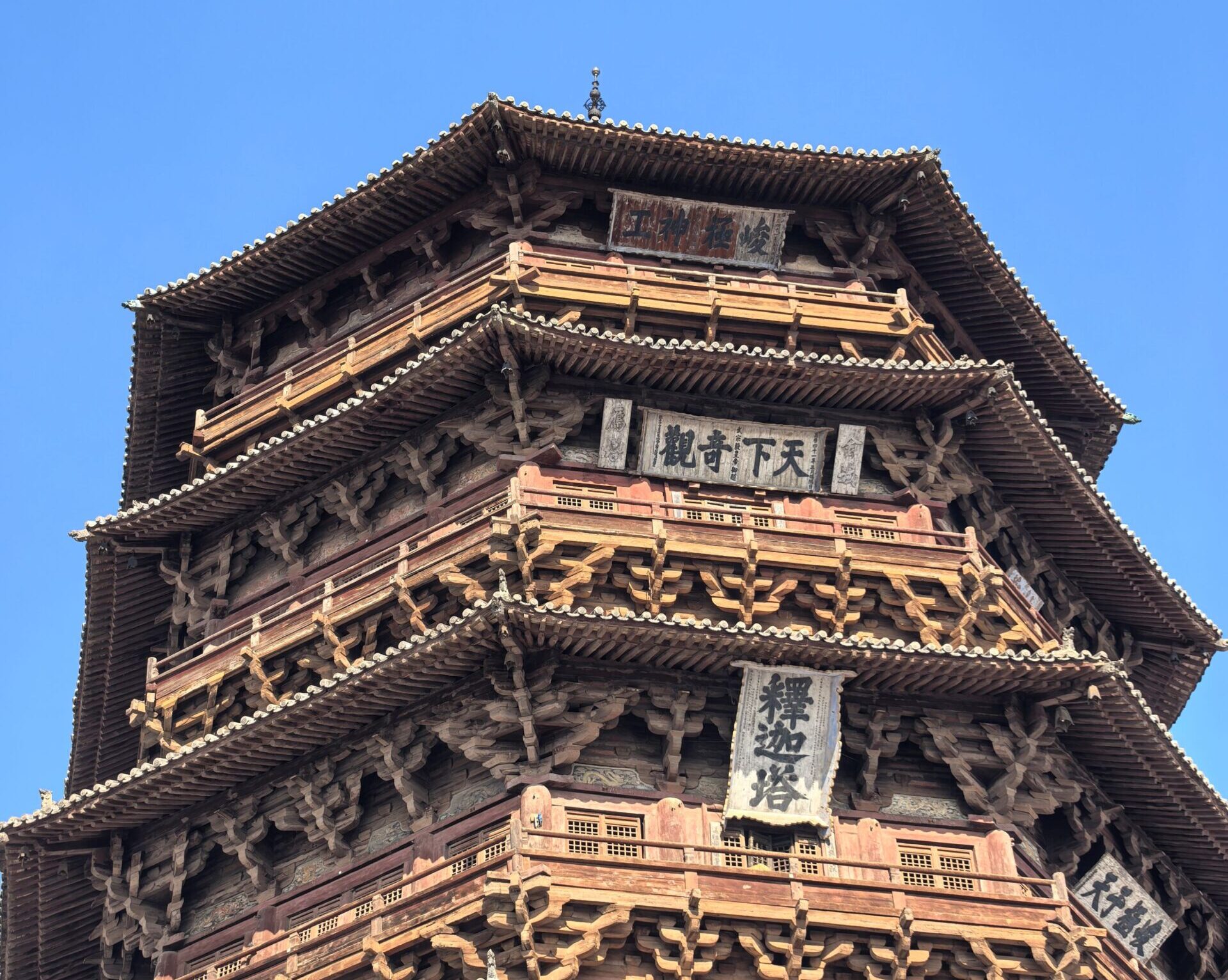
Few examples illustrate this tradition more vividly than the Yingxian Wooden Pagoda in Shanxi Province. Rising 67.31 meters above Fogong Temple, it is the tallest and oldest surviving multi-story wooden tower in the world—roughly the height of a modern 20-story building.
Built nearly a thousand years ago, the pagoda has endured dynastic change, earthquakes, and warfare. Elsewhere, famous towers rely on stone or steel. The Leaning Tower of Pisa is built of stone. The Eiffel Tower depends on iron. The Yingxian Pagoda, by contrast, stands almost entirely on timber. This difference places it in a category of its own in global architectural history.
In recent years, the pagoda has entered global popular culture. The international success of the Chinese video game Black Myth: Wukong has drawn fresh attention to traditional Chinese architecture, with the Yingxian Pagoda serving as one of its visual references. As a result, visitors from China and abroad have been drawn to the site, showing how ancient heritage can connect with contemporary culture.
Its endurance begins at ground level. The pagoda rests on a rammed-earth foundation protected by masonry. This combination shields the structure from erosion while supporting its immense weight. Above the base, tens of thousands of wooden components interlock to form the tower’s body. More than fifty types of dougong brackets link columns, beams, and eaves into a unified system.
Instead of resisting movement, the structure allows it. During earthquakes or strong winds, its wooden elements shift slightly and absorb stress. Pressure spreads through the framework rather than concentrating at a single point. In modern terms, the pagoda shows remarkable structural resilience. This balance of strength and flexibility helps explain how a timber tower of such height has stood for centuries.

Zhenwu Pavilion: Stability Through Balance
While the Yingxian Wooden Pagoda pushes timber construction upward, Zhenwu Pavilion in Guangxi takes a different approach. Built more than 400 years ago, it stands in a region known for earthquakes, typhoons, and high humidity—conditions that test any wooden structure.
Rather than height, the pavilion relies on internal balance. Its most striking feature is a lever-based structural system. Parts of the upper structure appear to float above partially suspended columns. Eighteen interlocking beams pass through surrounding pillars, forming a tightly connected framework. The load spreads in opposing directions, much like a set of balanced scales.
The entire building uses mortise-and-tenon joints, without a single metal nail. This method creates a structure that is both strong and flexible. As a result, the pavilion can bear heavy loads while absorbing shocks from storms and earthquakes. Over four centuries, it has survived repeated natural disasters without collapse.
The design has long impressed architectural historians. Liang Sicheng, a pioneer of modern Chinese architectural studies, described Zhenwu Pavilion as a rare example of how traditional timber construction solved complex engineering challenges through balance rather than mass. His assessment places the pavilion within a broader global story of architectural innovation.
Looking Ahead: Preserving Living Heritage
Together, the Yingxian Wooden Pagoda and Zhenwu Pavilion reveal the depth and variety of China’s wooden architecture. Their forms differ sharply. One rises to monumental heights. The other achieves stability through precision and balance. Yet both follow the same principle: durability through flexibility.
This principle now guides China’s nationwide survey of ancient wooden buildings. By systematically recording materials, techniques, and preservation conditions, the project aims to bring scattered knowledge into a shared scientific framework. The data will support future restoration and help protect these structures from growing environmental risks.
Today, modern technology is meeting ancient craftsmanship. Cultural heritage is no longer viewed as frozen in the past. Instead, it is understood as a living system that continues to evolve. By connecting centuries-old building wisdom with contemporary conservation science, China’s wooden architecture offers insights not only into its own history, but into how societies around the world can care for their built heritage.
If you liked this article, why not read: China’s Hezhen Yimakan Storytelling Earns Global Recognition