
Explore how China’s smart glasses are transforming technology, consumer experiences, and the global wearable market in 2025 and beyond.
As 2025 comes to a close, smart glasses are emerging as a new way for consumers to interact with technology. Users can check sports data, translate languages in real time, navigate routes, or even capture the scenery. These capabilities are entering everyday life and driving China’s smart glasses industry from early experimentation to large-scale production.
According to the latest IDC report, China is expected to ship 2.907 million smart glasses in 2025, a 121.1% increase from last year. Chinese brands are strengthening their global competitiveness. Xiaomi, Thunderbird, Xreal, and Viture all ranked among the top five worldwide, second only to the US-based Meta. By 2026, Chinese shipments are projected to reach 4.508 million units, accounting for 45% of the global market.
Innovation Drives Industry Growth
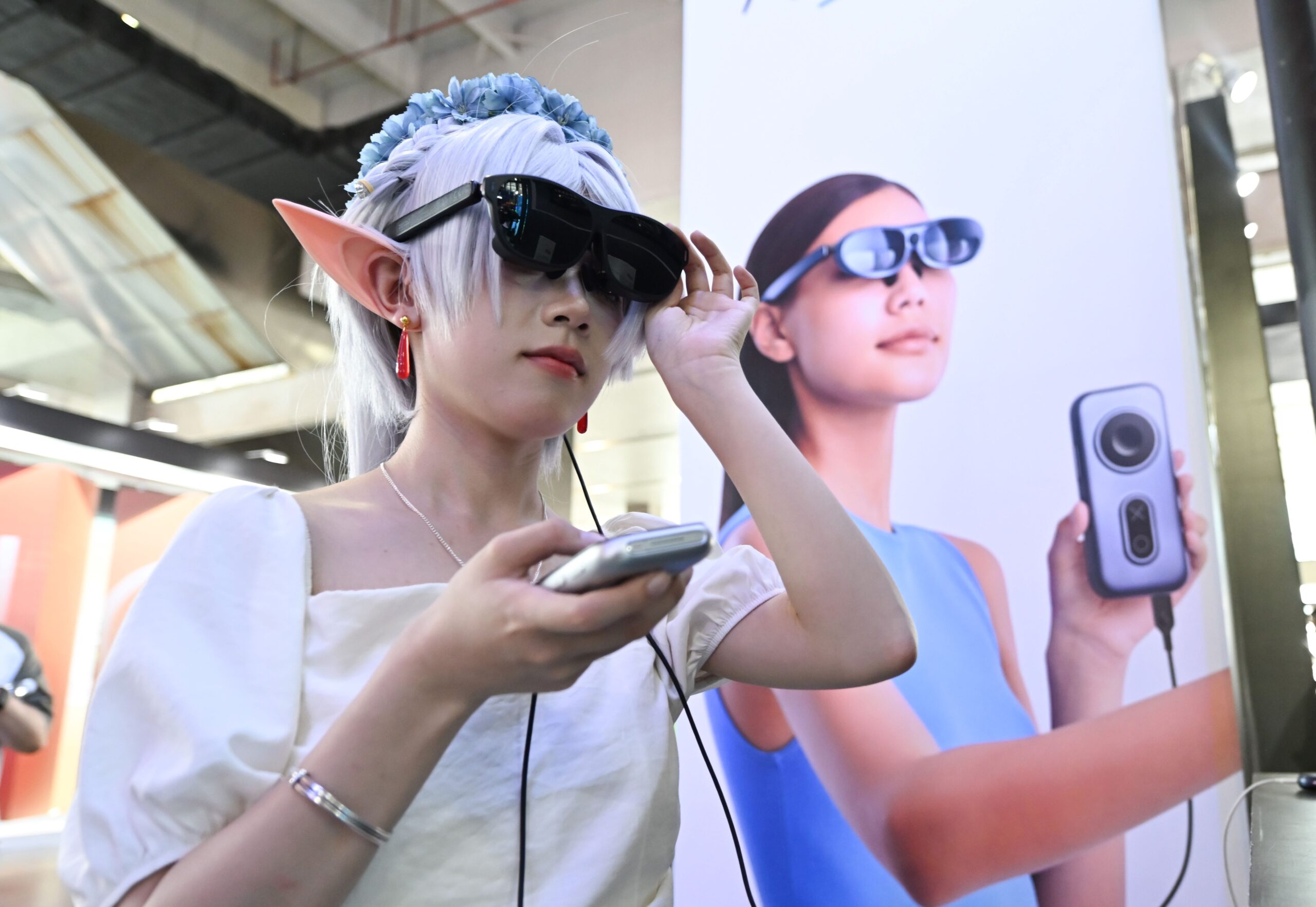
Take Rokid, a tech company based in Hangzhou. Its new AI+AR smart glasses launched in September. They sold over 40,000 units within five days, and online orders are already scheduled through October. Weighing less than 50 grams, the glasses include subtitles, translation, navigation, and video recording. In addition, they offer users a seamless “see and do” experience.
The company worked closely with supply chain partners to customise the production line. This process covered structural design, material selection, module development, and assembly. Step by step, Rokid established a scalable manufacturing process.
Meanwhile, in Huzhou’s South Taihu New District, Zhejiang Zhige Technology is producing ultra-thin, high-transparency AR diffractive waveguide lenses on a fully automated line.
General Manager Wang Fenghua said, “To maintain a tolerance of 0.01 millimetres, we repeatedly adjusted the process, rebuilt over ten jigs, and revised standard procedures hundreds of times.” The first-phase workshop produces 70 units per hour, with an annual capacity of 150,000 units. A second-phase facility is under planning, and products will gradually enter markets in Europe and Japan.
Expanding Consumer Applications
As technology matures, smart glasses are finding new uses in sports, travel, education, and work. For example, users can track their performance during swimming or cycling. They can also identify plants and animals while walking around West Lake. In addition, smart glasses allow wearers to capture scenic moments along the way.
The consumer base is also expanding. It now includes tech enthusiasts, gamers, travel photographers, athletes, near- and farsighted users, business professionals, and visually impaired individuals.
For instance, Alibaba’s Quark AI Glasses allow wearers to execute real-time translation, scan payments, record 3K videos, get navigation guidance, and play music—all via voice commands. Products like these are gradually establishing smart glasses as the next generation of personal devices after smartphones and tablets.
Global Expansion and Future Prospects
IDC forecasts that China’s smart glasses shipments will continue growing strongly over the next five to ten years. CINNO Research reports that Chinese consumer AI/AR glasses sales reached 262,000 units in the first half of 2025, a 73% increase year-on-year, with screenless AI glasses growing 463%. Annual shipments are expected to surpass 900,000 units, and the market could reach hundreds of billions of yuan in the next three years.
Meanwhile, technology upgrades and ecosystem development are accelerating global expansion. Improved production capacity, lightweight design, and basic AI functionality provide a foundation for better user experiences and product innovation. As the global market grows, Chinese smart glasses are set to become a key entry point for personal smart devices, reshaping the way people access information and interact with the world.
Additional reporting by CNS.
If you liked this article, why not read: 2025 Culture and Technology Trends in Hangzhou Spotlight ‘Intelligence’