AI can not only assist in diagnosis but also analyze big data to summarize the diagnostic approaches, treatment strategies, and medication principles of renowned Traditional Chinese Medicine (TCM) doctors.
You may have experienced Traditional Chinese Medicine, but have you ever seen an AI-powered TCM doctor?
“A Smart Device”
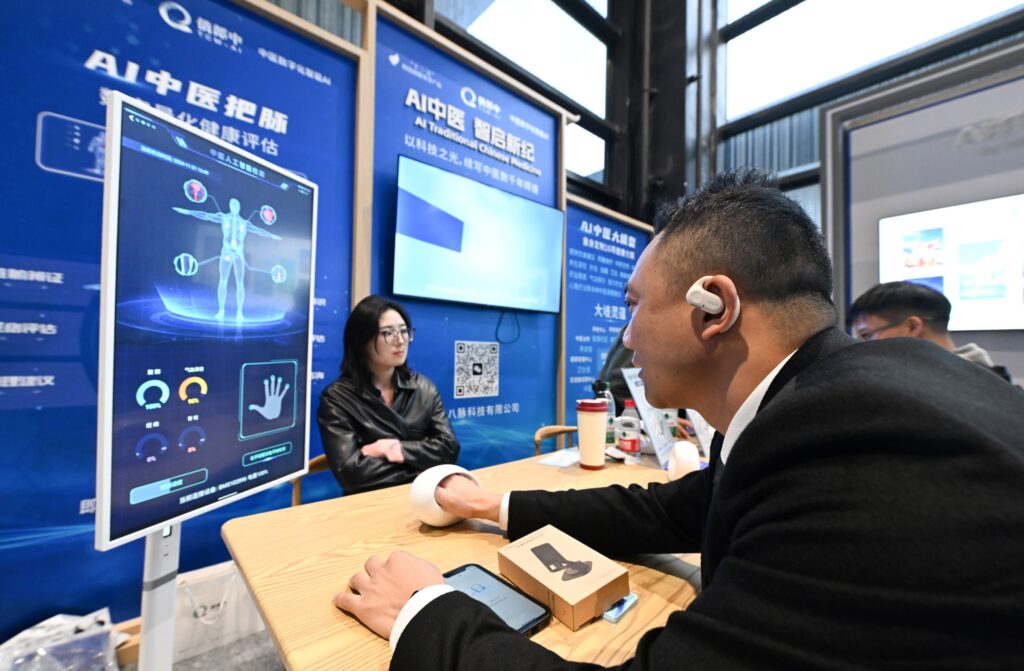
At the Changchun International Medicine and Health Expo held recently, a long queue formed before the AI Traditional Chinese Medicine device.
Following the instructions, users stick out their tongues with the tip pointing downward. The system instantly captures an image, analyzes key health indicators, and displays diagnostic results and treatment recommendations on the screen.
Beyond this, many attendees also tried out a smart pulse diagnosis instrument. By securing a sensor to their wrist, users could receive a health assessment within minutes. Based on the results, the system provides personalized health guidance and preventive care recommendations.
The accuracy of AI-based pulse diagnosis is powered by large-scale TCM models. These models are trained using TCM knowledge graphs, allowing AI to develop a strong professional foundation in Traditional Chinese Medicine.

“A Valuable Assistant”
Besides, one of the primary focuses of current research is the development of AI-assisted “Four Diagnoses” in TCM—Observation, Auscultation, Interrogation and Palpation (望闻问切). These technologies rely on advanced sensors to collect data on physical appearance, vocal characteristics, and biological signals, which AI then processes to provide efficient and objective diagnostics, supporting physicians in their treatments.
While AI holds great promise for TCM, its current clinical applications still have limitations. Accurate diagnosis remains heavily reliant on the expertise of human doctors. “AI is designed to complement, not replace, physicians. It serves as a valuable assistant,” experts emphasize.
Looking ahead, China is set to increase investment in AI-driven TCM research, paving the way for more advanced and reliable AI-powered TCM tools.
Written by Chen Wang, additional reporting by CNS、China Daily.
If you liked this article why not read:Yang BOT Shines at the 2025 Spring Festival Gala