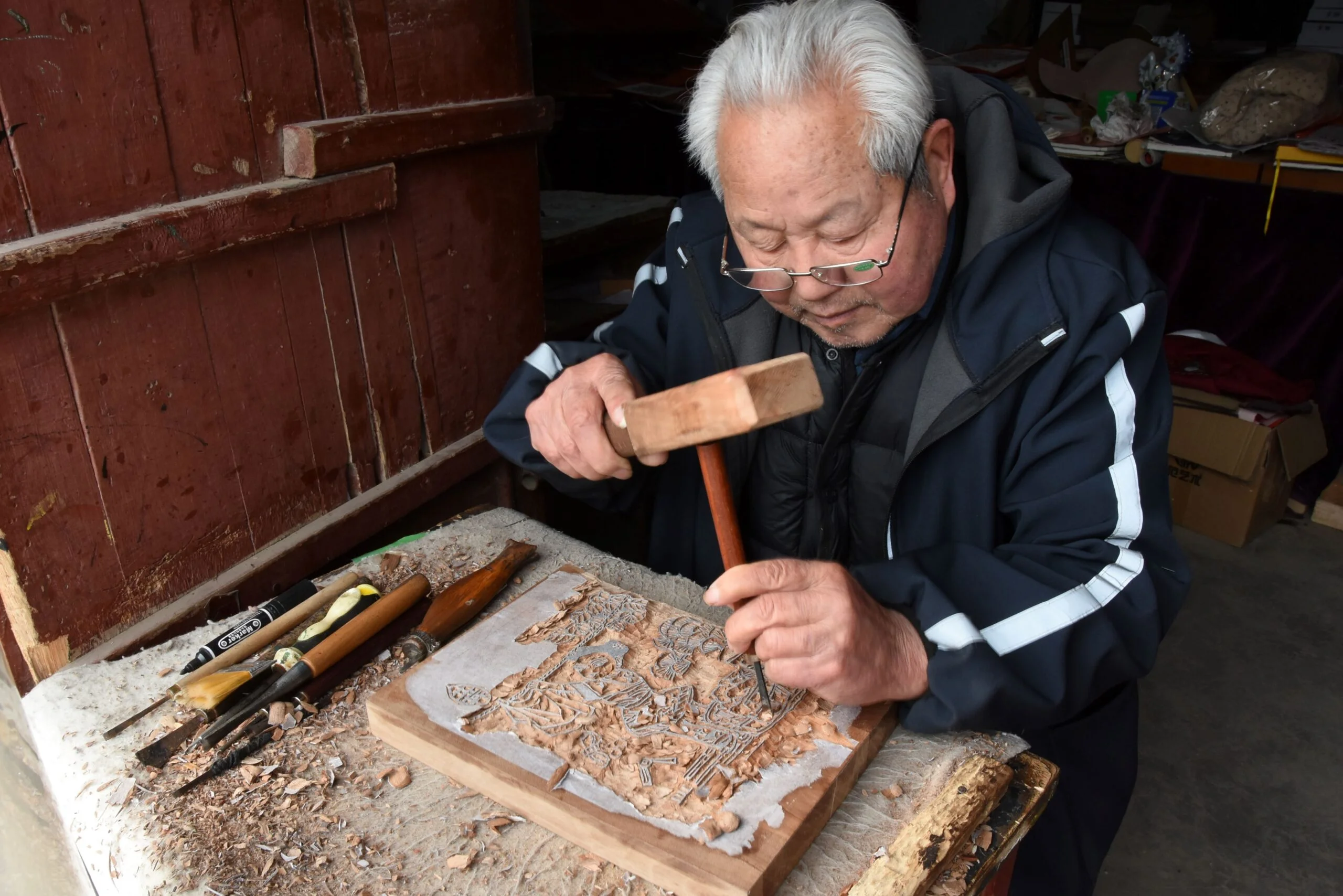

A family in central China keeps the tradition of woodblock New Year prints alive, blending centuries-old craft with modern design and digital tools.
In northern China, the days before the Lunar New Year mark the busiest season for woodblock New Year prints. This traditional folk art is still made by hand in Zhuxian Town, Henan Province, where three generations of one family carry on a craft that dates back centuries.
The period is known as Xiaonian, or “Little New Year,” a traditional milestone that signals the start of holiday preparations. As the festival approaches, homes begin to fill with bright red images printed with wishes for good fortune, protection, and prosperity.
A Folk Art Rooted in Everyday Life
Chinese New Year prints originated from ancient door-god paintings. Over time, they became one of the most popular forms of folk decoration, closely tied to daily life and seasonal rituals.
Zhuxian Town woodblock prints trace their history back to the Tang Dynasty and reached their peak during the Song, Ming, and Qing dynasties. Alongside Yangliuqing in Tianjin, Taohuawu in Suzhou, and Yangjiabu in Shandong, Zhuxian is recognised as one of China’s “Four Great New Year Prints.” In 2006, the craft was included on China’s national list of intangible cultural heritage.
Inside the Wantong workshop in Zhuxian Town, wooden walls display traditional designs such as “Five Sons Achieving Scholarly Success (五子登科)” and “Heaven Official’s Blessing (天官赐福).” At the centre of the space, 80-year-old craftsman Zhang Liansheng begins work early each morning.
Each print follows a demanding process. Artisans select wood, sketch designs, carve printing blocks, prepare pigments, print layer by layer, and mount the final image by hand. The full process involves more than 30 steps. This means each piece requires skill and patience.
“New Year prints are not just something you hang on the wall,” Zhang says. “They express how people imagine a good life. That idea has stayed the same for generations.”

Three Generations in One Workshop
As the Lunar New Year draws closer, the workshop grows busier. Zhang’s son, Zhang Jizhong, works alongside him. After three years of preparation, his Twenty-Four Zodiac series has attracted steady orders from collectors and local buyers.
The youngest member of the family, Zhang Yi, represents a new chapter in the craft. Trained in design, she brings digital tools into a traditionally handmade process. One of her most popular works, a Year of the Horse print titled “Horse Stepping on Auspicious Clouds,” reimagines traditional symbols through refined colour systems and updated visual storytelling.
Digital modelling allows her to adjust details before carving begins, increasing printing efficiency by nearly 30 per cent. Meanwhile, she has redesigned classic door-god figures for modern daily use. In addition, these images now appear on refrigerator magnets, phone cases, coffee mugs, tote bags, and more than 50 other cultural products. These items are sold not only in China, but also in Japan, South Korea, Europe, and the United States.
A Craft That Continues to Evolve
From hand-carved wooden blocks to digitally refined designs, the forms of Zhuxian New Year prints continue to change. The craft endures. Passed down through three generations, it carries the same hopes for a good year.
Additional reporting by Wang Yu.
If you liked this article, why not read: China’s Hezhen Yimakan Storytelling Earns Global Recognition.