
For the first time in nearly 1,000 years, two versions of Jin Shi Lu, a rare bronze and stone inscription, are displayed together.
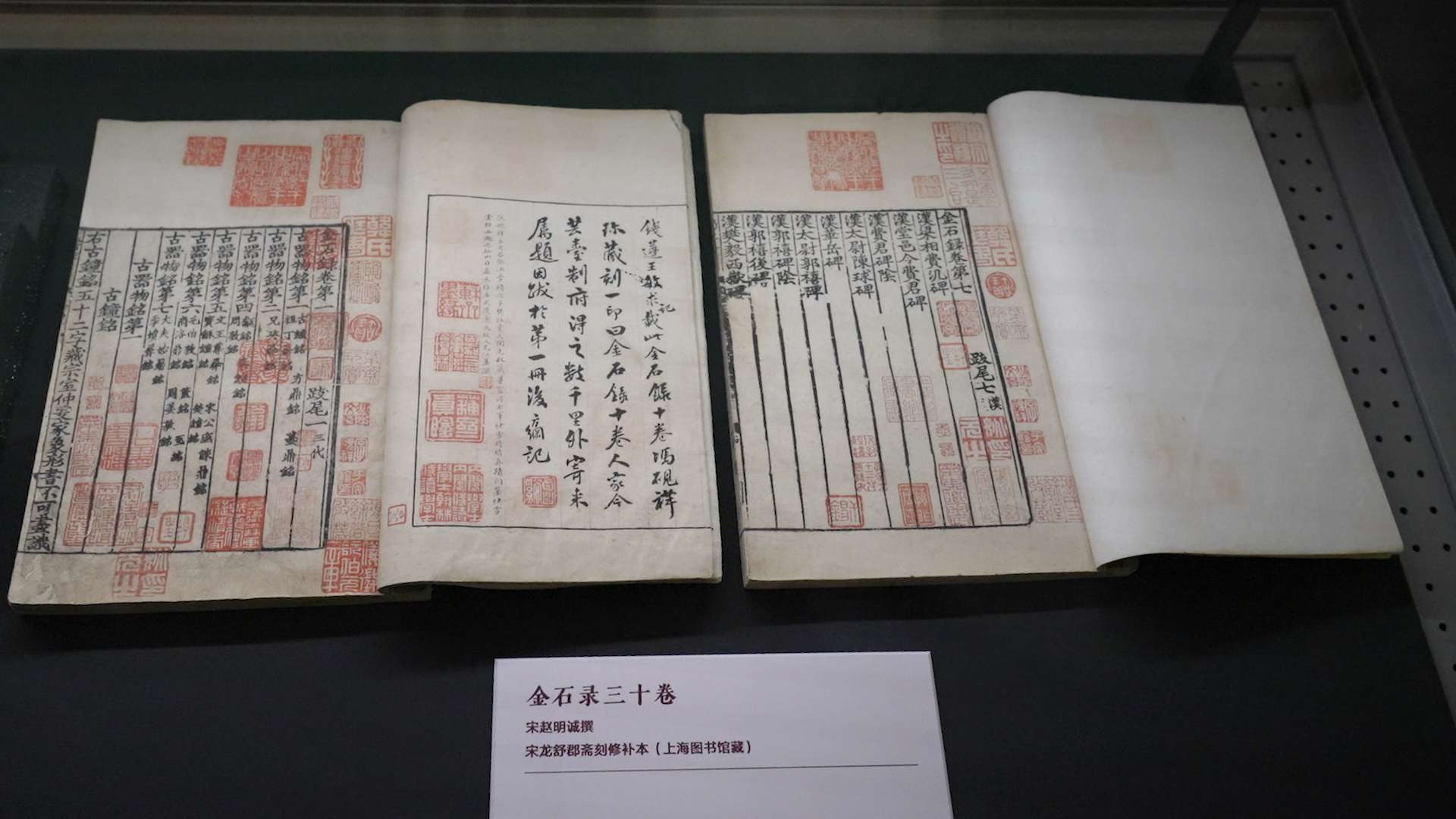
For the first time in nearly a thousand years, two versions of Jin Shi Lu (《金石录》), a multi-volume catalogue of bronze and stone inscriptions, are displayed together. The complete thirty-volume set from China’s National Library will appear alongside the ten-volume version from the Shanghai Library.
Jin Shi Lu is one of China’s earliest catalogues of inscriptions on bronze and stone. It was compiled over more than twenty years by the scholar Zhao Mingcheng and his poet wife Li Qingzhao. The book records inscriptions from ancient China through the Tang dynasty and the Five Dynasties period, making it an invaluable resource for studying Chinese history and epigraphy.
The two editions have very different survival stories. The National Library’s thirty-volume set is complete, while the Shanghai Library holds only ten volumes. For centuries, people believed that only the ten-volume set survived. The discovery of the complete set was unknown until recently, making both editions historically and academically significant.
A Century of Survival
The thirty-volume edition once belonged to a private library in Nanjing. During wartime, fire destroyed the library, but the family rescued the book. For almost a century, it remained largely forgotten. In 1951, when the family sold their old house, they found the book mixed in with a pile of discarded papers. Experts later recognised its true value, and it entered the National Library of China’s collection.
This exhibition gives visitors a rare opportunity to see the two editions together. It shows how China’s literary heritage has been preserved and tells the story of a text that has survived through the passage of time.
Written by Ronnie Yu, additional reporting by Li Shuzheng.
If you liked this article, why not read: The Enduring Wisdom of China’s Ancient Wooden Buildings