
China is expanding green consumption from vehicles to household appliances, as new policies support the large-scale implementation and recycling of these products.
China has unveiled a comprehensive policy plan to promote green consumption, marking a shift from broad advocacy to concrete, systemic action. The plan outlines 20 policy measures across seven focus areas, covering products, services, finance, and recycling systems.
The plan targets the upcoming “15th Five-Year Plan” period and reflects a growing focus on how everyday consumption fits into China’s climate and industrial goals.
More Low-Carbon Options in Everyday Consumption
One focus of the policy is expanding access to greener products. New energy vehicles (NEVs) remain a priority. Authorities are also promoting second-hand trading, leasing, retrofitting, and shared mobility. This approach shifts attention from one-time purchases to longer product life cycles.
Home consumption is another key area. The plan calls for energy-efficient appliances, water-saving equipment, and greener construction materials. Updated efficiency standards and certification systems will help consumers choose lower-carbon products. They also support demand for smart and ageing-friendly home products.
Changing How Goods and Services Are Used
The policy also targets consumption models rather than products alone. Measures include promoting greener dining, accommodation, and household services, with an emphasis on cutting the use of disposable items. Meanwhile, authorities encourage the use of artificial intelligence in retail and service scenarios to improve efficiency and reduce waste.
Support systems will expand to keep pace with these changes. Authorities encourage financial institutions to offer more green consumer credit and explore tools such as green REITs and insurance products. At the same time, China plans to strengthen a nationwide recycling network. Local collection points will be linked to sorting and processing centres to enhance the reuse of appliances, electronics, and other high-value waste.
By the Numbers: Growing Scale and Impact
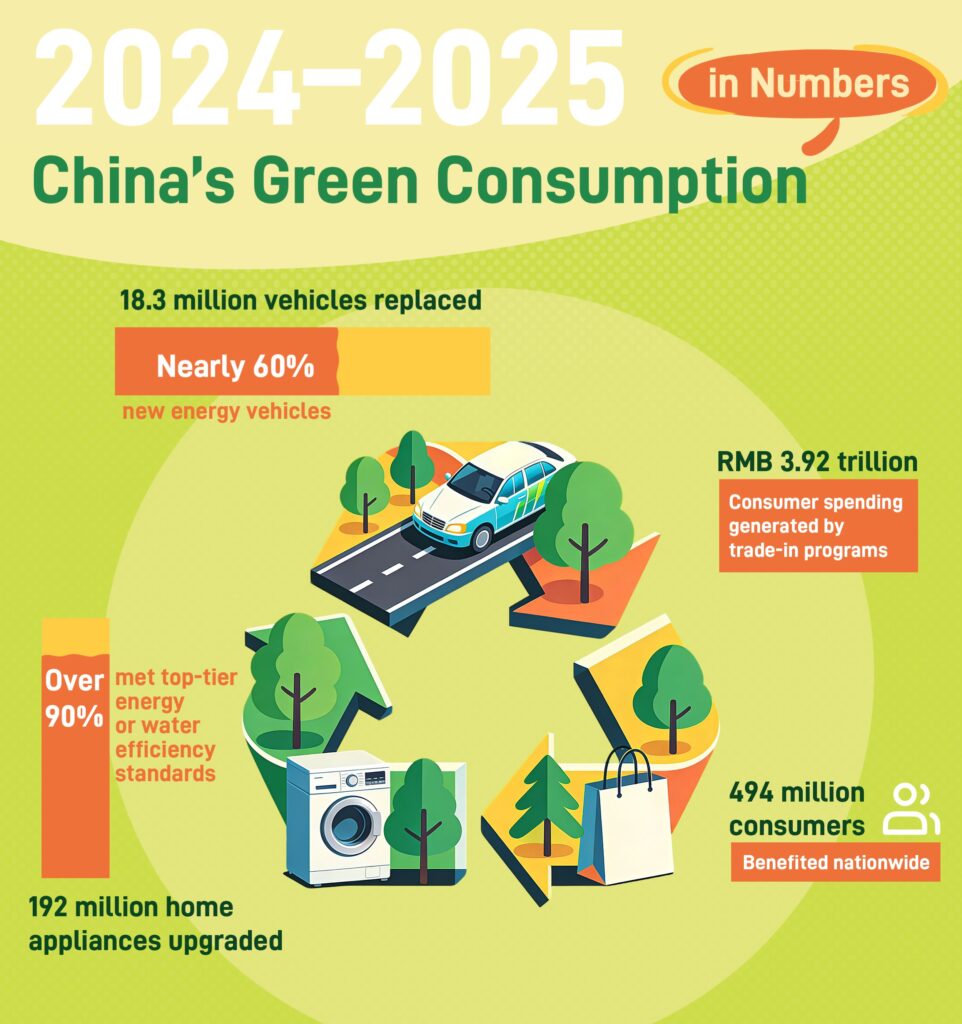
Recent figures illustrate how these policies are already reshaping consumption. Between 2024 and 2025, trade-in programs led to the replacement of 18.3 million vehicles, nearly 60 per cent of which were new energy models. Over the same period, 192 million household appliances were upgraded, with more than 90 per cent meeting top-tier energy or water efficiency standards.
As a result, these programs generated close to RMB 3.9 trillion (about £410 billion) in consumer spending. They reached nearly 500 million consumers nationwide. Looking ahead, officials say China will update a new round of national green consumption standards and step up participation in international standard-setting. This will link domestic consumption more closely with global supply chains and climate targets.
Chart Design by Wang Di. Additional reporting by the Ministry of Commerce of China, CNS.
If you liked this article, why not read: Proposals for Formulating China’s 15th Five-Year Plan to be Studied in October


XxjpsgC000110_20251218_PEPFN0A001.jpg)