
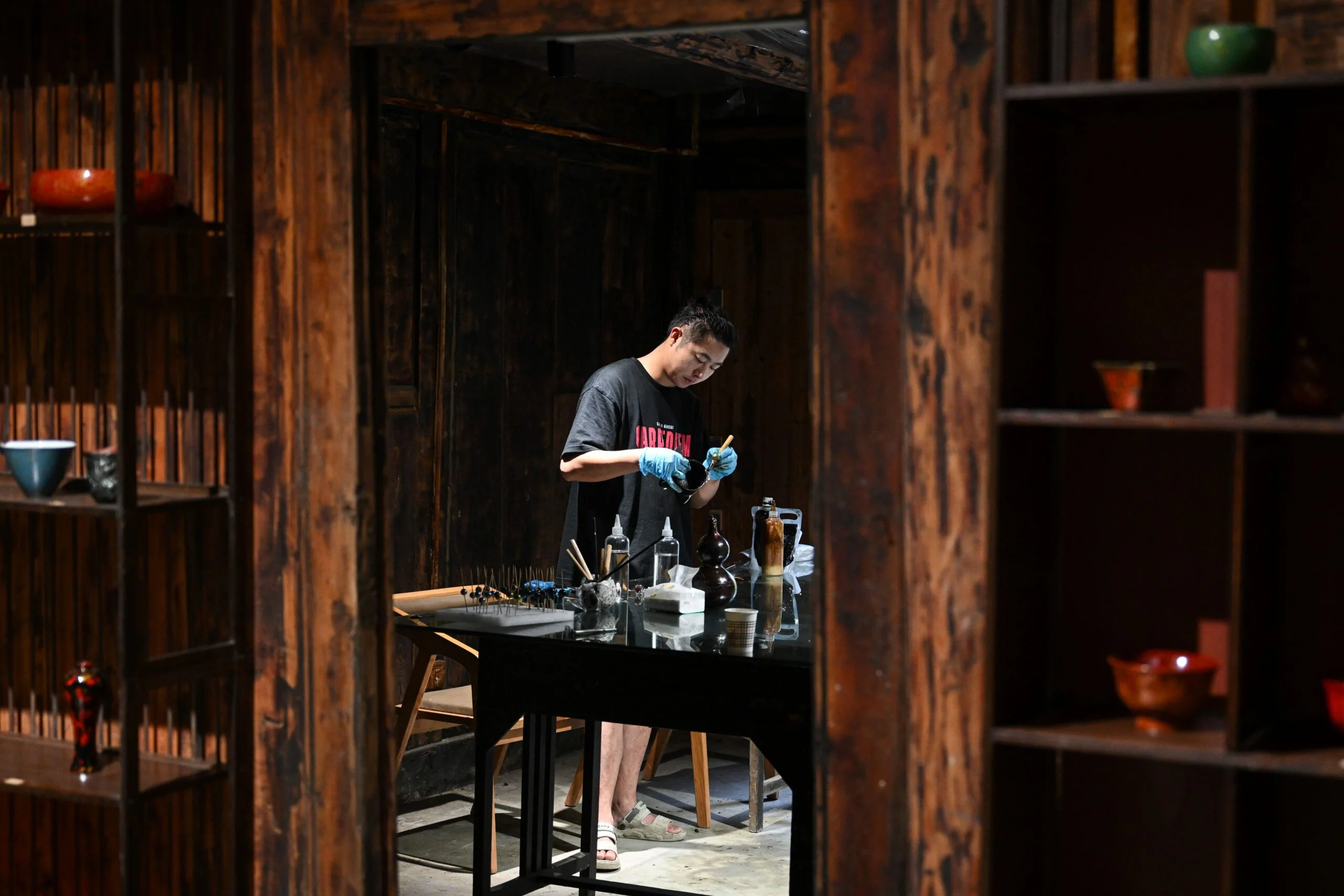

Discover how a 3,000-year-old Chinese lacquer tradition is finding new life in Songbai Village, where young artists and foreign craftsmen are reshaping the craft.
It is lacquer season in Songbai Village, deep in the Daba Mountains in southwest China’s Chongqing Municipality.
In the village, people are busy with lacquer, from 70-year-old lacquer tappers to artists born in the 2000s. For some, it is a livelihood passed down through generations. For others, it is a craft they have chosen to bring back to the countryside.
Lacquer, also known as raw lacquer, is a natural resin collected from lacquer trees. Tappers cut the bark and collect the sap, which is then processed into a coating used on wood and other objects. The techniques of collecting, processing and applying lacquer form a traditional craft known as lacquerware making.
Chengkou County has a history of producing lacquer that dates back more than 3,000 years. It is known as the “hometown of Chinese raw lacquer” and now has about 60,000 hectares of lacquer trees.
For lacquer artist Zhou Yongsheng, born in the 2000s, the craft has been part of his life since childhood. “My grandfather was a lacquer craftsman, and my maternal grandfather was a carpenter. Lacquer was used when making furniture,” Zhou said.
After growing up around the craft, Zhou developed a desire to become a lacquer artist. In recent years, he left his job in the city and returned to Songbai Village, where he now runs a small studio.
A Craft That Starts in the Mountains
For lacquer tappers, the work starts deep in the mountains.
Zou Yongxian, 70, has spent years collecting raw lacquer. He still remembers a traditional rhyme used to identify good-quality lacquer: “Clear as oil, it reflects a woman’s face. Shake it, and it shows tiger stripes; lift it, and it forms a fishing hook.” The rhyme describes the colour, gloss and texture used to judge raw lacquer.
Chengkou lacquer was once exported to Japan and remains popular in the market. Raw lacquer sells for about 200 yuan (about £40) per kilogram. An experienced tapper can collect several kilograms in a day and earn several hundred yuan. During the roughly three-month lacquer season, a tapper can make tens of thousands of yuan.
However, the work comes with a price.
Most people are allergic to raw lacquer. Many lacquer trees grow in remote mountain areas, so tappers may have to stay in simple huts for weeks. Mosquitoes, snakes and rodents are also part of the job.
According to local authorities, the village now has nearly 30 lacquer tappers. Most are older people, while few young people have taken up the work.
That has made the question of succession increasingly important.

From Traditional Craft to a New Way of Life
Making a piece of lacquerware is also a long process. A piece can go through more than 30 steps, including shaping the base, applying layers of lacquer and polishing. The process takes time, and finished pieces can be expensive.
In the past, local craftsmen mainly made lacquerware for practical purposes, such as coating furniture, doors, windows and coffins. Today, some younger artisans are trying to bring lacquer into everyday life again.
Yang Fengwei, another craftsman born in the 2000s who moved to Songbai Village from elsewhere, makes lacquer plates, cups and bowls. He calls them “practical lacquerware” and says they have proved popular with younger customers.
The village has also attracted artists from outside China.
French lacquer artist Vincent, who has lived in Songbai Village for five years, came because of the material itself. “France has lacquerware, but not lacquer. We did not know before that China had such good lacquer,” he said.
He has learned to tap lacquer trees and make lacquerware in the village. His works have been exhibited in France, Thailand and Hong Kong, China.
Lacquer has also found its way into local food culture. Lacquer trees produce lacquer oil, which can be used for cooking. Inspired by this, Vincent worked with Fu Chengyin, owner of a local food business known as Fu Xiaochu, to develop a series of cured meat products featuring black truffle and lacquer oil. The products have since been sold to markets in the United States and Singapore.
Meanwhile, the village is experimenting with other ways to build around its lacquer tradition. Yang has organised five concerts at the Chengkou Chinese Lacquer Culture Exhibition Centre. All five drew full houses. Vincent has also created a lacquer-themed homestay in the village, offering short-term stays for visitors interested in experiencing rural life and lacquer culture.
Additional reporting by Zhang Xu.
If you liked this article, why not read: Three Generations, One Craft: Woodblock New Year Prints


