
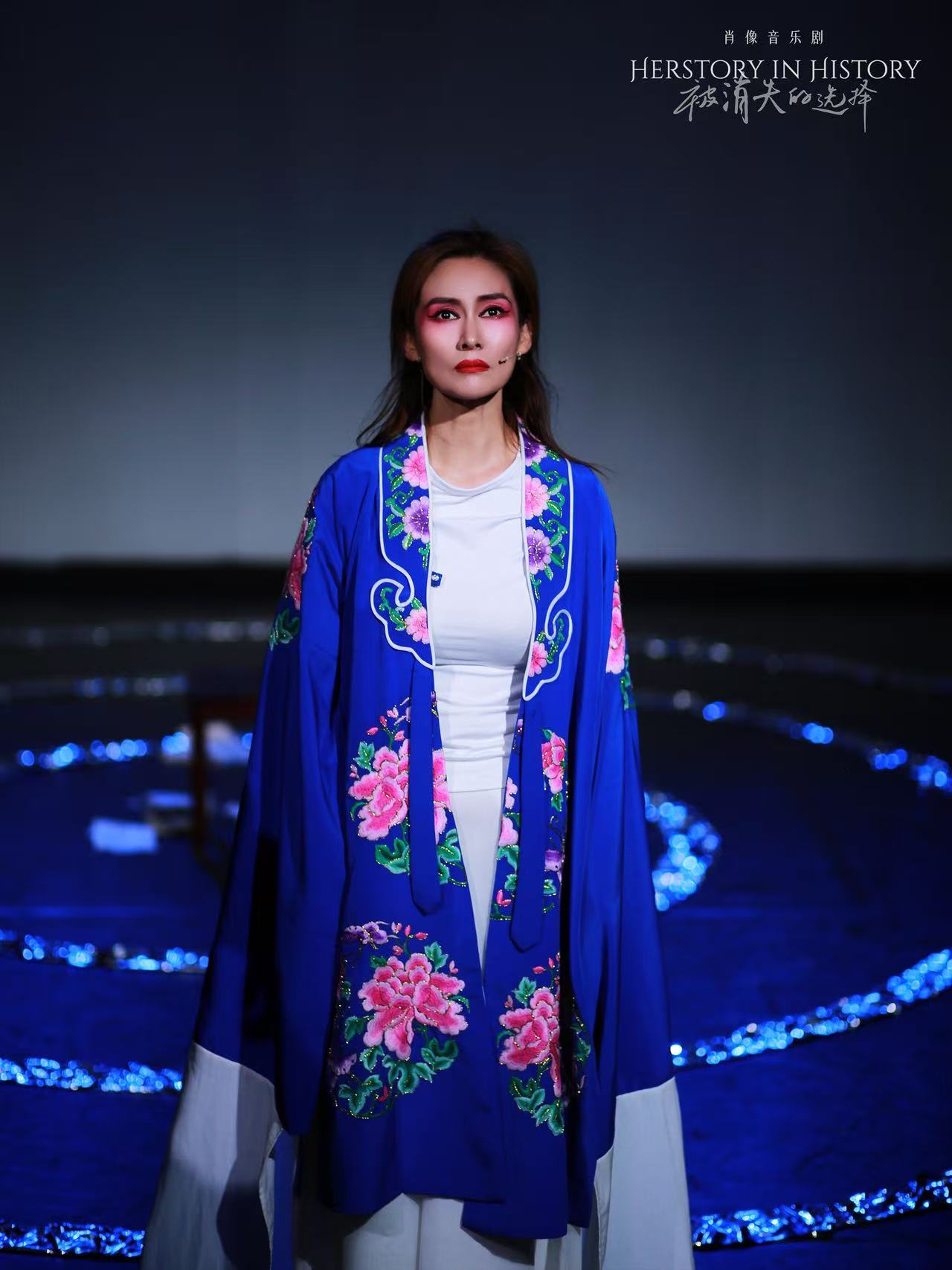

Through August, the original Chinese musical Herstory in History successfully completed its UK run in London and Edinburgh.
On 15 and 16 August, it premiered at The Studio at Rich Mix in London, with all three performances close to sold out. The production then appeared at the Edinburgh Festival Fringe, playing five performances at Venue 9 from 25 to 29 August. Following its UK run, the production is set to return to China: it will appear at the fifth YRD City Drama Season from 23 to 25 October, followed by a planned appearance at The 4th International Monodrama Festival in Beijing in early November.
As the first “portrait musical”, Herstory in History is written and directed by Keyuan Zhang and Fiona Zhu, with an original score by German composer and sinologist Johannes Grosz, the 50-minute solo musical is performed entirely by Zhu. Throughout the piece, the historical figure of Princess Zhao, a contemporary actress and Zhu’s own experiences on stage intersect.
How History Remembers Princess Zhao
The question at the heart of the musical grew out of another role Zhu had played.
In the musical The Orphan of Zhao, she performed Princess Zhao again and again, each time arriving at the same ending already written for the character. From the bedchamber to the city gate: fifteen steps. Then, after one performance, a young girl asked her whether Princess Zhao really had no other possibility.
Zhu began returning to the historical and theatrical texts surrounding the character. What she found was not simply a woman “forgotten by history”. Princess Zhao had, in fact, been written and rewritten many times, taking on different forms across different accounts: a tragic mother protecting the Zhao bloodline in one telling; a woman with desire, judgement and political agency in another. The storytellers and their times changed, while large parts of her own motives, voice and inner life remained unknown.
Even Zhao Zhuangji (赵庄姬), the designation by which she is known today, was not her personal name. More than two thousand years later, history tells us of her as a wife and a mother, but has not preserved a given name by which we can definitively call her.
“Princess Zhao had so much to say — her grievances, her thoughts, her stories — and no chance to say any of it,” Zhu said when discussing the creation of the work.
Herstory in History approaches Princess Zhao through these gaps, placing different versions of her alongside one another. As Zhang asks in his director’s note, “Before she became ‘the mother of the Orphan of Zhao’, who was she?” The production asks what might be lost when a woman is remembered primarily through a handful of identities familiar to later generations.
And as Zhu began questioning a character she had already played many times, her own experiences entered the portrait as well.
From Playing Her to Seeing Her Anew
Herstory in History is distinctly semi-autobiographical.
Zhu has worked in musical theatre for more than a decade, with credits in Chinese productions of The Lion King, Beauty and the Beast, Next to Normal and The Orphan of Zhao. In 2024, she was named Influential Actress of the Year at the China Musical Theatre Association Annual Gala. She came to Britain in 2025 to continue her studies at the Guildford School of Acting. In Herstory in History, she participates as performer, co-writer and co-director, bringing fifteen years of her own stage experience into Princess Zhao’s story.
The narrative moves between two periods. On one side is Princess Zhao as she survives in historical and theatrical texts; on the other is the life of a contemporary actress: the pressure of auditions, the experience of building a career in Shanghai, the frustration of repeatedly encountering similar roles, and expectations from family and those around her about when a woman should make particular decisions about her life.
The lives of these two women cannot simply be equated. What connects them is their experience of confronting identities and expectations in different circumstances. Who decides what kind of person a woman should become? When one kind of life is repeatedly described as “appropriate”, what does it mean to depart from it?
The movement between these two worlds also finds its way into Grosz’s music. His work is rooted primarily in Western musical traditions, but for Herstory in History, he worked with the Chinese creative team to bring traditional Chinese instruments and musical elements into a chamber-style score. Some vocal passages also draw on phrasing associated with Kunqu Opera.

Much of the production’s emotional movement rests on Zhu’s voice. Her singing moves between the strength required of a musical-theatre performer and quieter, more delicate passages. When the story comes closest to her own experience, her voice becomes less an expression of character and more an actress speaking about her own life. The final title song, “Herstory in History”, has a distinctive melody that leaves a clear musical impression.
The visual design is similarly built around a recurring path. A silver strip coils into a circle across the floor, with a small stool at its centre and a length of white silk suspended above it. Beneath a clothes rack lie crumpled and torn pieces of paper, like fragments of a historical record that can no longer be assembled into a complete whole. Zhu repeatedly follows this route, appearing to move forward only to find herself returning to where she began.
Live video brings the camera close to Zhu’s body and face, particularly her eyes. As she stands before the suspended white silk, her breath, hesitation and gaze are projected onto the screen behind her. Emotions left unspoken in the text remain visible in these enlarged details.
The “portrait” in “portrait musical” gradually takes shape through this interplay. The surviving records cannot be assembled into a complete picture of Princess Zhao; Zhu enters those gaps through her own body, voice and stage experience. As the ancient figure and contemporary actress overlap in narrative and image, the portrait of Princess Zhao also reflects the woman standing on stage today.
When an Old Story Arrives in Another City
The Orphan of Zhao was among the early Chinese plays to become known in Europe. Centuries later, the story has arrived here again, this time placing at its centre a woman long remembered principally as a mother.
Herstory in History is performed entirely in Chinese with English surtitles. Its Chinese-language songs, elements of Kunqu vocal phrasing and cultural context remain intact, while UK audiences enter the intertwined stories of Princess Zhao and the contemporary actress through surtitles. During the Edinburgh run, Zhu also took to the streets in the traditional Chinese costume worn in the production, meeting Fringe audiences from around the world beyond the theatre doors.
Following its UK performances, Herstory in History will return to China for appearances at two theatre festivals. From 23 to 25 October, it will take part in the fifth YRD CITY DRAMA SEASON at HuangPu Theatre in Shanghai. In early November, the company plans to travel to Beijing for THE 4TH INTERNATIONAL MONODRAMA FESTIVAL, with exact performance dates yet to be confirmed.
From London and Edinburgh to Shanghai and Beijing, the production will encounter audiences in different theatrical and cultural contexts. UK audiences meeting Princess Zhao through English surtitles may enter the portrait from a different position from Chinese audiences already familiar with The Orphan of Zhao.
The question that first came from the audience, however, remains on stage:
Beyond the lives already written for us, what other choices might still remain?
If you like this article, why not read: Seventy Years with the Guqin, Wu Wenguang Hopes That an Ancient Sound Will Keep Growing


