
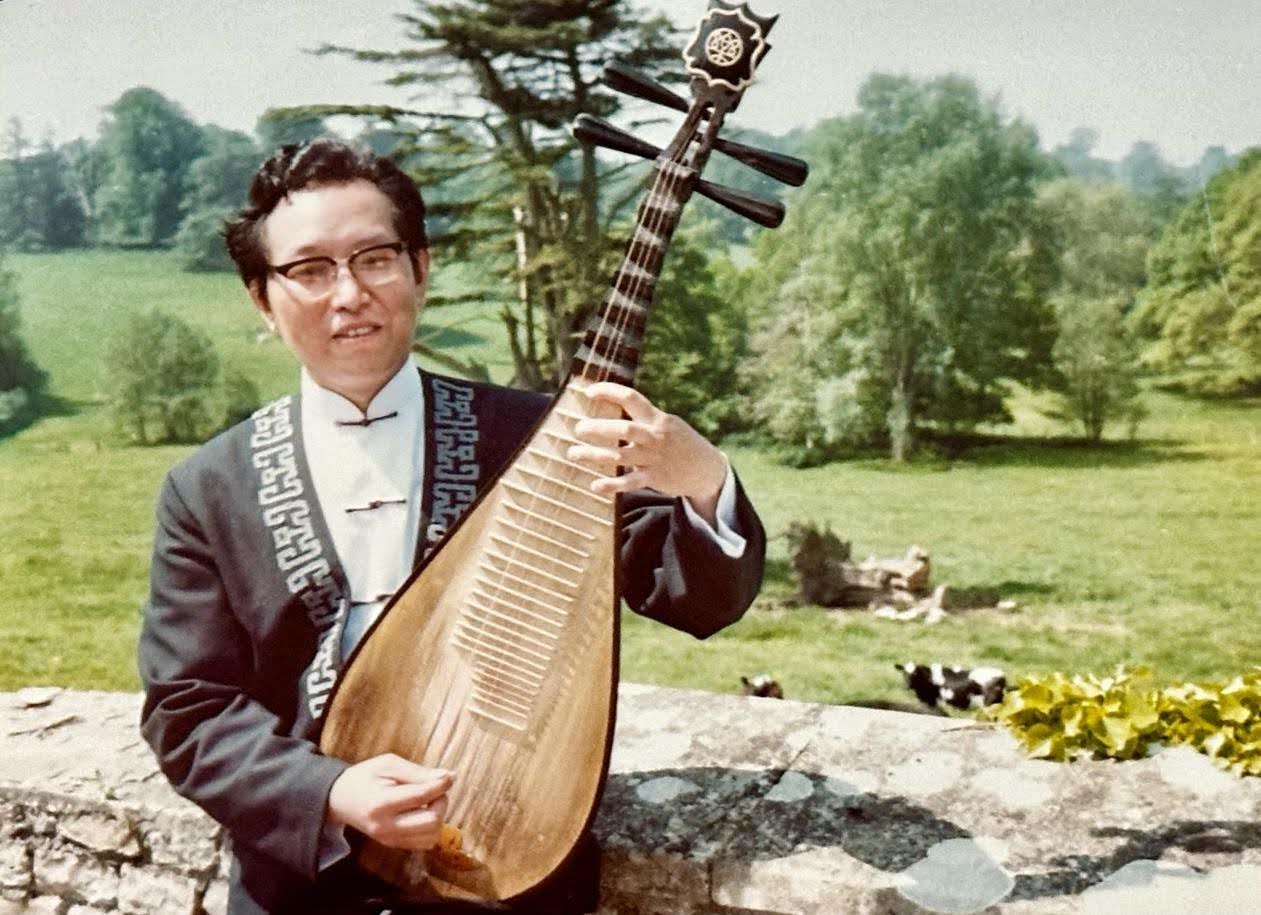

Forty-three years ago, Wu Wenguang made his first visit to the United Kingdom, with a group of Chinese ethnic music performers and a guqin that was already 800 years old.
At an arts festival in southwest England, he encountered the world-renowned violinist Yehudi Menuhin. Menuhin showed a keen interest in the ancient Chinese instrument. Wu recalled introducing him to the guqin and demonstrating how it was played. In the end, they took a photo together.
Later, he went to London and performed the ancient piece “Guangling San”as a solo at a concert held at the Riverside Theatre. More than forty years have passed, and this experience still remains in Wu Wenguang’s memory. He said that the British audience could concentrate, capture the details in the music, and had a very high level of appreciation.
43 years later, Wu Wenguang came to the UK again. At this time, he was 80 years old and had reached the 70th year of his career in ancient music art.
In August 2026, invited by the Third Cambridge Chinese Music & Cultural Festival, he travelled to Cambridge and London to give two lectures titled “Guqin Through the Ages: From Jianzi Notation to Symphonic Music”. It was his first visit to Cambridge and his first time entering the Royal Academy of Music, an institution he had long heard of. “After more than 40 years, to have the opportunity to come back to the UK and to London again, it is a real honour,” he said. Walking into the Royal Academy of Music, he found that seeing it in person far exceeded anything he had imagined.
Returning to the UK after 43 years, Wu’s thoughts have moved beyond simply bringing the guqin to overseas audiences. The question he is grappling with runs deeper: how could an art form with a thousand-year history meet a world that never stops changing?


“It can’t just remain there and stagnate.”
Wu’s connection with the guqin began in his youth. Over the decades, he has witnessed the instrument’s world expand from a small circle of devoted practitioners to a much broader community of players, an ever-growing repertoire, and active research and composition. “Its cultural value has come to be more and more appreciated,” he said. Today, the guqin exists in both its traditional form and in new creative directions, with professional and amateur players each finding their own path. In his view, this represents a guqin world that is both rooted in inheritance and open to development, also more varied than ever before.
The guqin occupies a uniquely distinctive place in Chinese musical history through its notation tradition. Generation after generation, guqin players have used written scores to pass classical pieces down to those who come after them. Yet guqin notation does not work like a modern musical score, fixing every detail of a performance in place.

Why can a musical notation that was left over hundreds of years ago still be transformed back into music today?
In response to the reporter’s question, Wu mentioned a word, “interpretation”. “Guqin music has its own character, and in particular, it carries within it the possibility of interpretation,” he said. This idea, he believes, is deeply embedded in Chinese traditional culture. Confucius spoke of “transmitting rather than creating”, yet in Wu’s reading, transmission itself contains an act of creation.
Successive generations have added their own commentary to the classics, returning to them from the vantage point of their own times. The same is true of guqin transmission. The fact that those who came before left scores behind does not mean those who follow are bound to reproduce them without change. “So many pieces have come down to us from the past. Every generation has the need, the right, or the responsibility to interpret them,” he said. “It can’t just remain there and stagnate.”
And the title of his lecture during this UK visit pushes that thought in a direction that might seem, at first glance, to span an enormous distance: “From Jianzi Notation to Symphonic Music”.

When the Guqin Meets the Symphony
The guqin and the symphony orchestra appear to belong to entirely different worlds. One is associated with scholars, studies, solo performance and quietude; the other brings together a large ensemble of instruments in a vast sound structure. When our reporter asked Wu why he had brought the two together, he did not see it as particularly surprising.
Traditional Chinese music, from Wu’s point of the view, tends to unfold along a single melodic line, while Western music has developed polyphony and harmony. Moving from a single line to multiple voices, he said, “is not such a difficult thing”. The real question is whether one wants to do it, whether it is permitted, and how it might be done. Beyond the music itself, public attitudes towards tradition and existing cultural habits also shape where an ancient art form can go. Wu believes that Western techniques such as polyphony and harmony are not beyond borrowing, what matters is how different musical languages can be genuinely brought to bear on the creation of Chinese music.
In Wu’s opinion, his hope is “Using this kind of transformation to introduce traditional guqin music, or Chinese music more broadly, to the world in a better way”. After a pause, he reached for a weightier phrase: “It is a kind of cultural mission”.

“Because I Exist in This Era”
When asked why he has continued to dedicate himself so fully to the guqin, Wu turned to an English word: destiny. “Because I exist in this era,” he said. His explanation reached back to an earlier generation of guqin players. When he was young, senior guqin masters placed their hopes in his generation. “Because you are young, you still have energy, you can still learn,” he recalled them saying. Those older musicians hoped that his generation would carry the work forward and “perhaps do more for the guqin”.
Decades have passed, and the young musicians of that era have become the elder statesmen of today. The expectations that were once placed on his shoulders are now being passed to a younger generation. “Just as I now place my hopes in the next generation,” he said.
Wu has never pursued the guqin as a profession. “Although I have never made it my career, the guqin has always been my discipline,”he told our reporter. Over seventy years, he has moved from learning the instrument as a boy, through performance, transcription and research, to exploring how the guqin might engage with contemporary music.
He is optimistic about the guqin’s future. He believes that tomorrow’s guqin world will be more complete and more multifaceted than today’s, with a wider cultural reach. “Although I may not live to see what the guqin will become,” he said, “I am certain it will continue.”
That confidence comes partly from the enduring capacity of Chinese culture to pass things on, and partly from what he sees as the guqin’s inherent openness to interpretation. As long as those who come after are still willing to engage with and reinterpret the ancient texts, the guqin, in his view, will always have room to keep growing.

Passing Hope to the Next Generation
As more and more young people are drawn to the guqin, what is it they should truly inherit—performance technique, or the culture and spirit that lives within the instrument?
“Both exist. Both do.” Wu replied. In his opinion, there is no one-size-fits-all path for the guqin. Everyone has different educational backgrounds, different growth environments, and different abilities and interests. Some are good at playing, some are suitable for research, and some seek spiritual nourishment and self-cultivation from the guqin. Everyone can find their place in the field they are good at.
As the interview drew to a close, the reporter asked Wu what he would say to the young people learning the guqin today, if he had just one thing to tell them. Compared with the earlier parts of the conversation, his answer this time carried little in the way of theory.
“Study, study, and study again. Practise, practise, and practise again. Research, research, and research again.” He paused for a moment. “And if time allows, give everything you have to this ancient art.”

If you like this article, why not read: The 3rd Cambridge Chinese Music & Culture Festival Visits Royal Academy of Music in London


