
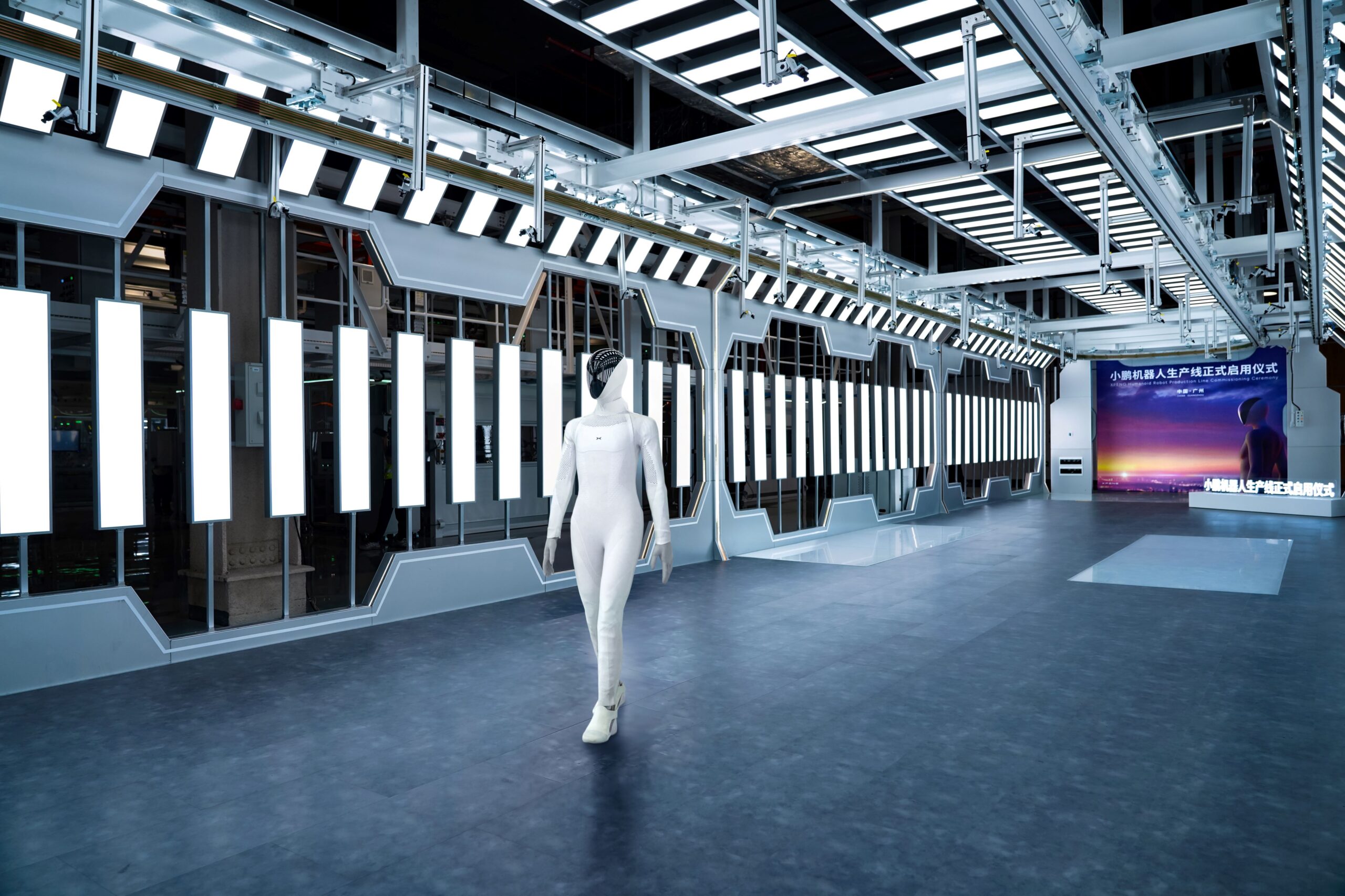

XPENG has opened an automated production line for humanoid robots in Guangzhou, marking a step towards mass production and overseas deliveries.
Chinese electric vehicle maker XPENG has opened an automated production line for advanced general-purpose humanoid robots in Guangzhou, marking a move from robot development and prototyping towards mass production.
The company’s IRON humanoid robot has completed assembly on the new line and walked off the production line on its own. XPENG said the facility is the world’s first automated production line for advanced general-purpose humanoid robots.
The company plans to start mass production of its humanoid robots by the end of 2026. It will first deploy them in XPENG stores and campuses before launching and delivering the robots in China and overseas markets in 2027.
From Prototypes to Production
The new production line is designed for large-scale manufacturing from the outset. More than 80 per cent of its core processes are automated, according to XPENG.
The company has also brought manufacturing and quality-control practices from its electric vehicle business into robot production. It said this approach will help ensure consistent production and support future increases in production capacity.
For XPENG, the shift is significant because humanoid robots have largely remained at the research, demonstration and prototype stage. Moving to an automated production line is an important step towards making them commercial products.
IRON is designed with a human-like body and a fully enclosed flexible lattice structure. It has 76 degrees of freedom across its body and 21 degrees of freedom in each hand.
The robot is powered by three XPENG Turing AI chips. The company said its physical AI foundation model can run directly on the robot, allowing it to perform complex tasks without remote operation. This is intended to reduce response times and improve data security.
XPENG aims to develop IRON as a general-purpose humanoid robot platform that can work across different scenarios and improve through real-world use.
A Growing Global Robot Market
XPENG’s move comes as humanoid robot production expands rapidly in China.
According to a recent report by US market research firm Smart Analytics Global, cited by Bloomberg, Chinese humanoid robot makers accounted for more than 97 per cent of global shipments in the first half of 2026.
Shanghai-based AgiBot shipped about 8,400 units during the period, accounting for 44 per cent of global shipments, while Hangzhou-based Unitree Robotics shipped about 5,900 units, according to the report.
The two companies’ shipments were higher than those of several leading US humanoid robot developers, including Tesla, Figure AI and Agility Robotics.
The report estimated that global humanoid robot shipments reached about 19,100 units in the first half of 2026, more than three times the 5,100 units shipped in the same period last year. It expects full-year shipments to reach about 60,000 units in 2026 and 500,000 units by 2030.
Against this backdrop, XPENG is seeking to use its experience in vehicle manufacturing, AI and supply chains to expand into robotics.
He Xiaopeng, chairman and CEO of XPENG, said the company wants to develop a robot with broad generalisation capabilities that can enter everyday life and perform useful tasks.
For now, however, the company is still preparing for the next stage. Mass production is scheduled for the end of 2026, while broader commercial sales and deliveries are planned for 2027.
If you liked this article, why not read: Will AI Replace Jobs? China Sees New Roles Emerging


