
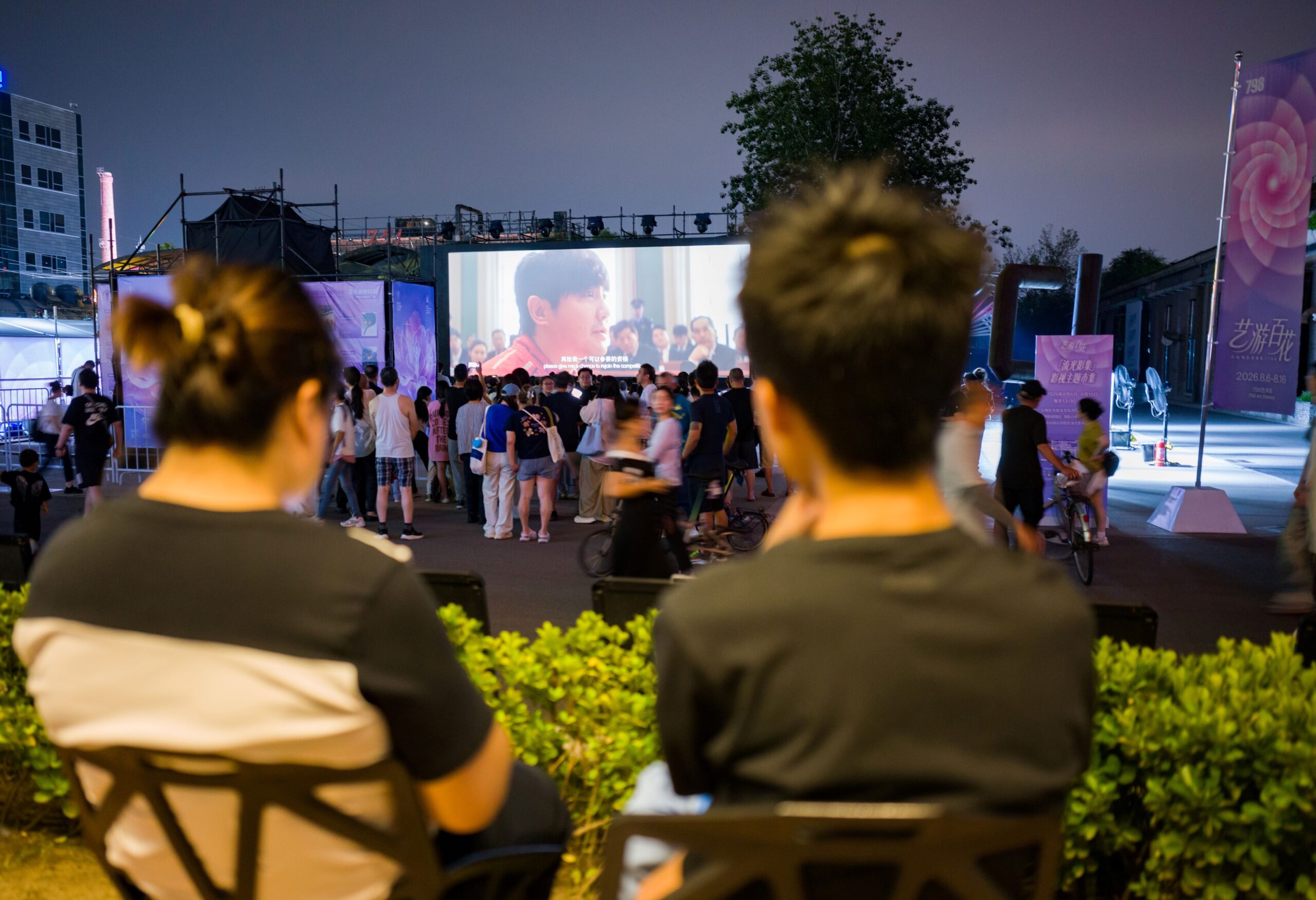

Outdoor cinemas are making a comeback in Chinese cities, offering residents new ways to enjoy films in parks, historic sites and other open-air spaces.
With historic courtyard buildings nearby, a giant screen lights up as racing cars roar. A cool breeze cuts through the late-summer heat, while the sound of cicadas blends with the engines from the film.
Recently, an outdoor cinema opened at the former site of the Mongolian and Tibetan School, about 2 kilometres from Tian’anmen Square in central Beijing. That evening, audiences watched Pegasus 2, a Chinese film about a racing driver chasing his dream.
Outdoor cinemas are also a familiar summer pastime in Britain and other parts of Europe. In China, however, the format is finding new life in a range of urban spaces.

From Old Memories to New Experiences
Outdoor cinemas were once a common part of life in Beijing. In 1962, the open-air cinema at Beihai Park’s Wanfo Tower resumed screenings. Zhongshan Park also began regular outdoor shows that year. Local audiences watched Chinese films such as Snowstorm in the Dabie Mountains and Two Brothers, as well as Soviet films.
At the time, indoor cinemas were limited. Some people walked for dozens of kilometres to watch a film, while others travelled across the city.
More than six decades later, outdoor cinemas have returned to Beijing. The experience, however, has changed greatly.
Li, 78, lives near the former Mongolian and Tibetan School site. He has gone to the outdoor cinema there for three consecutive weeks.
“In the past, we had to wait a month for a film. We also had to arrive several hours early and bring our own stools to get a good spot,” Li told HKCNA. “Now, indoor cinemas are much more convenient. Still, the atmosphere of watching a film outdoors brings back many memories. The screen, sound system, seats and picture quality are all much better than they used to be.”
For Li’s daughter, the experience offers more than a film.
“We live nearby, but we had never really taken the time to visit the former school site,” she said. “Watching a film here gave us a chance to learn that it was the first specialised school for ethnic minorities in modern Chinese history. It was a real discovery for us.”
She also said that watching a film together gave the family a rare chance to spend time together after busy working days.

Outdoor Screens Spread Across Cities
In recent years, some bars and cafés in Beijing have also hosted outdoor screenings. Most were small events featuring arthouse or niche films.
This year, however, more communities, shopping centres and historic sites have joined in. They have turned unused spaces into temporary cinemas, while screenings now include more mainstream films for a wider audience.
At an outdoor screening in a shopping district in eastern Beijing, most viewers were young people. They carried drinks and snacks and watched the film in small groups.
Audience member Yi Hang said the setting felt more relaxed than an indoor cinema.
“You can talk and interact more freely,” Yi said. “You can finish shopping, watch a film and enjoy some food in one evening. There are fewer rules, and it gives us another way to spend the night.”
Wang Weian, who comes from a southern Chinese city, said the scene reminded him of his childhood.
“It feels warm and familiar,” Wang said. “It also makes me feel more connected to Beijing.”
The trend has also spread to other parts of China. In Wuhan, audiences can watch films from boats at a floating cinema on East Lake. In Chengdu, audiences can watch films while paddleboarding at Luhu Lake. In Sanya, outdoor screenings have been held on the beach in Tianya town.
These venues offer audiences a chance to watch films while experiencing the local scenery and cultural surroundings.

Free Screenings and New Challenges
Most outdoor screenings in Beijing are free, although some charge admission. At the Mutianyu section of the Great Wall, for example, visitors can watch outdoor films after purchasing a night-tour ticket. Chaoyang Park has also hosted lakeside screenings, with ticket holders receiving souvenirs such as badges and postcards.
However, outdoor screenings can also bring practical problems.
Some viewers told reporters that people sometimes walk around, leave and return during screenings, or use their phones. Such behaviour can affect the viewing experience.
Weather is another challenge. A community worker said outdoor screenings depend heavily on weather conditions and can be difficult to manage.
“People no longer need outdoor cinemas to watch films. Many come simply out of curiosity,” the worker said. “If they want better viewing quality, they will still choose an indoor cinema.”
The worker said the aim was to give residents another leisure option.
“It may help support the night-time economy, but turning it into a profitable business on its own is not easy,” the worker said.
If you liked this article, why not read: How a Chinese Film Turns Food into a Story of Survival and Peace


