

FluxFormAI compliance engineering platform aims to support Chinese technology companies expanding overseas.
As an official event of London Tech Week 2026, the World Future Technology Development Summit 2026 was held at IET London: Savoy Place on the banks of the River Thames. The summit focused on strengthening strategic links between emerging technologies and international capital markets, bringing together more than 400 experts, industry leaders, investors, and innovation organizations from fields including artificial intelligence, robotics, intelligent manufacturing, sustainable technologies, public policy, and industrial investment. The event provided a platform for participants to examine emerging trends and new paradigms shaping the future of global technological development.
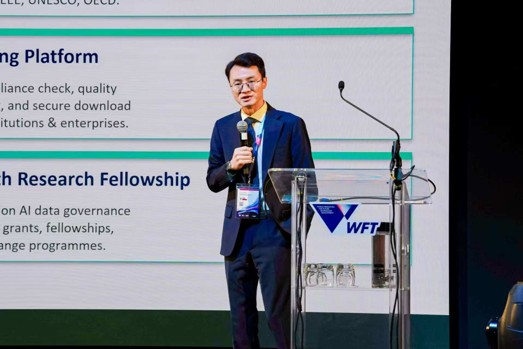
During the keynote session, a research team from University College London (UCL) delivered a presentation on the development and governance of trustworthy AI training data and officially launched the Global Initiative on the Development and Governance of Trustworthy AI Training Data. The initiative was jointly endorsed by the UCL Centre for Artificial Intelligence, the World Federation for Future Technology Development, the International Artificial Intelligence Association, the National Institute of Advertising, and the Nouvelles d’Europe UK Edition, with academic support from Professor Song Kai’s research team at Beijing Language and Culture University. The initiative reflects a growing consensus on cross-disciplinary, cross-border, and cross-industry collaboration in AI governance.

Trustworthy Data Emerges as a New Competitive Frontier in AI
According to the initiative, the global AI landscape is undergoing a significant transformation. Competition is increasingly shifting from being driven primarily by algorithms and computing power to being shaped by access to high-quality training data. As large language model architectures mature, the report argues that the key factor determining AI performance is no longer solely model size or computational capacity, but the availability of trustworthy datasets that are verifiable, properly licensed, traceable, and of high quality. The initiative highlights several challenges confronting the AI sector, including the proliferation of misinformation, ambiguity surrounding data copyright ownership, contamination of training datasets by AI-generated content, and insufficient resources for low-resource languages. These issues are increasingly viewed as major obstacles to the responsible development of AI worldwide.
Six Core Standards Proposed for Trustworthy AI Data Infrastructure
To address these challenges, the initiative calls for the establishment of a global infrastructure for trustworthy AI training data and proposes six foundational standards: provenance; licensing; factuality; ethics and bias mitigation; standardization; and dynamic updating. The framework aims to reduce AI hallucinations, model bias, and compliance risks at the data source level while providing a stronger foundation for AI deployment in high-risk sectors such as finance and healthcare, as well as in professional knowledge applications and cross-cultural communication.
The launch also underscored UCL’s growing role in AI governance, policy research, and interdisciplinary technological collaboration. The university’s work in AI regulation, model safety, societal impact, and international cooperation has contributed significantly to the development of trustworthy data standards. Organizers said the initiative seeks to bridge technological innovation and governance frameworks, fostering closer alignment among academic research, industry requirements, and public policy.

From Principles to Practical Compliance Engineering
Alongside the initiative, the summit also introduced FluxFormAI, a global responsible AI compliance engineering platform jointly developed by teams associated with UCL and the University of Cambridge. The platform focuses on key areas including data compliance, regulatory mapping, security benchmarking, quality assessment, iterative model improvement, risk classification, and safety review processes. Its objective is to transform fragmented global AI governance requirements into practical, verifiable, and deployable engineering solutions that can support the international expansion of AI technologies and products.
Organizers described the launch as an indication that trustworthy AI development is moving beyond high-level principles into a new phase characterized by standardized engineering practices and governance infrastructure. For technology companies seeking access to overseas markets, trustworthy training data and compliance engineering capabilities are expected to become complementary pillars of global competitiveness. While trustworthy data determines the quality and scope of a model’s understanding of the world, compliance infrastructure determines its ability to operate sustainably across different markets and regulatory environments.
Global Action Plan and International Collaboration
The initiative also outlines four major action programs: conducting global audits and ratings of AI training datasets; promoting mutual recognition of international standards; building open and shared data governance platforms; and establishing a global youth research fellowship program to cultivate the next generation of AI governance professionals. Through these efforts, the initiative aims to connect universities, research institutions, AI companies, policymakers, and content creators in building a transparent, fair, compliant, and sustainable AI data ecosystem.
The World Future Technology Development Summit provided an international platform for advancing dialogue on these issues. Organizers emphasized the importance of integrating cutting-edge research, industrial applications, and international investment while strengthening cooperation between the United Kingdom, China, and the broader global technology community.

Speaking during the event, Li Qiang, General Manager of the Nouvelles d’Europe UK Edition, said the construction of trustworthy AI corpora is not only critical to technological advancement but also to the authenticity, objectivity, and diversity of international communication. Li noted that as generative AI becomes increasingly involved in information production and cross-language communication, high-quality, traceable, and legally authorized datasets are becoming essential infrastructure for helping global audiences better understand China. He expressed hope that trustworthy datasets could preserve authentic and multidimensional narratives about China in ways that align with international communication practices and technology governance standards, providing AI systems worldwide with richer and more contextually grounded information.
Looking ahead, trustworthy training data will become a strategic form of infrastructure in the AI era. As the initiative concludes: “Algorithms determine efficiency, computing power determines speed, but trustworthy data determines the future.” At a time when both AI competition and global governance frameworks are being rapidly reshaped, the initiative’s supporters contend that establishing open, compliant, traceable, and sustainable data ecosystems will provide the foundation for responsible artificial intelligence while creating new forms of public infrastructure for international technological cooperation and the development of the digital civilization.
If you like this article, why not read: How One Chinese County Built a 40.8 Billion Yuan Crayfish Industry


