
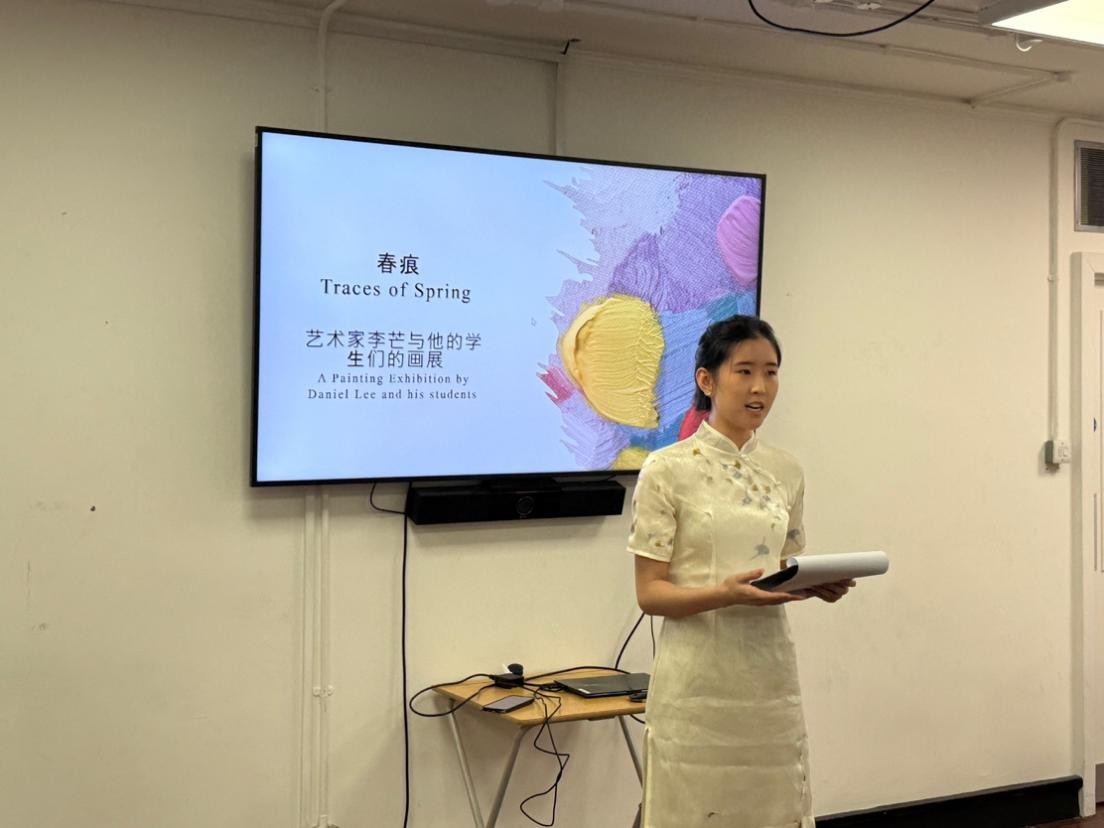

Traces of Spring: Paintings by Daniel Lee and His Students exhibition opened on April 25th at Charing Cross Library in London as a vivid example of cross-cultural exchange and art education.
The exhibition is jointly presented by the Mothers’ Bridge of Love (MBL) and Charing Cross Library, an important part of the MBL and Charing Cross Library 2025–2026 annual exhibition programme. The Traces of Spring exhibition is open to the public and will continue until July 3rd.
On the afternoon of April 25th, the lower ground floor of Charing Cross Library was filled to capacity, with the room carrying the brightness and anticipation that seem unique to spring. Host Cao Qianzi opened the event by speaking of “April springtime in London”, describing the exhibition as “a spring painted into being with brushes”. She noted that it was not simply an exhibition of artworks, but a shared experience of growth, companionship, and inspiration. To warm applause, the artist, student representatives, curatorial team, guests, and visitors gathered together to mark the opening of a project many months in the making.
Centred on the theme of spring, the exhibition presents one representative work by London-based artist and art educator Daniel Lee, alongside works by 32 students inspired by the season. Within the same space, an established artist stands beside thirty-two emerging creators, forming a dialogue between inheritance and individuality.

When Daniel Lee spoke, his tone was humble and heartfelt. Smiling, he described himself as “a fortunate man”. He had once only imagined holding a small teacher-and-student exhibition at home, and had never expected to share such a formal and warmly received exhibition with his students in a public cultural space in central London. He gave special thanks to the Mothers’ Bridge of Love team for their planning and organisation, as well as to the volunteers who had supported the classes and to family members who had travelled to attend. What moved him most, he said, was not the number of works on display, but the commitment of his students, who continued creating despite the demands of busy lives.
He explained that his students include bank executives, restaurant managers, university lecturers, and young people still in education. By day, they fulfil their responsibilities; by evening or on weekends, they return to the drawing board and reconnect with themselves. “Everyone has their own artistic journey,” he said. Art education, in his view, is not about copying the teacher’s style, but helping each person discover their own voice. For younger students in particular, he emphasised the value of concentration and perseverance. “These matter not only in painting, but in life.”
Lee’s featured work, Spring Ripples, Parliament, became the visual centrepiece of the exhibition. In the painting, golden midday light outlines the Palace of Westminster in warmth and clarity, while passing figures become silhouettes quietly facing the historic building. Early spring sunlight draws together history and the present, crowds and city life, immersing them in a gentle poetic atmosphere. The work reflects both the spirit of London and Lee’s long artistic exploration of bringing the essence of Eastern aesthetics into Western urban landscapes.

Later in the programme, student representative Jenny Wang delivered remarks that touched many in the audience. She recalled joining Daniel Lee’s online classes last September after encouragement from a friend, beginning with the basics of paper, pigments, and brushes. She said Lee taught more than technique; he offered a way of seeing the world afresh. “Meeting a good teacher is a kind of good fortune,” she said. A true teacher does not only show you how to paint, but gives you the courage to pick up a brush and believe you can express yourself freely.
Her exhibited work, Spring at the Window, carries the same sensitivity. Spring does not appear directly as scenery, but exists in the light and colour beyond the window. Indoors rests the weight of memory; outside, a bright world unfolds. The standing figure between them seems poised at the threshold of past and future, silent yet full of strength. Jenny said art had taught her to observe life more carefully and to face herself more honestly.

When seven-year-old Oscar Xu Han stepped forward, the room responded with warm laughter and applause. In a child’s voice, but with complete sincerity, he said that Mr Lee had travelled to many countries and brought much beauty back to his students, and that he felt very lucky to be among them. His painting, Dream on the Piano Keys, shows a young girl seated by a window at the piano, sunlight resting on her shoulders as her gaze drifts somewhere beyond the room. It is a quiet dream belonging to childhood, filled with imagination and natural artistic feeling.
Another student representative, Adrianne Yu-Mason, spoke of an eight-year journey in art. She began learning to paint at the age of seven and is now nineteen. Daniel Lee has affectionately described her as “the student who has studied the longest”. She said painting began as an interest but has since become part of her identity. At school, classmates even call her “the artist”. Her exhibited work, Smile from the Heart, focuses on human expression, seeking to capture a gentle strength that is understated yet deeply moving. She reflected that spring is not only flowers and sunshine, but also the awakening of emotion, and that a smile can be one of spring’s truest expressions within the human heart.

During the guided viewing that followed, visitors moved through the exhibition with Daniel Lee, listening to the stories behind each painting. From the tremble of fresh green leaves on branches to the shifting reflections of clouds after rain, from the layered light of city architecture to subtle movements of human emotion, the artist’s vivid yet unpretentious commentary brought viewers into the moment each work was created. Many lingered before the paintings, nodding, smiling, or quietly sharing their own responses.
The meaning of Traces of Spring exhibition lies precisely in this mutual reflection. While the students’ works carry forward the spirit of their teacher, they also reveal clearly individual directions. Some focus on landscapes, some on emotional portraiture, some retain the wonder of childhood imagination, while others display mature observation. Like shoots breaking through the earth in spring, they grow from shared soil while reaching toward their own skies.

As an ongoing cultural initiative, the 2025–2026 annual exhibition programme by the Mothers’ Bridge of Love and Charing Cross Library has already presented a series of public-facing themed events. Earlier highlights, including the Chinese Ethnic Minority Children’s Costume Exhibition and the MBL Lunar New Year Family Cultural Day, attracted strong public participation and continued to expand the role of the library as a shared space for art, education, and community engagement.
For many years, Charing Cross Library has been an important cultural space for London’s Chinese community while also welcoming people from a wide range of backgrounds. The Mothers’ Bridge of Love continues to build bridges of cross-cultural understanding through cultural programmes and educational practice. Their partnership allows art to become not only something to be displayed, but a meaningful medium that connects people, communities, and cultures.
Within this space where books and light meet, the Traces of Spring exhibition invites visitors to slow down, to sense the subtle pulse of the season between the paintings, and to reconsider how we see, understand, and connect across different cultural worlds.
If you like this article, why not read: London’s First Chinatown Revealed at St Anne’s Church Limehouse Exhibition


