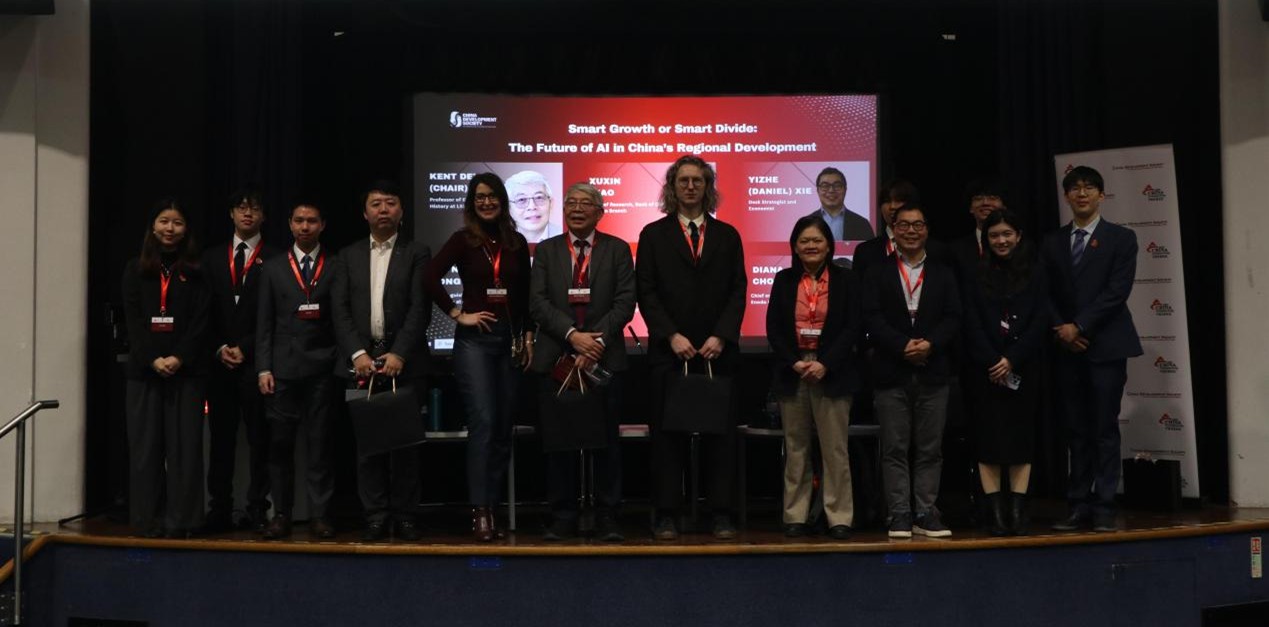

The 18th LSE China Development Forum rethinks China’s development path in the era of technological transformation.
It was held on February 7th at the Old Theatre of the London School of Economics and Political Science (LSE). More than 20 speakers from political, business, and academic circles in China, the UK, and beyond gathered to discuss topics including artificial intelligence, national image, and green transition, offering structural perspectives on China’s evolving role within the global system.
Participants broadly agreed that the central challenge China now faces is no longer simply the pace of growth, but rather how to build a more resilient development model in the face of technological advancements, regional disparities, and shifting global dynamics.
China at the Technological Frontier: From Follower to Rule-Shaper
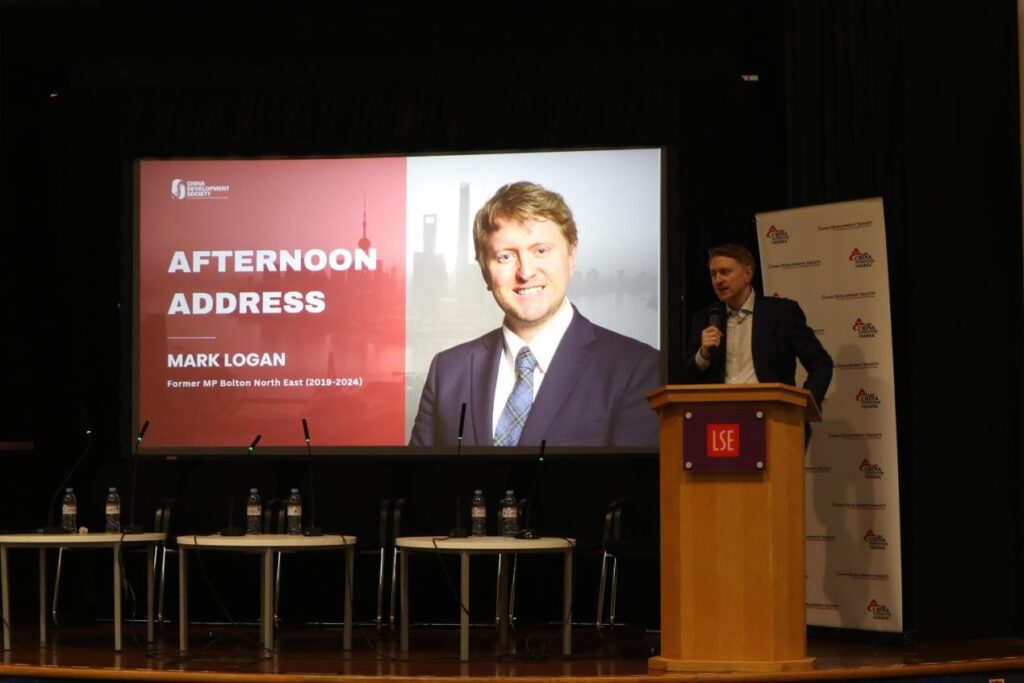
Former UK Member of Parliament Mark Logan said that framing China merely as a “technology follower” no longer captures today’s realities. Across various sectors, including artificial intelligence, green technology, electric vehicles, and digital platforms, China is advancing toward the global technological frontier, with its innovative capacity and industrial scale exerting a tangible influence on global markets and supply chains.
Logan described China as standing at a “crossroads” of multiple development trajectories, where issues ranging from technological diffusion and industrial upgrading to international cooperation and competition increasingly intersect.
“The question is not whether China is rising,” he noted, “but how it will deploy the technological and industrial capabilities it has already built.” These choices will not only shape China’s future but also redefine global innovation systems and growth patterns.
Discussions on national image unfolded in this context. Logan observed that China’s presence on the international stage is shifting from a singular focus on manufacturing and trade toward a more complex role encompassing technology, platforms, and cultural influence, one that extends beyond traditional political narratives.
Uncertainty as the New Normal: Choices for Individuals and Society
John McLean OBE, Chairman of the China-Britain Business Development Centre and Senior Adviser to the China-Britain Business Council, linked China’s transformation with the realities facing younger generations worldwide. He argued that stable, linear career paths are fading in an era of rapid technological iteration, with uncertainty becoming a defining feature of the global economy and labour market.
Pointing to China’s transition within a single generation, from manufacturing toward AI, green industries, and the digital economy, McLean said this intensity of change is reshaping the relationship between individuals and society. “Technology can automate processes, but it cannot replace human understanding, trust, and collaboration,” he said, emphasising that lifelong learning, adaptability, empathy, and clear communication are increasingly critical capabilities.
According to McLean, China’s experience serves as a national transformation case study and as a reflection of broader structural challenges facing societies in the technological age.
Three Panel Discussions: Understanding China’s Choices Through Structural Tensions
In the panel on artificial intelligence, discussions centered on the tension between technological progress and regional inequality. Speakers noted that while AI has the potential to reduce geographic constraints and create opportunities for inland regions, computing power, capital, and high-skilled talent remain heavily concentrated in major coastal cities. This clustering effect could deepen existing disparities. Participants highlighted that state-led infrastructure initiatives provide a foundation for technological diffusion, but whether they translate into broader employment and income growth depends on institutional design and market dynamics.
In the panel on national image, the focus shifted from the traditional “Made in China” label toward the narrative power of Chinese companies and brands in global markets. Discussions suggested that China’s soft power is increasingly moving away from state-centric cultural outreach toward market-driven communication shaped by enterprises, platforms, and consumer culture. However, in a tightening geopolitical environment, this transition toward a more brand-oriented approach faces challenges from institutional inertia and limited narrative investment.
The green transition panel addressed debates surrounding China’s pivotal role in global clean-energy supply chains. Participants noted that China’s green industries are simultaneously essential to achieving global climate targets and a source of geopolitical and economic tension. With climate urgency, market fairness, and geopolitical considerations increasingly intertwined, differing industrial strategies, state-led versus market-driven, are likely to shape both the pace and equity of global decarbonization. Speakers also emphasized that despite growing obstacles, international cooperation remains the only viable long-term path in such an interdependent sector.
Founded in 2009, the LSE China Development Forum has now been held for 18 consecutive editions and is widely regarded as one of Europe’s most influential public forums focused on China. The event aims to bridge academic research and policy discussion, providing a platform for deeper and more nuanced engagement with China’s development trajectory.
Written by Tianai Lu and Jianying Feng. If you like this article, why not read: Bicester Village Hosts Festive 2026 Chinese New Year Celebration