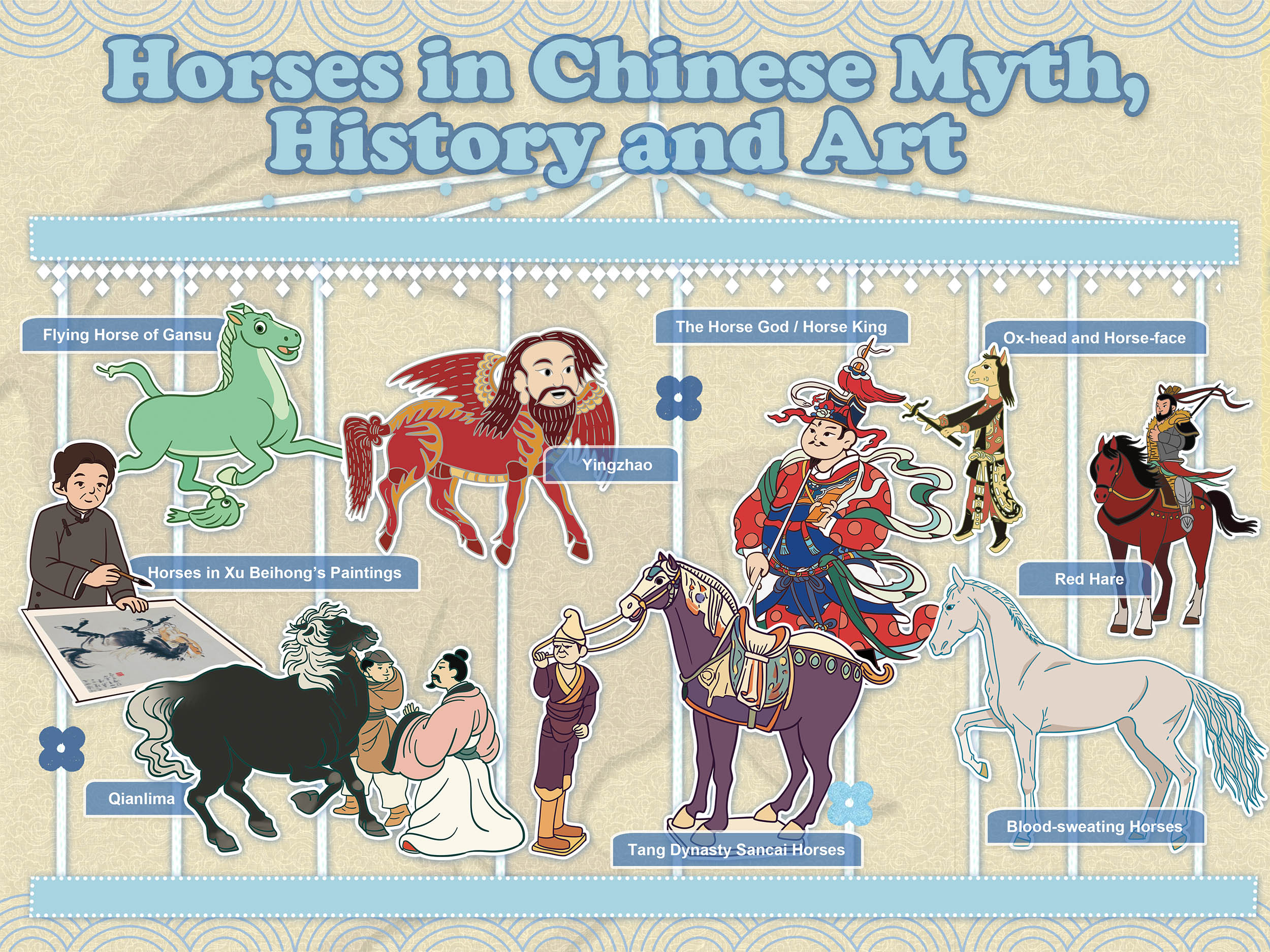

As the Year of the Horse approaches, explore how the horse’s enduring legacy is shaped by Chinese myth, history, and art.
From China’s earliest dynasties, horses were vital to transport, warfare, and daily life, while also carrying profound symbolic meaning in myth, ritual, and art. As the seventh sign of the Chinese zodiac, the horse came to embody speed, strength, loyalty, and a bond between the human and the divine.
Horses in Myth and Legend
In Chinese mythology and folklore, the horse is a divine creature: a messenger of the gods, a powerful deity, and a guardian of the dead.
1. The Horse God / Horse King (马神/马王爷)
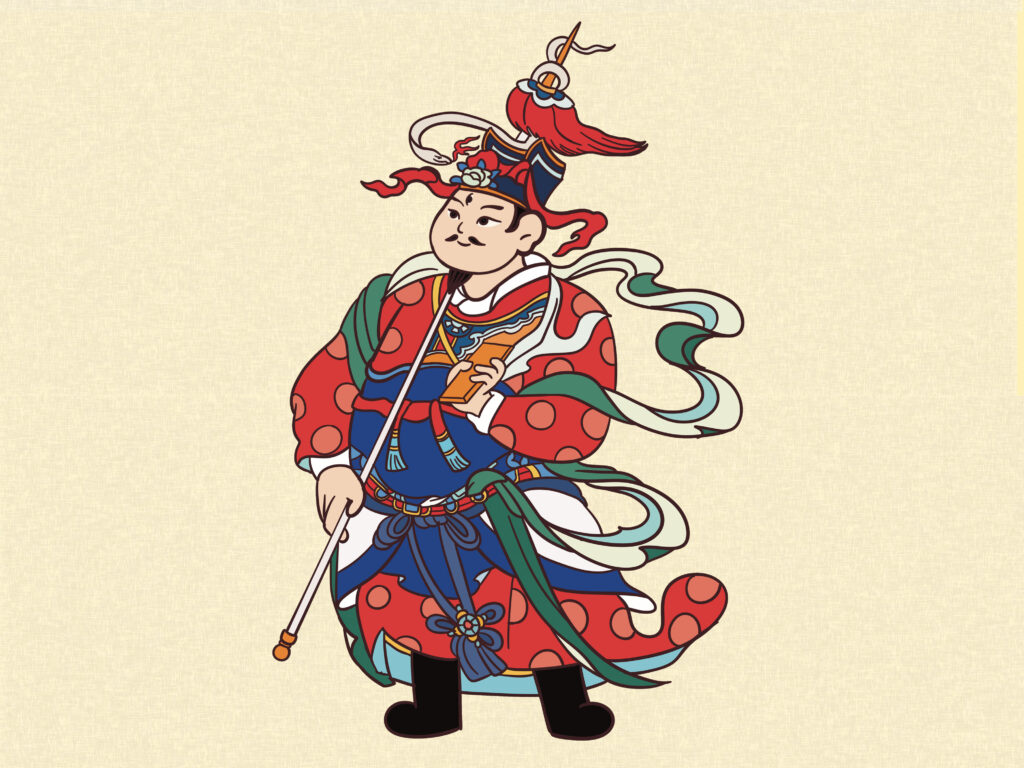
The Horse God, also known as the Horse King, is the deity who rules over and protects horses, mules, donkeys, and even other animals.
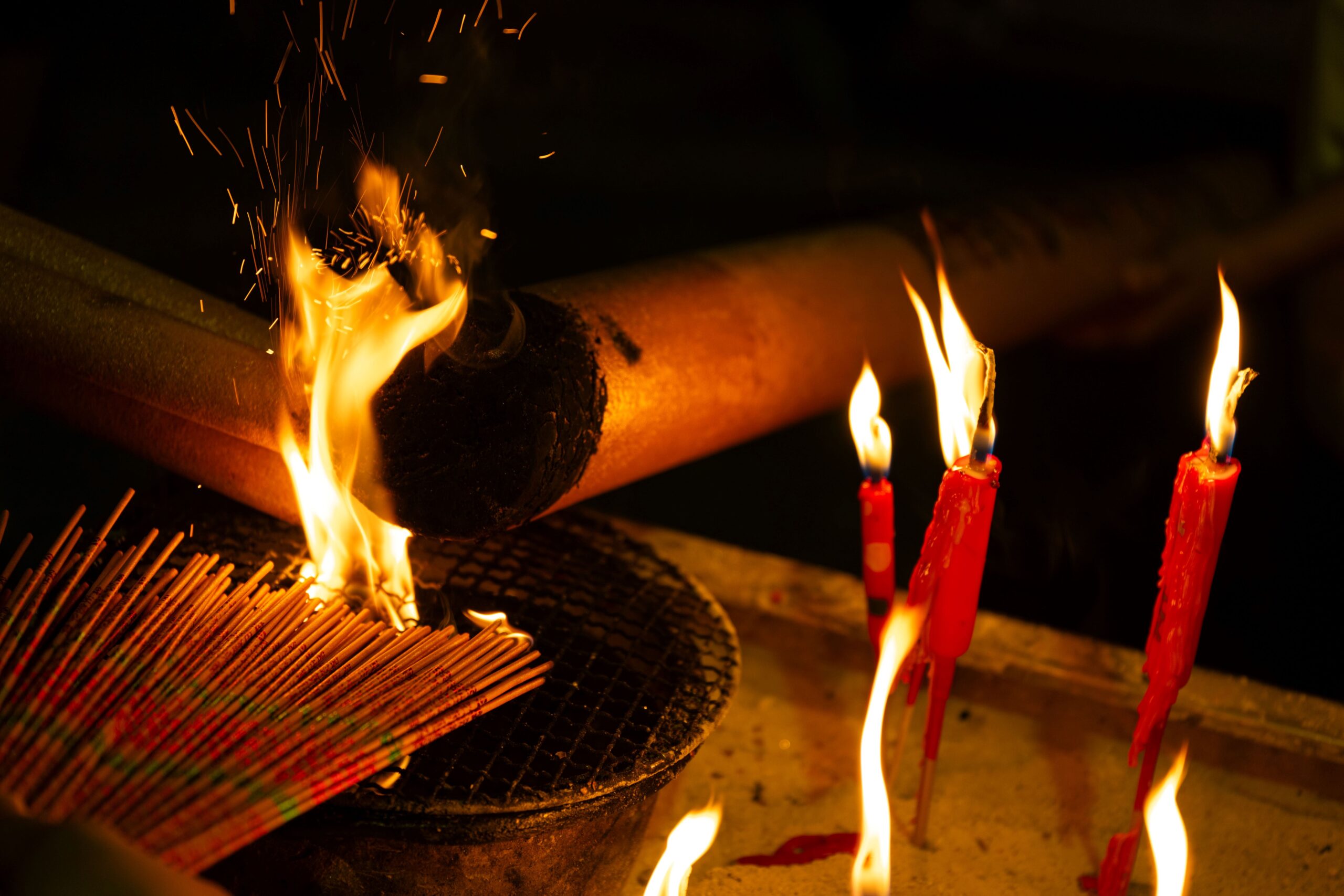
Worship and ritual offerings to the Horse God date back to the Zhou dynasty in China, around 2,800 to 3,000 years ago. By the Ming dynasty, roughly 380 to 650 years ago, these had become official state rituals, conducted under government supervision. Temples dedicated to the Horse God were built across the country, including a solemn temple within the Forbidden City in Beijing.
The Ancestral Horse Deity, regarded as the ancestor of all horses, was the earliest incarnation of the Horse God. Legend has it that he was once a dragon-horse belonging to the Queen Mother of the West (王母娘娘). However, after making a few grumbling remarks behind the Queen Mother’s back, he was reported by a crow who had overheard and banished to the mortal realm.
Over time, the Horse God gradually acquired more human characteristics. In folklore, he is referred to as the ‘Horse King’ and is believed to possess extraordinary discernment and the power to subdue demons and banish evil spirits.
2. Yingzhao (英招)
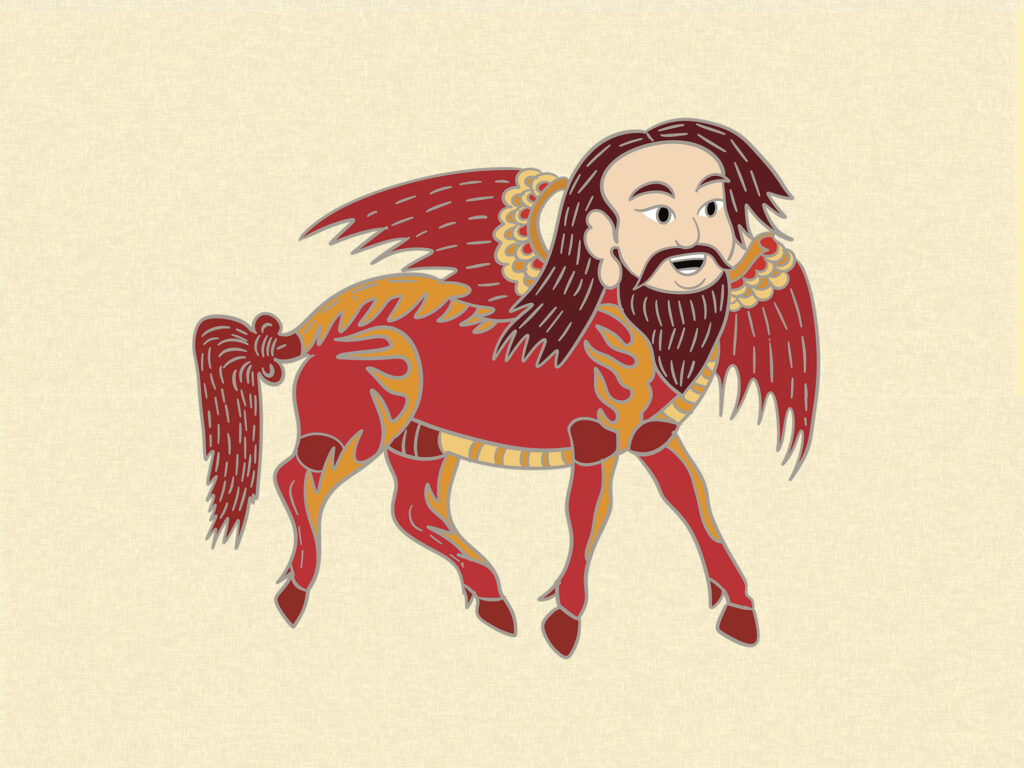
Yingzhao is another formidable horse from Chinese legend. He is a typical example in Chinese mythology of a hybrid figure combining human and animal traits. According to the Classic of Mountains and Seas (山海经), Yingzhao has the body of a horse, the face of a human, tiger-like stripes and a pair of wings. He serves the Jade Emperor (玉皇大帝).
Yingzhao frequently patrols throughout the lands, conveying the Jade Emperor’s commands, and has fought in countless conflicts against wicked gods.
As the Jade Emperor’s messenger, Yingzhao, being depicted with a horse’s body, reflects the horse’s strength and speed, qualities traditionally associated with power and courage.
In some folk traditions, Yingzhao is also revered as a god of livestock, charged with guarding the heavenly garden and the rare birds and exotic animals that dwell within.
3. Horse-face (马面)
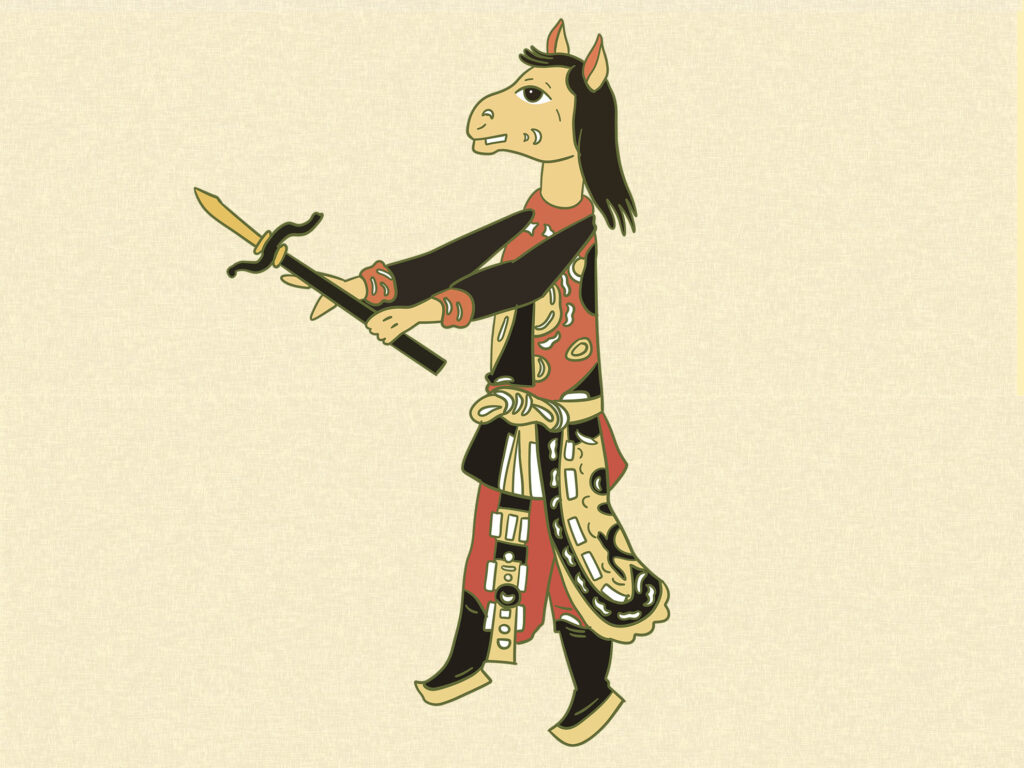
Horse-Face originated from Buddhism and was later incorporated into Daoism and popular folk belief.
Horse-Face, also known as the Horse-Head Rakshasa (马面罗刹), appears in the Shurangama Sutra, composed more than 1,300 years ago. Rakshasas are malevolent spirits, and the Horse-Head Rakshasa is the horse-headed evil spirit. He appears with the body of a man, but as his name suggests, the face of a horse.
Horse-Face is often paired with Ox-Head, a similar figure in Chinese mythology, and together, Ox-Head and Horse-Face serve as guardians of the underworld. They are also the agents of punishment and are worshipped as gods of the dead in folk religion. They escort souls to the underworld for judgment and then deliver them to their next place of reincarnation or punishment.
Horses in History and Popular Tales
Beyond historical fact, China’s celebrated horses endure as timeless symbols of talent and devotion.
1. Blood-sweating Horses (汗血宝马)
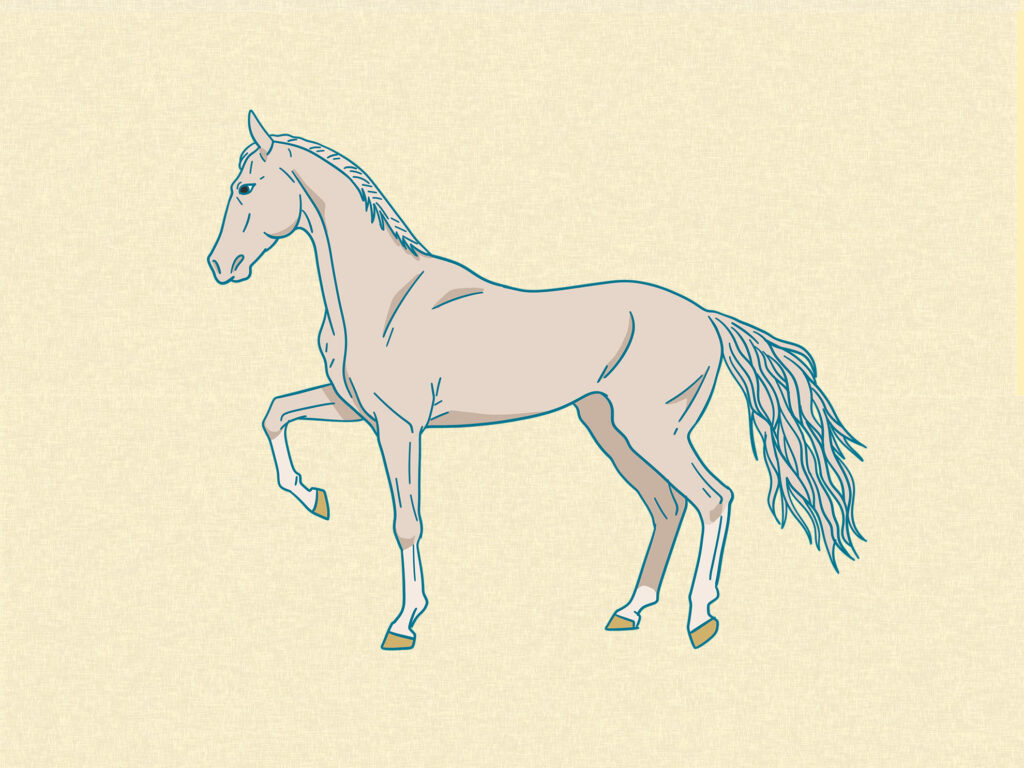
The Akhal‑Teke, known in China as the ‘blood‑sweating horse’, is famed for its speed and endurance. It is said to travel 1,000 li (about 500 km) in a day and 800 li (about 400 km) at night.
The earliest Chinese record of the ‘blood‑sweating horse’ appears in Records of the Grand Historian (史记) by Sima Qian, over 2,100 years ago. During the Han dynasty, the traveller and diplomat Zhang Qian travelled to the Western Regions and reported that the state of Dayuan (in what is now Uzbekistan and Turkmenistan) ‘produces excellent horses, their sweat being blood, descended from the Heavenly Horse’. The Akhal-Teke was introduced to China via the Silk Road.
The Akhal-Teke has thin skin, fine hair, well-developed capillaries and a tightly muscled body. It has almost no fat. When it runs, its veins stand out and its coat appears reddish in the sunlight, giving the impression of bleeding. This striking feature gave it the name ‘blood‑sweating horse’.
2. Red Hare (赤兔马)
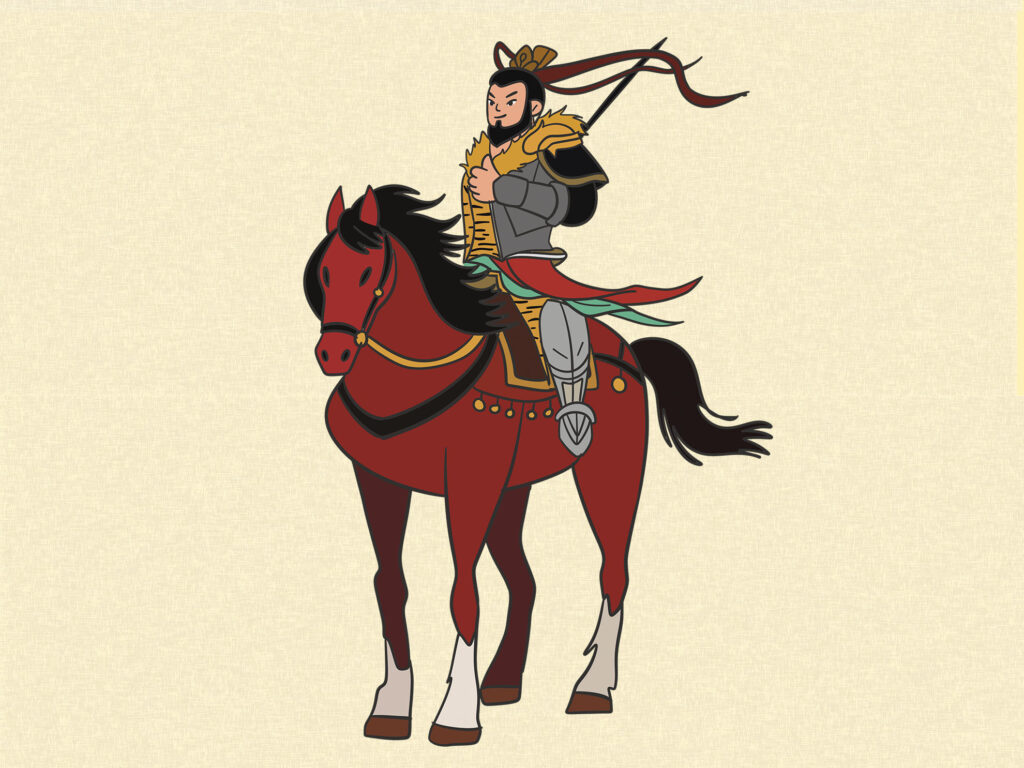
The Red Hare or Chi Tu (赤兔)was the legendary steed of the warrior Lü Bu during the Three Kingdoms period, over 1,700 years ago. In China, there is a proverb, ‘Among men Lü Bu, among horses the Red Hare,’ meaning the very best of its kind.
According to popular tales, the Red Hare’s original name was ‘赤菟’; 菟refers to a fierce beast, like a tiger or leopard, so 赤菟 was a crimson, formidable steed. Legend has it that after Lü Bu’s death, the horse came into the possession of Cao Cao, the warlord and chancellor, who later gave it to Guan Yu, the general and hero. When Guan Yu died, the Red Hare, mourning him, starved itself to death—a horse of loyalty and devotion.
3. Qianlima(千里马)
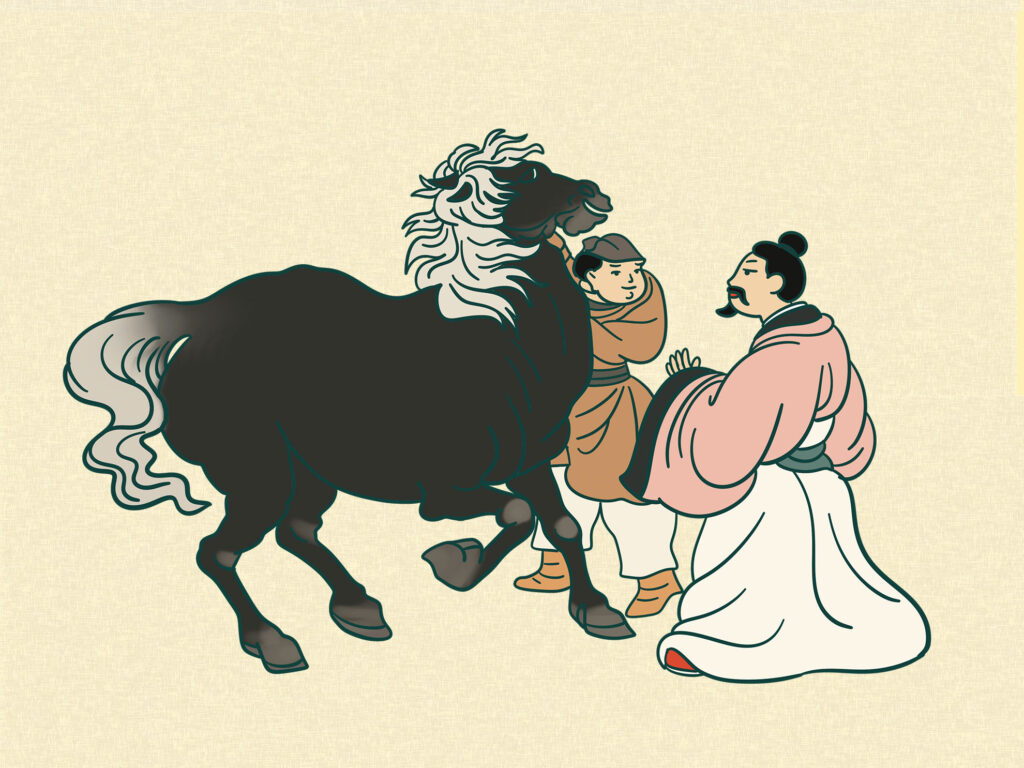
In Chinese, the term Qianlima, meaning ‘thousand‑li horse’, is often used as a metaphor for exceptional talent. The Tang‑dynasty writer Han Yu wrote in On Horses (马说): ‘Only when there is a Bole (伯乐) can there be a Qianlima. Qianlima are common, but Bole is rare.’ Bole was originally the name of a star, said to be an immortal in charge of heavenly horses.
During China’s Spring and Autumn Period, a man named Sun Yang was famed for his ability to recognise great horses. One day, he saw a horse struggling to pull a salt cart up a steep slope. Recognising it as a rare fine steed, Sun Yang bought it from the driver and presented it to the King of Chu. The king, seeing the horse so lean and weak, doubted its quality. Bole explained that it had been overworked and poorly cared for, and with proper nurturing, it would regain its strength. Indeed, after rest and careful feeding, the horse ran a hundred li in a single ride and achieved many victories in battle.
Because of Sun Yang’s extraordinary eye for horses, he came to be called ‘Bole’.
Horses in Artefacts and Art
Horses have inspired Chinese art for centuries, from bronzes and ceramics to modern paintings.
1. Flying Horse of Gansu (马踏飞燕)
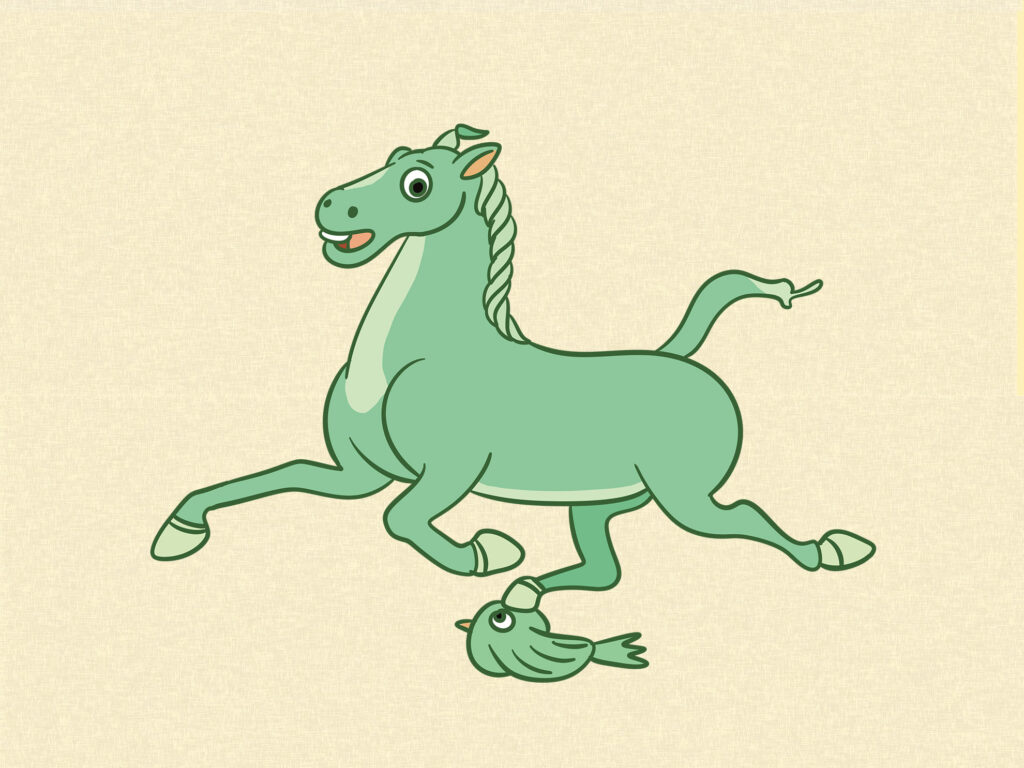
The Flying Horse of Gansu, also known as the Bronze Running Horse (铜奔马), was discovered in Gansu. It is a bronze burial object from a tomb dating back around 1,800 years. The tomb belonged to a general surnamed Zhang of the Han dynasty. The sculpture shows a powerful horse treading on the back of a swiftly flying bird, capturing the steed in mid‑air, full of speed and vigour.
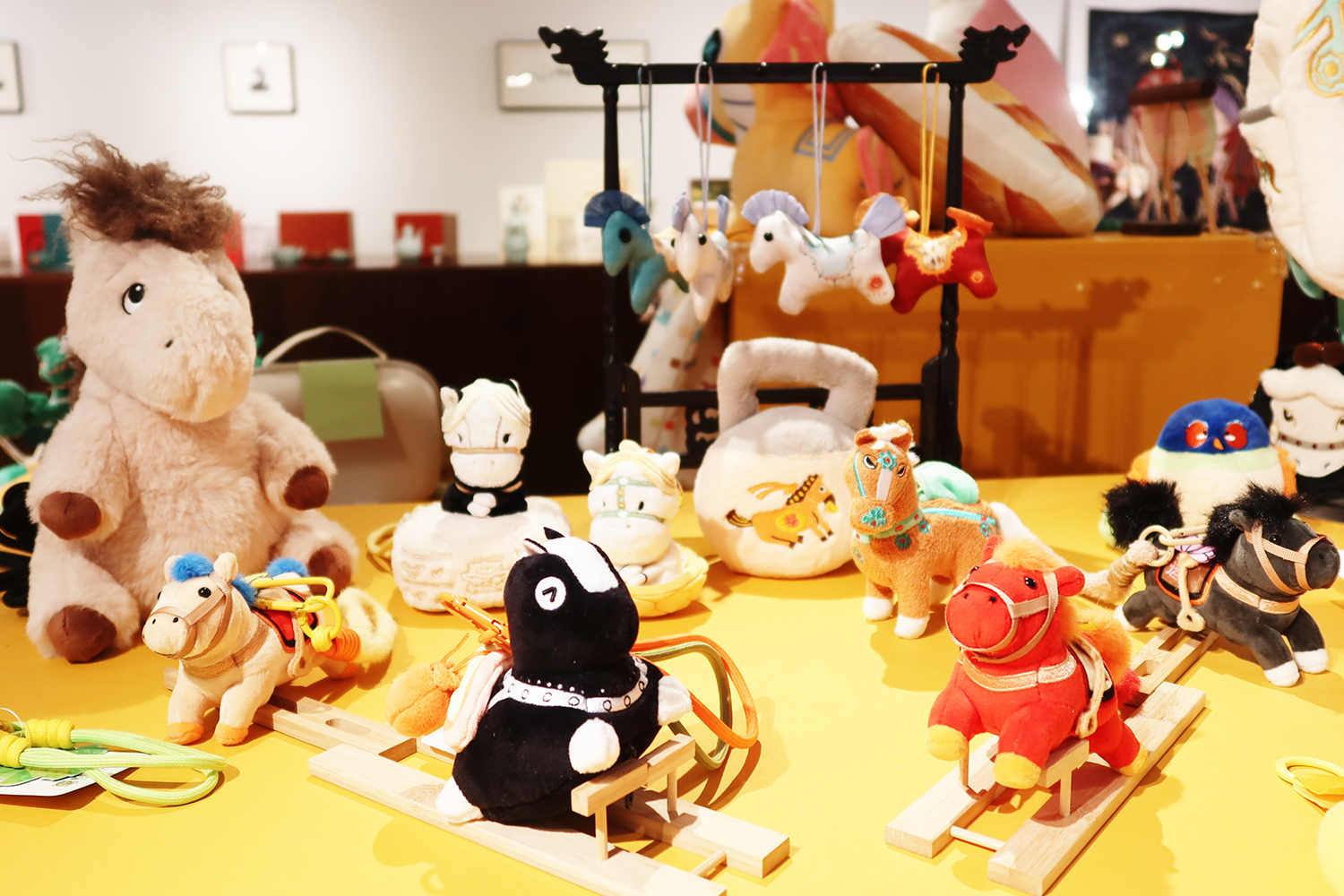
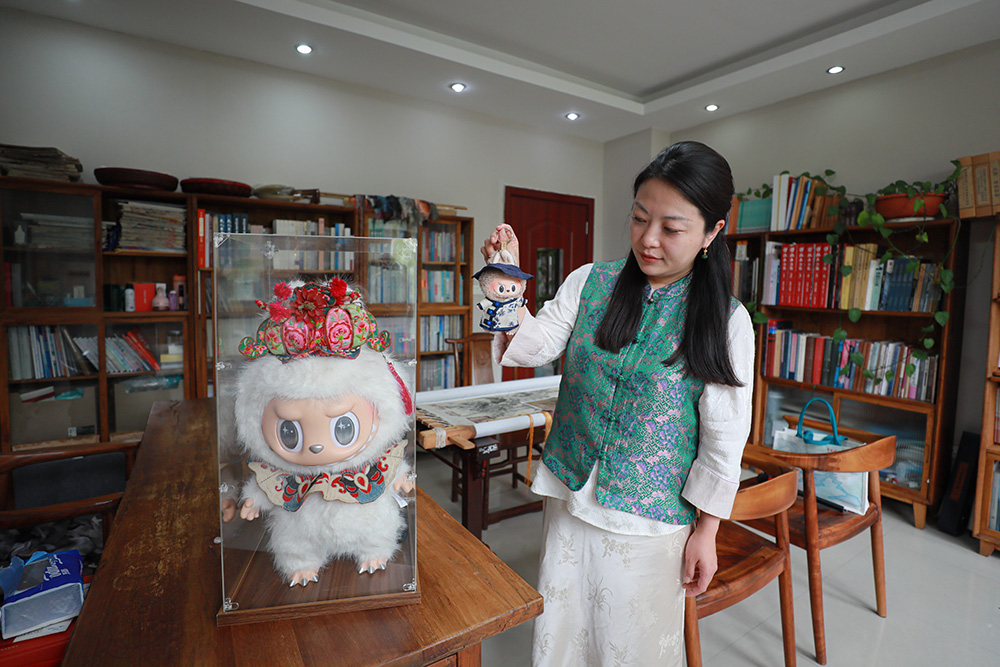
In recent years, the Flying Horse has become a popular exhibit at the Gansu Museum. The museum turned it into a cultural merchandise, producing a plush toy based on the sculpture; with its comically awkward design, it quickly became a best‑selling item.
2. Tang Dynasty Sancai Horses
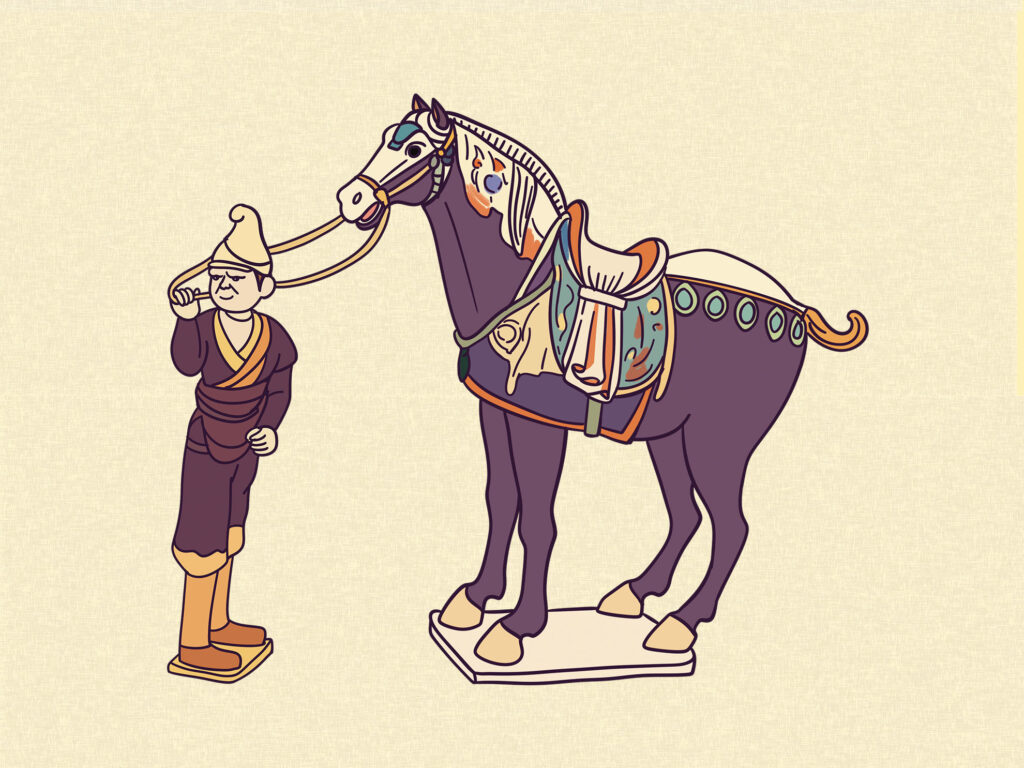
The people of the Tang dynasty placed great importance on horse training to defend against nomadic invasions. Horses were also essential for leisure and recreation, so artworks depicting them were abundant. Tang Sancai (三彩, ‘three colours’) is a type of ceramic popular during the Tang dynasty, featuring yellow, green, and white as the primary colours.
Tang Sancai horses are lifelike and full of character, with almost no two exactly alike. Some are captured mid‑gallop, others walking slowly; some raise their heads and neigh, while others lower them to nibble their hooves. These details show that Tang artists were not only familiar with the appearance of horses but had also studied their posture and temperament. Many Tang Sancai pieces also depict Central Asian figures leading horses or camels, indicating the significant role horses played in cultural exchange at the time.
3. Horses in Xu Beihong’s Paintings
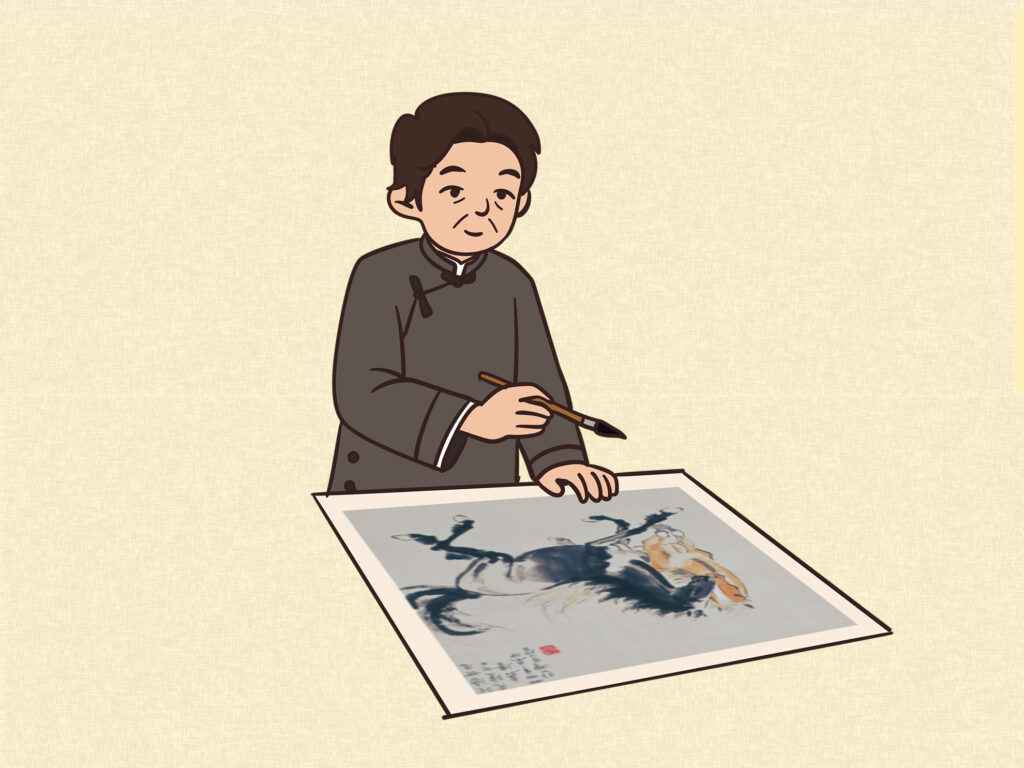
Xu Beihong, a modern Chinese master painter, was renowned for his skill in depicting horses. From the beginning of his self‑taught studies, he loved painting them, initially copying animal designs from cigarette boxes. In 1919, he studied in Europe and drew inspiration from Western approaches to portraying horses.
Starting in 1930, Xu began painting horses in ink and wash. Using traditional Chinese painting as his main medium, he incorporated Western realism, gradually developing his own style: bold, varied brushstrokes outlined the horses’ overall form; flying strokes captured manes and tails; precise lines defined key features such as the mouth, nose, and knees.
Xu’s horses are also known as ‘China’s most expensive horses’. On 20 October 2025, his 1944 work, Galloping Horse (奔马图), appeared on a judicial auction platform in Chongqing. The work was valued at an estimated 105 million yuan (approximately £11.2 million), with a starting bid exceeding 47 million yuan (£5 million).
Written by Estelle Tang, Illustrated by Yifan
If you liked this article, why not read: China Issues the Bingwu Year Special Stamps