
Discover how international artists transform rural life in Lishui, China, through a distinctive art residency that fosters connections between local culture, craft, and creativity.
52Hz: A Song Heard in a Riverside Village
Along the quiet banks of the Ou River in Zhejiang, a new rural art residency invites digital nomads and international artists to rethink how we live, listen, and connect.
Meanwhile, the name “52Hz” comes from the story of the so-called world’s loneliest whale, whose song goes unheard by others. For many digital nomads, it’s a familiar metaphor: drifting lightly, sometimes feeling isolated, yet occasionally finding resonance.
This autumn, that resonance appeared in Guyan Huaxiang, a riverside art village in Lishui, Zhejiang. Nestled in the ancient town of Dagangtou, the village carries traces of a thousand-year-old irrigation system and the Ou River’s shipping culture, thus combining Jiangnan’s quiet charm with the textures of working riverside life. Visitors photograph the riverbank, art students set up their easels, and elderly residents rest under the shade of camphor trees.
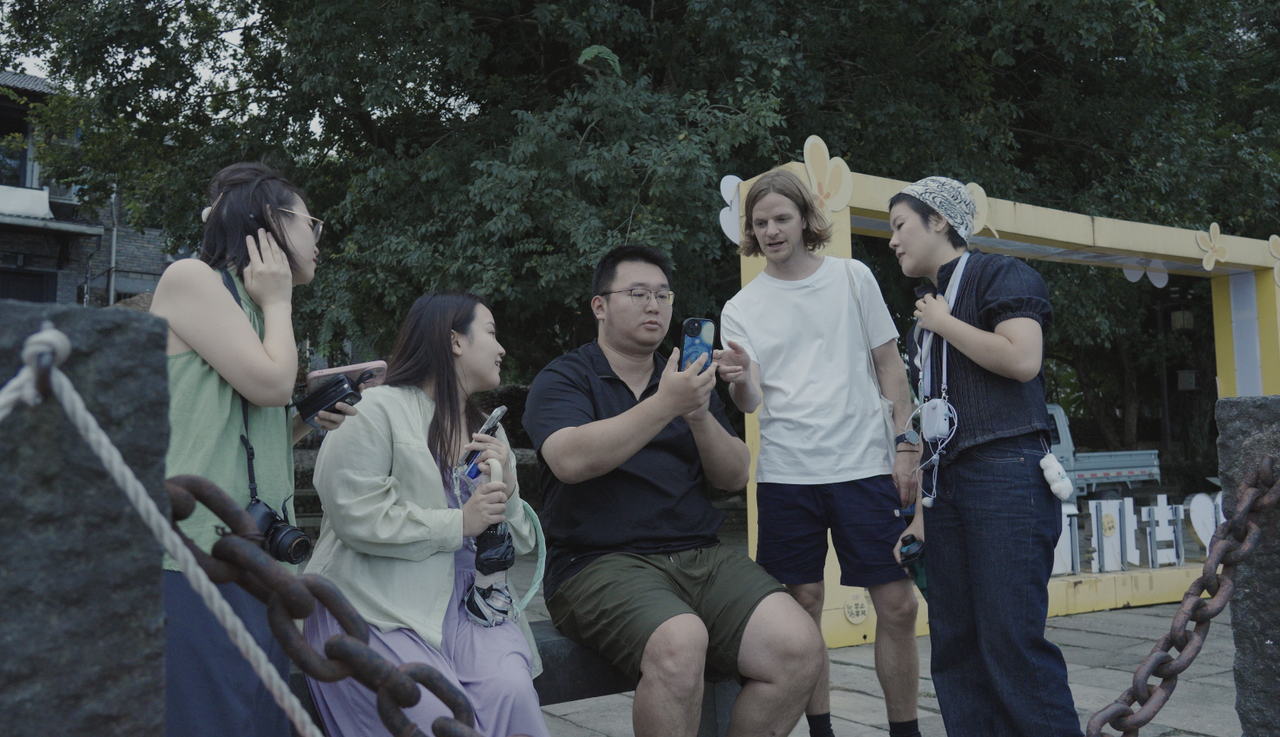
Into this landscape, four international artists—Helen Frosi, Oliver Eglin, Ise Sharp, and Jade Gaskin—participants of “Wild Moods.” For a year, 52Hz has used the village as a creative base. Young creators from design, research, filmmaking, craft, and performance collaborate here, exploring life “beyond the office” and infusing the village with fresh creative energy. Together, the artists asked a shared question: in an age of speed and disconnection, how do we build genuine connections again?

Stories of Connection
Oliver: Seeking Stories Behind Doors
British visual artist Oliver Eglin uses photography to slow down and connect. He rarely uses digital cameras. Film gives him a reason to talk to strangers.
“I can ask, ‘May I take your photo?’ It becomes a passport into someone’s world.”
His subjects weren’t spectacles. They were fishermen, fruit sellers, and old men resting by their doors. Each shutter captured a quiet exchange, a moment of human connection. For Oliver, art begins with connection, not expression.

Helen: Listening to the River’s Pulse
Helen Frosi turned inward. A British artist and curator, she works across sound, ecology, and sensory experience. Before coming to China, her paintings were tense and swirling. In Guyan Huaxiang, the river and mountains softened her brushstrokes. Calm seeped in.
Helen also led a workshop called “Plangent Vessels,” inviting participants to feel subtle vibrations in ancient camphor trunks. For her, deep listening is a way to reconnect with the more-than-human world.

Jade: Giving Life to the Inanimate
Jade Gaskin embraced local crafts—wood carving, ceramics, and ink painting—and celebrated their imperfections.
“I want the teapot in my painting to grow legs and walk,” she joked.
Jade blends traditional forms with her energetic, chaotic style, experimenting with glazes, shapes, and motifs, letting Chinese aesthetics mix with her own visual language.

Ise: An Inner Landscape Transformed
For Ise Sharp, the residency sparked an internal shift. Her style changed from tense and fragmented to soft and spacious. The experience itself became the most important “work” of the residency.
Living in a digital nomad community gave her an intimate view of contemporary China.
“People here are incredibly communal and creative. They organise events, cook together, share skills, and support each other. Many left long-hour corporate jobs to build another way of living.”

Art, Relationships, and Local Impact
As “Wild Moods” ended, the four artists left with different works but a shared feeling: they had rediscovered connection—quiet, tangible, and rooted in everyday life.
Xie Yunyao, project director, reflected on the residency’s core intention: “My goal was to create a space where culture could be genuinely ‘exchanged,’ rather than a one-way ‘showcase.’ I’m glad that Chen Sangyu, who co-managed the international residency, shared this vision. All our subsequent work revolved around this principle. Now, these artists have become our best ‘cultural ambassadors.’ When they return to their countries, they bring back not only artworks but also friends, stories, and a true sense of rural China.”
Residents were amazed. Children joined workshops and learned directly from international artists—“studying abroad without leaving home,” parents said. Artists and local craftsmen became close friends, practising wood carving, ceramics, and painting together. Some now plan future collaborations and ways to bring local crafts overseas.
The residency left several tangible outcomes: a documentary supporting cultural tourism, international “storytellers” who will share rural China experiences globally, and a collection of artworks, including paintings, ceramics, and mixed-media pieces.

Echoes of Wild Moods
With support from the Liandu District People’s Government, more projects are already underway. The community recently released the Digital Nomad Co-Creation Resource White Paper, helping creative workers start projects in Lishui. Over ten cultural and tourism projects are currently incubating. Lishui has also introduced new policies—“Eight Measures to Support Digital Nomads”—to attract talent and encourage long-term creative settlement.
“Wild Moods” wasn’t about producing masterpieces. It was about learning to look, listen, and share an afternoon with someone you’ve just met. In Guyan Huaxiang, the most meaningful art turned out to be life itself. Sometimes, the wildest thing you can do is slow down. And sometimes, connection arrives where you least expect it.
Like the 52Hz whale, the artists’ voices found resonance here, not in the vast oceans, but in the small, slow rhythms of riverside life.
Photo credits: Zeng Wenxiong and Liu Yueming; provided by the project team.
If you liked this article, why not read Young Explorer Program Day 5: Embracing Jiangnan Water Village Culture