
The Xixia Imperial Tombs was inscribed as a World Heritage Site at the 47th session of the UNESCO World Heritage Committee held in Paris, France, on July 11, becoming China’s 60th entry on that list.
Multicultural Interactions in Northwestern China
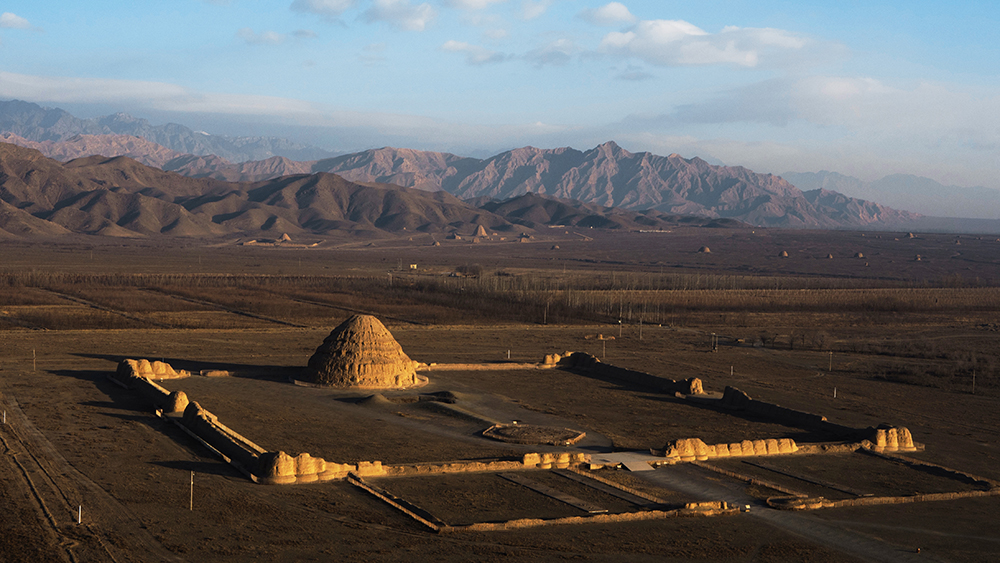
The Xixia Imperial Tombs is located in the eastern foothills of the Helan Mountains in Yinchuan, Northwest China’s Ningxia Hui Autonomous Region. It is also renowned as the “Oriental Pyramids,”
The site is a royal mausoleum complex of the Xixia Dynasty (1038-1227). The tombs constitute the largest, highest-ranked, and most intact archaeological site from the Xixia period that has survived to the present day.
To date, this site has uncovered nine imperial tombs, 271 subordinate tombs, 32 flood control sites, and more. There are over 7,100 architectural components and finely crafted artifacts found at the site.
Historical records indicate that during the Xixia Dynasty, various ethnic groups, including the Tangut, Han, Uygur, and Tibetan, coexisted. Their diverse livelihoods, religious practices, and cultural customs enriched the Xixia’s heritage, shaping its distinctive and multifaceted cultural identity.

Systematic Protection and Sustainable Use
“The application effort has demonstrated China’s ongoing commitment to strengthening the holistic and systematic protection, preservation and sustainable use of its cultural and natural heritage,” said China’s Vice Minister of Culture and Tourism Rao Quan.
Regarding follow-up work related to the Xixia Imperial Tombs, the official pledged to further strengthen heritage protection, advance academic research in archaeology and cultural relics, strengthen the capacity of heritage management institutions. At the same time, the official will enhance the systems for showcasing and interpreting the site’s cultural value.

This year marks the 40th anniversary of China’s accession to the World Heritage Convention.
At the 47th session of the UNESCO World Heritage Committee, 26 newproperties are inscribed to the World Heritage List. They are 24 cultural properties, four natural properties, and one mixed property.
Written by Yetao Gu, additional reporting by Xinhua and Global Times
If you liked this article why not read: The Grand Canal’s Journey: From Ancient Route to Global Icon