
The “Intangible Cultural Heritage Sichuan • Hundred Cities Hundred Arts” Yanbian • Lisu Ethnic Costume Fashion Show recently took place during China International Fashion Week (Spring) in Beijing. The show not only revitalized the patterns, colors, and craftsmanship of the Lisu and Yi ethnic groups but also seamlessly blended traditional elements with modern fashion.

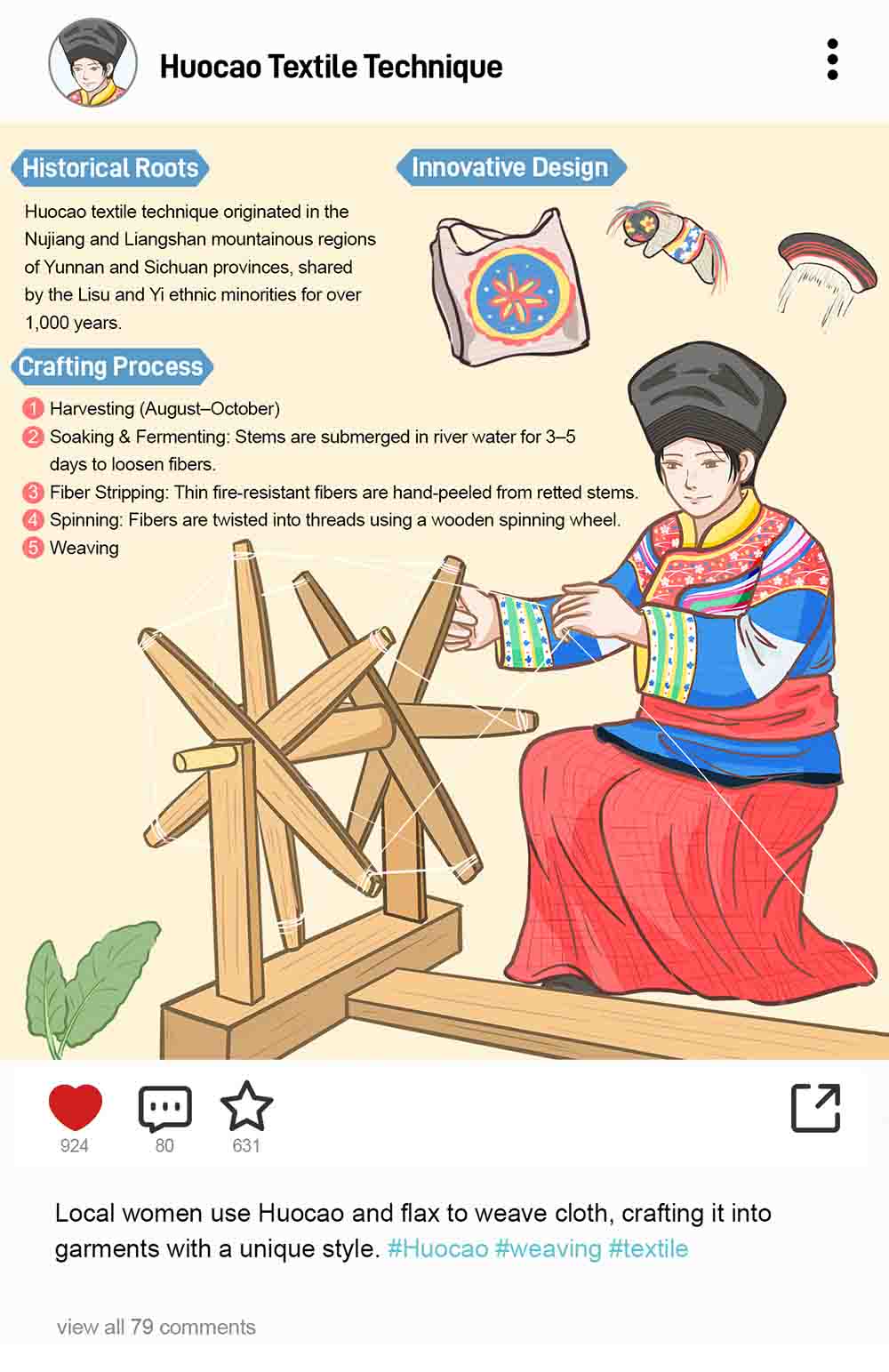
There is a precious textile material, Huocao (a type of fibrous herb) thread in the mountains of southwest China. This thread, due to its careful processing, boasts a unique texture and natural fragrance. Local women skillfully use ancient weaving techniques to transform Huocao thread into distinctive Huocao cloth.
The Huocao Textile Technique mainly relies on Huocao and flax plants as raw materials. Huocao thrives in humid pine forests and shrublands at altitudes of 1,800–2,600 meters. It sprouts in April and flourishes from July to August, with the leaves displaying translucent white fibers on their underside. Weavers select the larger leaves for weaving, while flax provides the flexibility needed for the textile.

From June to August each year, Yi and Lisu women actively gather Huocao from the mountains. After washing the leaves, they peel the fresh white fluff and twist it into threads. To produce flax threads, they soak the stalks, strip the bark, and spin the fibers. The weavers then use flax as the warp and Huocao as the weft, arranging the threads on looms. They pedal rhythmically, interlock two shuttles, and weave the Huocao linen.
The entire process, from raw material to finished product, involves 72 intricate steps. These steps include soaking the flax, stripping the bark, cutting the threads, spinning, and boiling. Weaving a 230cm×23cm cloth usually takes 15 hours, while crafting a garment may take several months.
Today, the Huocao Textile Technique proudly holds a place on the Yunnan Provincial Intangible Cultural Heritage List. Local women have also created their first cultural product—the Cimi Sachet (meaning “monkey” in the Lisu language). These insect-repellent sachets, shaped like baby monkeys, are sewn onto children’s clothing as blessings. With support from the local government, Cimi sachets are now sold as car pendants, bracelets, and other accessories.
Written by Yi Shen, Poster designed by Di Wang.
If you liked this article why not read:【Trending Code】How Sticky Paste Dyeing Technique Get Global Recognition