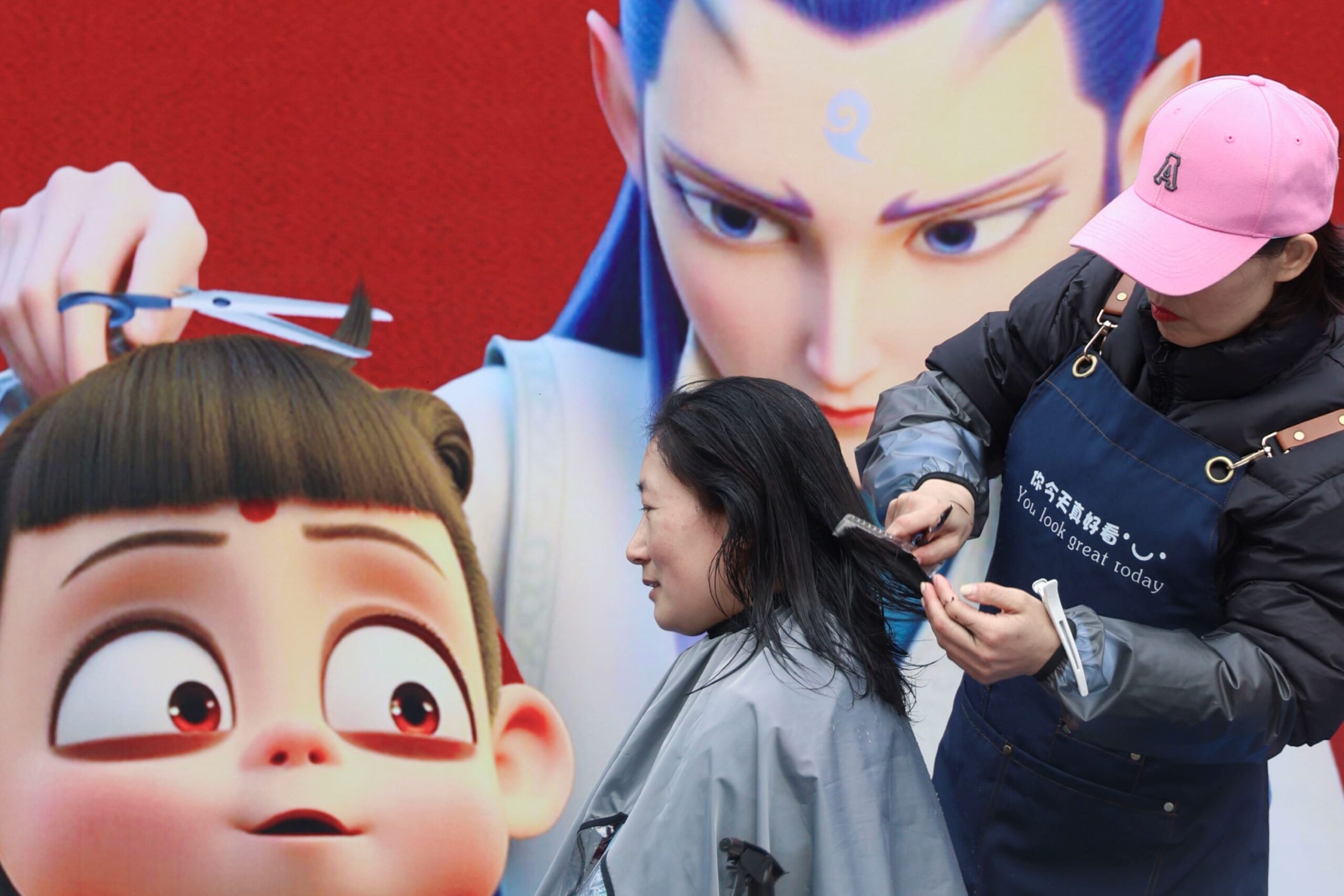

Barbershops across China see a surge in customers, with children’s salons offering creative styles like “dragon haircut” and Nezha-inspired designs.
March 1st marks the second day of the second month in the Chinese lunar calendar, a day known as “Dragon Raises Its Head” (Longtaitou, 龙抬头). Many people across China visit barbershops for a haircut, believing it will bring good fortune for the new year.

In Changchun, Jilin Province, a children’s barbershop was bustling with activity as parents brought their children for haircuts. To make the occasion even more special, the barbershop offered creative and playful hairstyles. The animated film Nezha 2, a major hit during the Chinese Spring Festival, inspired some barbers to skillfully design Nezha’s image on the back of children’s heads, adding a festive touch.

Meanwhile, in Beijing, major barbershops saw a significant surge in customers. Many opened early in the morning to accommodate the demand. Some barbershops organized voluntary haircut events. They offered free haircut to inheritors of intangible cultural heritage, sanitation workers, property staff, and couriers. Other essential service providers also benefited from the initiative.

A Day of Tradition, Renewal, and Prosperity
The tradition of “Dragon Raises Its Head” is deeply rooted in ancient Chinese astronomy and agricultural customs. Ancient Chinese observers divided the stars near the equator and ecliptic into 28 constellations. These constellations were grouped into four celestial palaces: Azure Dragon in the east, Vermillion Bird in the south, White Tiger in the west, and Black Tortoise in the north. In this astronomical event, the “dragon” refers to the Azure Dragon of the East. Its head is represented by the Jiao constellation (角宿). The phrase “Dragon Raises Its Head” describes the Jiao constellation gradually rising from the eastern horizon. This phenomenon symbolizes the arrival of spring.
For ancient agricultural societies, celestial observations guided the timing of farming activities. The second day of the second lunar month typically falls around the Jingzhe (惊蛰) solar term, a period associated with the awakening of insects and the renewal of life. This time marks the transition to spring, making it an ideal moment to begin farming and embrace new beginnings.