
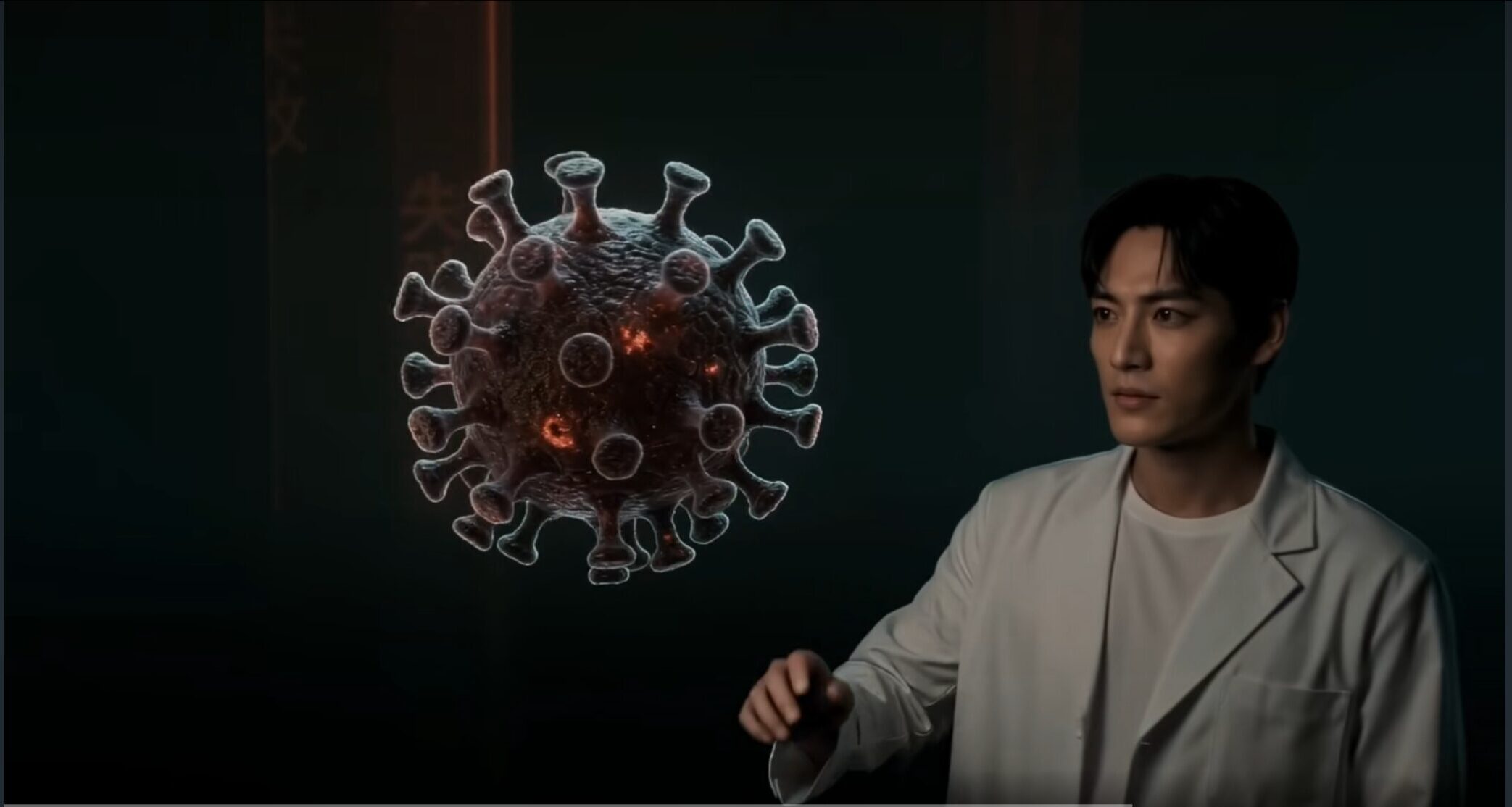

A Chinese creator made the AI short drama Guixu largely on his own. Its success shows how AI is changing filmmaking in China.
A young Chinese creator has made a sci-fi short drama largely on his own. He wrote the script, designed the shots, generated characters and scenes with AI, and handled post-production.
The result is Guixu, an AI-produced short drama that has attracted more than 100 million views across Chinese online platforms since its release in late March.
The project has cost nearly 200,000 yuan (about £21,500). Each eight-minute episode takes about seven to 15 days to complete. Yet its most striking feature is its small production team: for most of the work, there was just one person.
That setup shows how generative AI is lowering the barriers to film and television production in China. However, easier access to the technology does not necessarily make it easier to create a compelling story.
From Images To Stories
Guixu follows a post-apocalyptic sci-fi story. Strange changes begin to appear across a city, from streets and residential buildings to underground spaces. The story eventually develops into a global biological crisis.
A production of this scale would normally require actors, sets, visual effects and a sizeable crew. AI, however, allowed creator Jiang Lan to handle much of the process himself.
Jiang studied art at university and later worked in visual design. He first encountered AI through his work, using it to analyse products and create images and short videos.
He had long been interested in science fiction, disaster stories and biological mutations. In February 2026, the release of ByteDance’s Seedance 2.0 showed him a way to turn those ideas into moving images.
Jiang uses different AI tools at different stages. Large language models help him organise research and develop the story world. AI also helps create characters, locations, creatures and shots. Music and some sound work can be generated or refined with AI as well. The soundtrack also adds to the atmosphere, giving some scenes a cinematic sense of scale.
However, the process is far from one-click production.
Some complex shots require repeated adjustments. In some cases, a prompt for only a few seconds of footage can run to more than 1,000 Chinese characters. “AI is like handing a virtual film crew to the creator,” Jiang told the Global Times. “But the director still needs to know what they want to express.”
Other young creators are taking a similar path.
Hu Hai, born in 2001, formed a three-person team with two other young creators to make the mystery and horror series Reverse Land. The series has released three episodes, each receiving more than 1 million likes on Douyin.
For Hu, AI has lowered a barrier that once kept small teams out of film production. “AI handles efficiency, while humans remain responsible for aesthetics, the script and the core content,” he said.

Lower Barriers, Higher Standards
China’s AI short-drama market is expanding rapidly. DataEye estimates that the domestic AI drama and animation market exceeded 22 billion yuan (about £2.4 billion) in the first five months of 2026 and could reach 40 billion yuan (about £4.3 billion) for the full year. The number of domestic AI short-drama users also surpassed 600 million in the first half of the year.
The rapid growth, however, has also brought a familiar problem: quantity does not always lead to quality.
Many AI short dramas rely on familiar formulas and fast-moving plots. As a result, viewers can encounter similar stories, characters and visual styles.
Guixu has attracted attention for taking a different approach. Several Chinese film and television bloggers have described it as a high-quality production made by one person. More importantly, viewers have begun discussing its plot and world-building rather than simply asking how the images were generated.
That distinction matters, said Lv Fan, an associate research fellow at Peking University.
In his view, Guixu does more than show that AI can produce impressive images. It encourages audiences to judge AI-generated content as a creative work rather than simply as a technology product.
Many AI works, he said, lack a visible creator. Their stories can feel as if “a machine is simply running through a plot”, rather than expressing a creator’s own ideas.
Guixu, by contrast, has a clear world and a defined set of values. It also builds suspense gradually instead of relying only on visual spectacle.
That difference becomes clearer as the story unfolds. At first, Guixu can seem mainly like a showcase of what AI can do, with highly realistic images and striking scenes of strange creatures. As the plot moves forward, however, the focus shifts towards the people caught in the crisis.
The story begins with humans facing attacks from strange creatures and trying to understand and fight them. It later introduces characters who cross the boundary between humans and the mutated beings for deeply personal reasons. These storylines bring questions of survival, sacrifice and identity into the wider conflict.
The series also gives space to quieter moments. Lv pointed to a brief conversation between the male lead and an older woman in the first episode. The exchange lasts less than a minute, but he said it feels close to everyday life and captures the relationship between neighbours in a modern city.

What Remains Human?
The rise of AI-generated actors has also sparked debate over whether digital performers could replace human actors.
Lv believes replacement is not necessarily the most important direction. Instead, AI could reshape acting and eventually create new forms of performance.
The challenge is therefore changing. Early AI-generated videos often struggled with visual inconsistencies. Today, creators face a different problem: how to build recognisable characters, convey emotion and keep audiences engaged.
For Jiang, AI itself is unlikely to remain a long-term advantage. As the technology becomes easier to access, more creators will be able to produce similar visual effects.
What may become more valuable, he believes, are personal style, strong storytelling and the ability to build a coherent world over time.
That is also why AI does not necessarily mean quick profits.
Each episode of Guixu takes about seven to 15 days to make, and the project’s total investment has approached 200,000 yuan. The series has not yet generated advertising revenue. Jiang’s main income has come from platform revenue sharing.
He therefore advises newcomers to experiment with AI short dramas as a side project before making a full-time commitment.
Meanwhile, Jiang has also uploaded Guixu to YouTube, hoping to reach audiences outside China. He believes science fiction and disaster stories can travel more easily because they rely less on specific cultural backgrounds.

Additional reporting by Gaokai.
If you liked this article, why not read: What Happens When AI Runs One of China’s Busiest Ports?


