
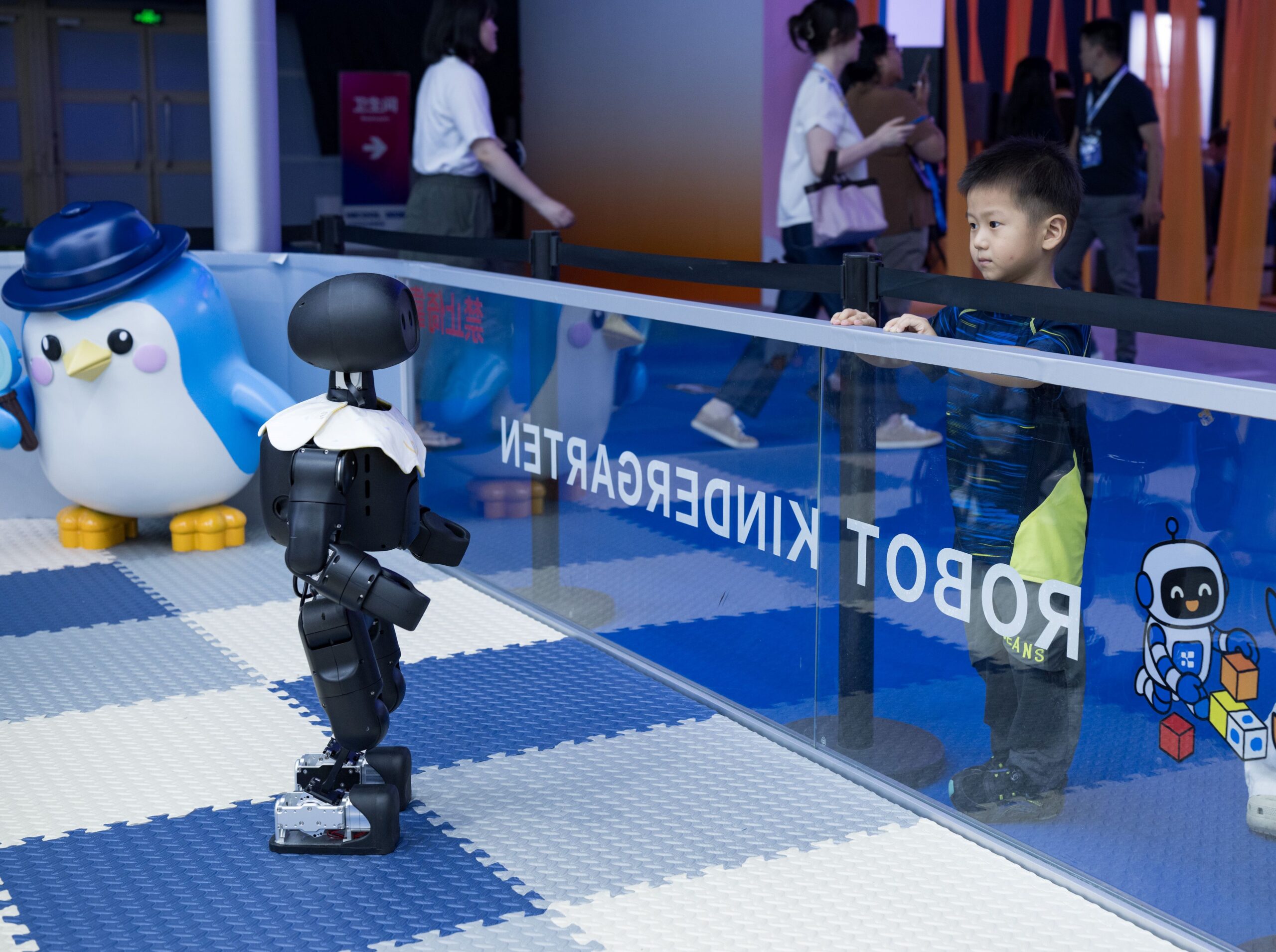

A “Robot Kindergarten” backed by Turing Award winner Richard Sutton is showcasing how robots can learn through interaction and trial and error.
The four-day HICOOL 2026 Global Entrepreneur Summit opened in Beijing on Aug. 26th, bringing together more than 600 exhibitors and thousands of entrepreneurs from around the world.
The opening ceremony also saw awards presented to winners of the HICOOL 2026 Global Entrepreneurship Competition. Launched in May, the competition attracted 10,209 projects and 13,472 entrepreneurs from 141 countries and regions. Overseas projects accounted for 56 per cent of the total.
Since its launch in 2020, the HICOOL Global Entrepreneurship Competition has helped produce five listed companies, 18 unicorns and 219 specialised and innovative enterprises. Award-winning projects have raised more than 71.9 billion yuan (about £7.9 billion) in total financing.
Among the projects on display, a “Robot Kindergarten” drew particular attention.
The project was jointly developed by Richard Sutton, winner of the 2024 Turing Award and a pioneer in reinforcement learning, and Tashan Technology. It provides a training environment where robots learn through direct interaction with the physical world.
So, what exactly is a “Robot Kindergarten”?
China Economic Net describes it simply as a new type of training ground for robots. Here, robots do not simply copy human actions. Instead, they explore their surroundings, observe the results and adjust their behaviour based on feedback.
For example, a robot can interact with real objects and learn what happens when it pushes, grasps or moves them. It can then change its actions and try again. Through this process, it gradually builds up its own experience.
The approach combines reinforcement learning with tactile technology developed by Tashan Technology. Tactile sensing allows robots to detect physical contact and changes in their surroundings. Reinforcement learning helps them adjust their actions based on the results.
This matters because robots often perform well in controlled environments but face greater challenges when dealing with unpredictable objects and situations in the real world. Learning through physical interaction could help them adapt more effectively to such situations.
The project is also part of a broader effort to develop embodied intelligence. This approach enables AI systems to perceive and interact with the physical world through robotic bodies.
The “Robot Kindergarten” is expected to open in Beijing in September as a joint laboratory focused on tactile sensing and continuous robot learning.
Interestingly, the facility will bring together robots and children. While robots learn how to interact with their surroundings, children will take part in activities designed to encourage curiosity and exploration.
The “Robot Kindergarten” offers a glimpse of a growing approach to embodied intelligence: helping robots learn not only from human demonstrations, but also from their own experience in the physical world.
If you liked this article, why not read: Household Robots Shine at World Robot Conference


