

Global young sinologists are pursuing genuine internal insight into Chinese civilisation by transforming from observers to participants.
How can one move beyond a superficial understanding and truly enter the inner fabric of a civilisation? This is not only a methodological challenge but also one of identity and perspective. At the 2026 New Sinology Program Doctoral Pre-camp, jointly organised by the Centre for Language Education and Cooperation together with leading Chinese universities, including Renmin University of China, and prominent Chinese scholars, young researchers from Germany, Türkiye, South Korea and other countries are seeking answers through their academic journeys. Their experiences suggest that moving from an “outside observer” to an “inside participant” is essential to developing a deeper understanding of China.
For many overseas students passionate about China, the greatest obstacle is often neither language nor access to academic literature, but an intangible sense of academic distance. Moritz Kuhlmann, a young German Sinologist pursuing dual doctoral degrees at Ludwig Maximilian University of Munich and Renmin University of China, understands this well. His research focuses on the Sinicisation of Marxist philosophy.
Speaking at the pre-camp, Kuhlmann admitted that in Chinese universities, simply being an exchange student or visiting scholar makes it difficult to become genuinely integrated into the academic community. “Only by gaining an internal identity—becoming part of a supervisor’s research team and contributing to the university community—can you develop a true sense of belonging and carry out more in-depth research,” he said.
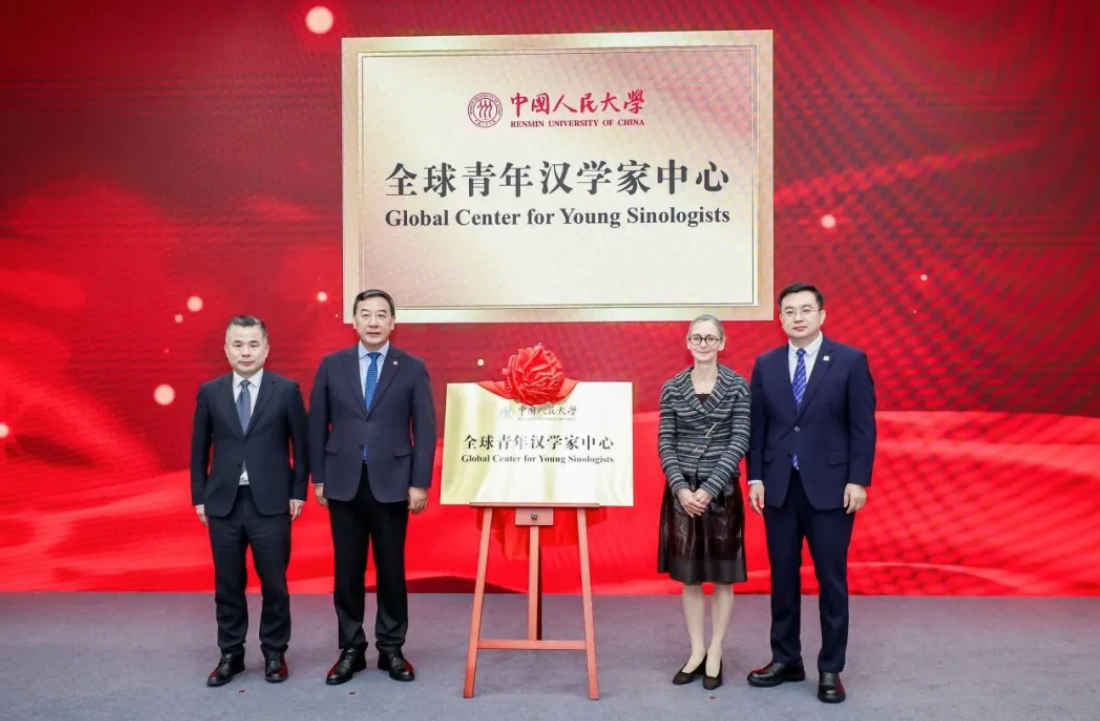
Kuhlmann also noted that on January 9, the world’s first Young Sinologists Centre was established at Renmin University of China, allowing him and his fellow students to help build a new academic platform. Being a co-builder of this initiative, he said, has made him feel that his research is truly connected to China’s academic landscape.
This transformation of identity has also expanded both the depth and scope of research topics. Zehra Simsek, a doctoral student at Central China Normal University, discovered during the pre-camp that she was the only participant from Türkiye. This unique position helped her better define both her academic direction and her sense of mission.
“My country needs a new generation of scholars who can genuinely understand China,” said Simsek, whose current research examines representations of China in British and American literature. Her aspiration has grown beyond serving merely as a bridge between China and Türkiye.
“A bridge simply transfers knowledge or information between two sides,” she explained. “I hope to become a ‘node’ instead.”
To her, this shift—from a transmitter of knowledge to a producer of locally grounded knowledge—best embodies what it means to be a participant. Her proposed doctoral research will focus on narratives about China in Turkish digital media, aiming to establish a direct framework for discourse analysis that moves beyond existing cross-cultural communication models, which are often shaped by Western-centric perspectives.
Throughout the event, many participants filled their notebooks with practical information—from how to access GIS platforms and search Chinese classical literature databases to tips on writing research proposals, as well as introductions to prospective supervisors and their academic specialities. For most attendees, the greatest value of the pre-camp lay in transforming broad academic interests into concrete and feasible research plans.
Ahmed Ahmed Saad Shaheen, an Egyptian master’s student at Renmin University of China, described the New Sinology Program as an opportunity to broaden his intellectual horizons. Although his academic background is in international Chinese language education, lectures covering economics, journalism and communication, historical geography and other disciplines prompted him to consider pursuing interdisciplinary doctoral studies.
“These presentations showed me that understanding China today requires multiple perspectives,” he said.
According to Zhang Jing, an associate research fellow at the School of International Cultural Exchange, Renmin University of China, this interdisciplinary vision is precisely what the New Sinology Program seeks to foster. The program aims to move beyond language and cultural instruction toward deeper intellectual dialogue between China and the West, cultivating scholars capable of engaging with both Chinese and international intellectual traditions.
Zhang noted that diverse “inside perspectives” can generate unique and irreplaceable academic contributions. As a preparatory stage of the New Sinology Program, the doctoral pre-camp serves as an important platform for identifying promising talent and showcasing the appeal of Chinese scholarship. Looking ahead, its participants are expected not only to retell China’s stories to the world but also to become deeply engaged interpreters who contribute to the shared understanding of China from within.
By Chenhui.
If you liked this article, why not read: Italian Sinologist: Matteo Ricci Built a Cultural Bridge with His Stories of China


