
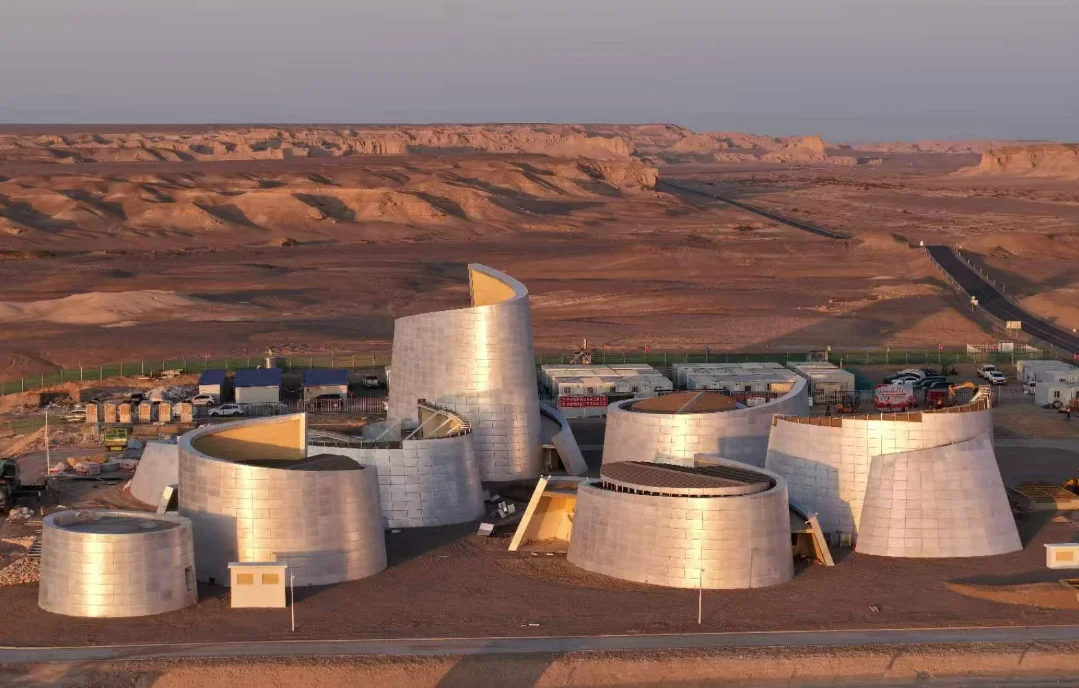

The world’s first pterosaur science museum has opened in Hami, Xinjiang, showcasing rare fossils and a unique underground design inspired by pterosaur eggs.
The Hami Pterosaur Museum, the world’s first science museum dedicated to pterosaurs, opened on September 13 in Hami, Xinjiang. The Hami Pterosaur–Yadan National Geopark was also officially inaugurated that day, according to the Institute of Vertebrate Palaeontology and Paleoanthropology (IVPP) of the Chinese Academy of Sciences.
Wang Xiaolin, a researcher at the IVPP and a leading pterosaur expert, said the museum is located within the Hami Pterosaur–Yadan National Geopark. Its main structure lies underground, about eight metres below the surface of the Gobi Desert. The museum covers about 8,000 square metres, including roughly 4,600 square metres of exhibition space.
The museum adopts the “spiral of life” design concept. Six elliptical buildings form an organic, staggered layout. Seen from above, they resemble a cluster of “pterosaur eggs” lying quietly in the vast desert.
Home of Pterosaurs
The museum features five permanent exhibition halls: the Earth Memory Hall, Pterosaur Encyclopedia Hall, World Pterosaurs Hall, Chinese Pterosaurs Hall and Hami Pterosaurs Hall. It also includes two interactive spaces, the Curiosity Centre and the Imagination Space.

The museum displays only original fossils excavated from the site. One of its highlights is the world’s first three-dimensionally preserved pterosaur egg and embryo fossils. Other rare specimens include Chinese Silutitan, which lived alongside the Hami pterosaurs.
The Hami Pterosaur–Yadan National Geopark covers 276.42 square kilometres. The park features two areas: “Pterosaur Eden” and the Dahe Yadan area. The two themes—fossils and Yadan landforms—complement each other.
Hami is renowned as the “Home of Pterosaurs.” It is home to globally rare and unique pterosaur fossils, as well as spectacular Yadan landforms. The region is a major centre in China for the protection and study of palaeontological fossils, as well as for public education in geology and ecology. International scholars have described Hami as one of the most exciting sites of discovery in more than two centuries of pterosaur research.
Written by Sha Liu, with additional reporting by CNS and Xinhua.
If you liked this article, why not read: How Chinese Museums Are Becoming More Accessible


