
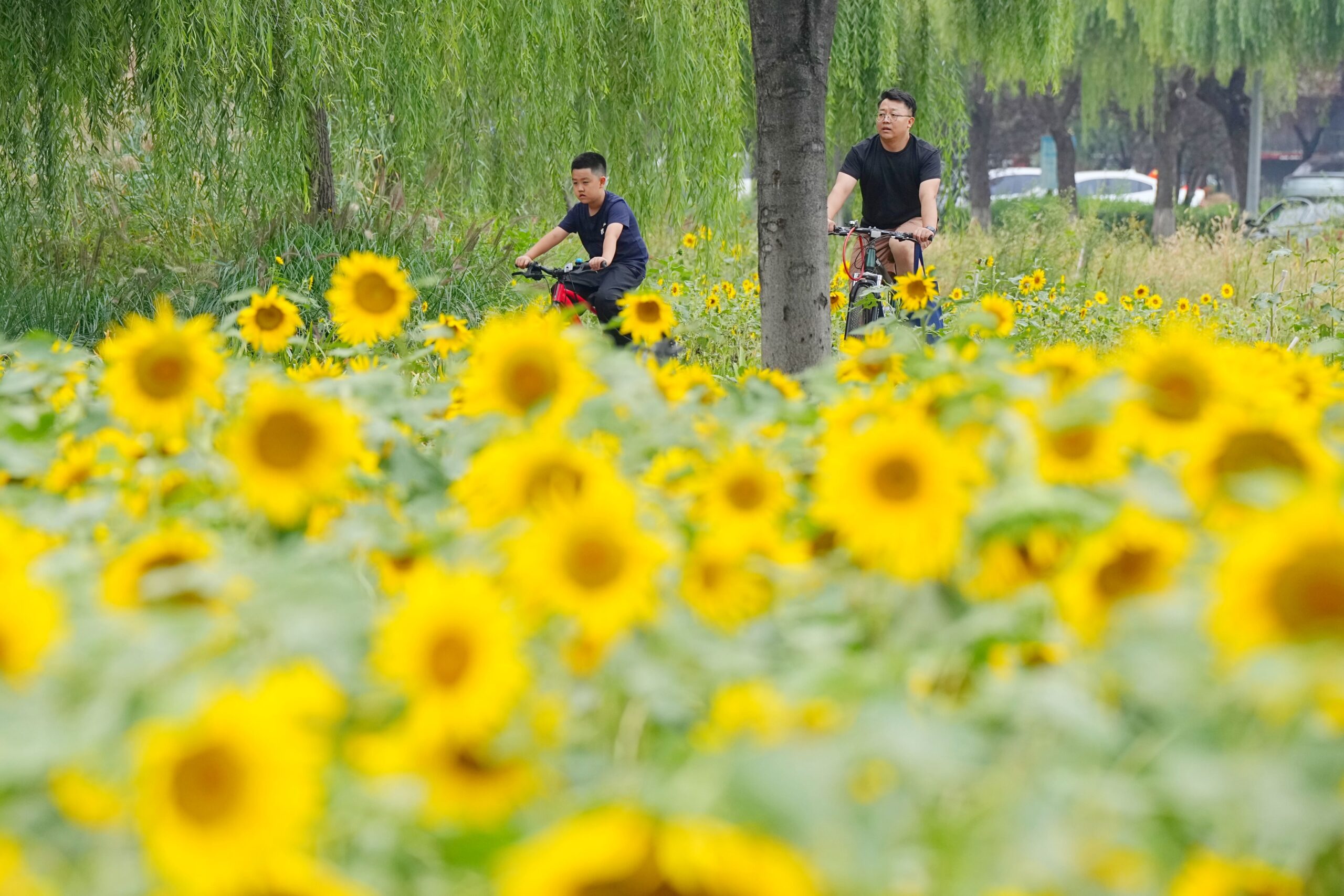

China records more than 200 million green mobility trips a day as cities expand public transport, improve connections and promote low-carbon travel.
Getting around China’s cities is becoming easier and greener. Public transport is expanding, connections between different modes are improving, and walking and cycling are becoming more common.
In Shenzhen, residents can take the metro for daily travel. In Yanjiao, a town in Hebei Province closely connected to Beijing, customised commuter buses serve cross-city workers. In Chengdu, cyclists can use the Tianfu Greenway to connect with rail services.
As a result, green travel has become a regular part of urban transport. In 2025, China recorded more than 200 million green trips a day. This included about 100 million urban rail trips, 100 million surface-bus trips and 24 million shared-bike trips.

The share of green travel is also high in many cities. Among 36 typical Chinese cities, the average green travel share reached 73.9%. The figure was 75.4% in mega-cities.
Shared bikes and e-bikes are also being used for longer journeys. According to Meituan, users travelled a combined 46.2 billion kilometres on shared bikes and e-bikes over the past five years. These journeys are estimated to have reduced carbon emissions by about 2.64 million tonnes.
Meanwhile, commuting remains a challenge in major urban areas. China’s 22 megacities and mega-cities have about 100 million commuters. Around 4% travel across city boundaries. A survey found that nearly 90% of people who currently use private cars or taxis for motorised trips would consider reducing such use if public transport became more efficient and convenient.
The government has also set targets for better connections between cities. A plan released in May 2026 aims to provide one-hour commuting conditions for 75% of the population in major metropolitan areas by 2030. During the 15th Five-Year Plan period (2026–2030), China plans to further improve intercity commuting while promoting greener and smarter transport.
Infrastructure is expanding alongside demand. By 2025, 54 cities had more than 11,000 kilometres of urban rail transit in operation. Urban bus routes covered 1.776 million kilometres, while new-energy buses accounted for 87.5% of city buses.
Connections between different modes of transport are also improving. By the end of 2025, 75.4% of central rail stations had bus connections within 50 metres, while bus stops covered 79% of central urban areas within 300 metres.

Technology is being used to make public transport more predictable. Chengdu, for example, has introduced “on-time buses” that provide arrival forecasts through electronic bus stops. Hangzhou has applied a bus large model to areas such as scheduling and passenger-flow monitoring.
Beijing has also used digital services and incentives to encourage greener travel. The city launched its green travel integrated service platform, MaaS, in 2019. In 2020, it introduced a carbon-inclusion programme that rewards people for choosing buses, the metro, bicycles and walking, as well as for using map-based route planning.
The programme now has 6.16 million registered users. Cumulative carbon reductions have exceeded 460,000 tonnes, while users have redeemed benefits more than 7.1 million times.

For commuters, these changes are closely linked to everyday concerns such as travel time, transfers and access to public transport. As cities expand rail networks, bus services and connections between different modes, green travel is becoming easier to use as part of daily journeys.
Written by Ronnie Yu, Chart designed by Wang Di, additional reporting by People’s Daily, CNS.
If you liked this article, why not read: China’s Next Stage | Bringing Health Closer to Home


