
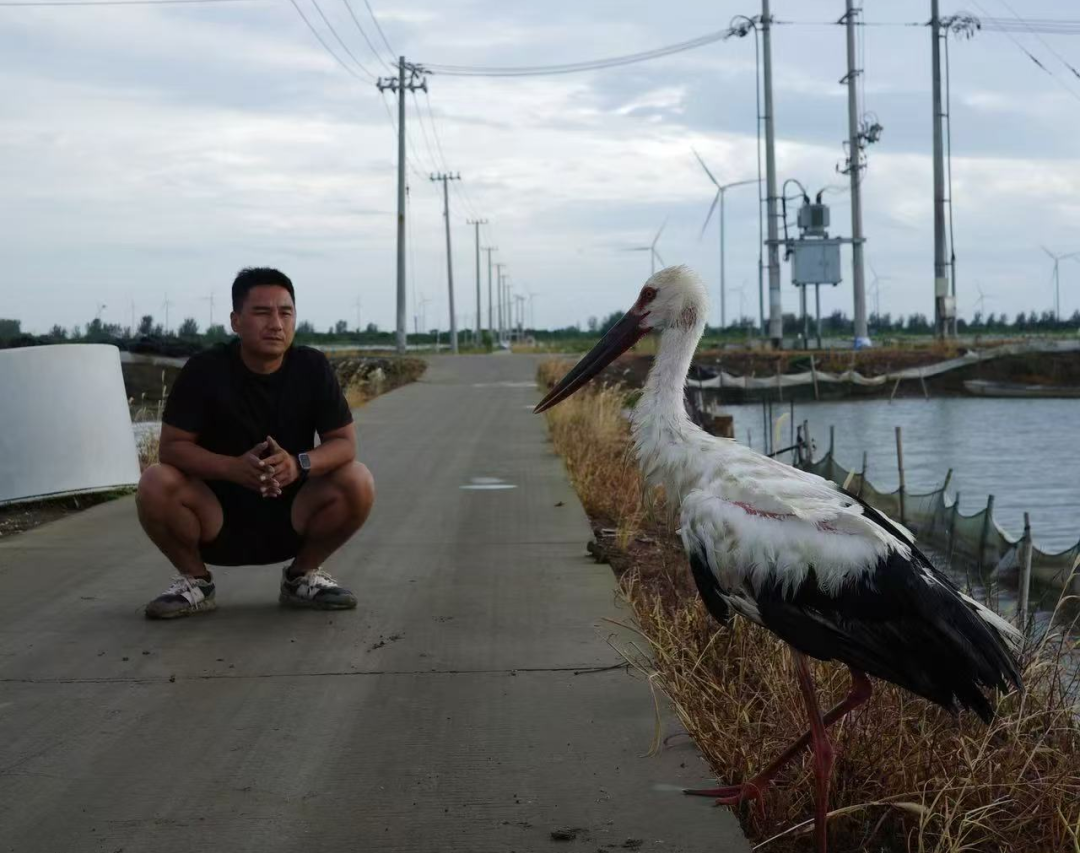

Dozens of endangered Oriental storks are feeding in crab ponds in Jiangsu, China, bringing a surprising dilemma for local farmers.
Early in the morning, mist still hung over the crab ponds in Sheyanghu Town, Baoying County, Yangzhou, east China’s Jiangsu Province.
Dozens of large birds with white bodies and black wings were walking through the ponds. They had long, sturdy bills. Every few steps, one would lower its head, peck quickly and swallow a young crab.
The visitors were Oriental storks, a first-class nationally protected species in China.
In the 1990s, only about 3,000 Oriental storks were believed to remain. Their numbers have since increased as wetland ecosystems have improved. Today, the global population has risen to more than 10,000.
In April this year, crab farmer Hu Dingsong posted a video on Douyin showing a group of unusual visitors at his 4,000-mu crab ponds. The visitors were Oriental storks, sometimes nicknamed the “giant pandas of the bird world” in China.
At first, Hu did not pay much attention to them. However, the birds kept coming. Soon, their visits began to affect his crab harvest and attracted widespread attention on social media.
Behind the online discussion is a more complicated question: What happens when wildlife returns to a habitat that people also depend on?
From Five or Six Birds to Dozens
Hu said the first Oriental storks arrived at his ponds in April.
“There were only five or six at first,” he said.
By May, their number had risen to more than 10. In late May, there were more than 20. By early June, the number had reached more than 40. Now, around 70 to 80 storks visit the ponds each day.
They did not arrive all at once. Instead, one or two birds appeared at a time. Hu noticed that some of the early arrivals seemed to lead other storks to the ponds. Gradually, the crab ponds became a regular feeding ground.
The same trend can be seen elsewhere in China.
At the Chenhu Wetland in Wuhan, central China, the wintering population of Oriental storks increased from 38 in 2021 to 174 in 2026. In Gaoyou, Jiangsu Province, more than 260 Oriental storks now live and breed in the area. About half of them have shifted from winter visitors to resident birds.
In other words, a species once considered a rare visitor is becoming a regular presence in more places.
Clearer Water, More Birds
Oriental storks are sensitive to their surroundings, including water quality and food availability. For Hu, their arrival is a clear sign that conditions in the ponds have improved.
“Crab farming requires good water quality. The water stays clean only when the aquatic plants are healthy,” Hu said.
In recent years, high temperatures linked to El Niño events have created challenges for crab farmers. Hu and other local farmers introduced aquatic plant varieties that can better withstand high temperatures.
“Even when temperatures are very high, these plants are less likely to rot,” he said. “They have helped improve the water quality.”
As the aquatic plants became denser, the water grew clearer. Hu also said the quality of the crabs improved.
“So when the storks come here, it means the environment is good, and the crabs are good too,” he said. “The ponds simply happen to suit them.”
The storks are not the only wildlife to have returned.
In recent years, wild ducks, pheasants, egrets, grey herons and other birds have also appeared around the crab ponds.
“There are birds everywhere now,” Hu said with a smile. “There are also more small fish and shrimp among the aquatic plants.”
A team led by Chang Qing, a professor at the School of Life Sciences at Nanjing Normal University, has been monitoring Oriental storks in Jiangsu in recent years.
According to the team, the increase in aquatic animals reflects a more complete food chain. The changes at Hu’s crab ponds are therefore part of a broader improvement in the ecosystem across the Lixiahe region.
A Dilemma for the Crab Farmer
Hu now knows the storks well.
Every day, he checks the ponds and watches the birds from his boat.
“Sometimes I row over, and the storks look up at me from a distance before going back to what they are doing,” he said. “After several months, I can recognise some of the regulars by their size and the details of their feathers.”
Still, affection for the birds does not erase the financial loss.
With 70 to 80 storks feeding in the ponds every day, the crab population has fallen noticeably.
“From a business point of view, having so many storks in one crab pond would be a disaster for any farmer,” Hu said. “They eat too many crabs, and the losses are significant.”
Then he paused.
“I have mixed feelings. Their arrival means the environment here is good, and the crabs are good. But every crab they eat is one that we have worked hard to raise.”
Hu and other local farmers know that Oriental storks are nationally protected in China. They cannot be harmed, nor do the farmers want to harm them.
Meanwhile, local authorities are working to reduce the farmers’ losses through measures such as insurance compensation. The compensation system is also being improved.
For Hu, however, the growing public attention has brought some comfort as well. More people have praised the improved environment online, while others have offered ideas for helping both the birds and the farmers.
“I hope people can come up with ideas together,” Hu said. “We need to protect these wild birds, but we also need to make sure that the farmers who depend on these ponds can cope with the losses.”
The sun rises as usual over the crab ponds.
The Oriental storks continue to walk slowly through the water. They do not know what their arrival means for the farmers. They simply know that the ponds offer clear water, abundant vegetation and plenty of food.
For Hu, their return is both a sign of a healthier environment and a new challenge for his livelihood.
Additional reporting by Geng Zhenzhen.
If you liked this article, why not read: How Injured Wildlife in China Gets a Second Chance


