
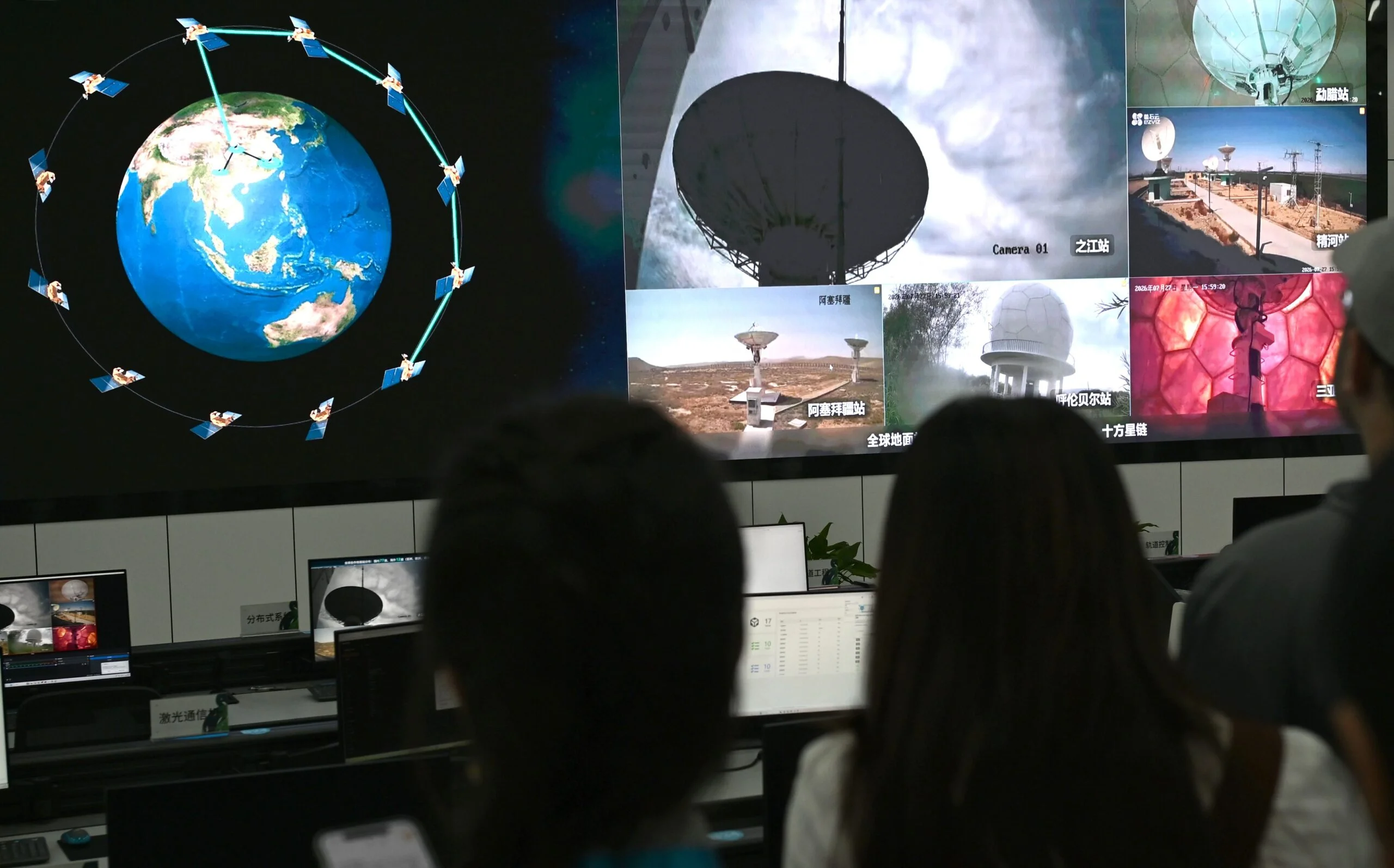

China is developing computing satellites that can run AI models in orbit, enabling faster data processing for weather monitoring, disaster response and space research.
Artificial intelligence may soon move beyond Earth.
China is developing a new type of satellite that can not only collect data but also process information in orbit. The project is called the Three-Body Computing Constellation. It aims to bring AI models into space and build a large-scale computing network among satellites.
The project recently entered a new stage after China launched two satellites for the constellation. The system is expected to expand the use of space-based AI in areas such as weather monitoring, environmental observation and intelligent satellite operations.
A New Category of Satellite
Traditional satellites mainly fall into three categories: communication satellites, navigation satellites and remote-sensing satellites.
The Three-Body Computing Constellation represents a different approach. Researchers describe it as a new category of satellite — computing satellites — which are designed to perform data processing tasks in orbit rather than simply send information back to Earth.
The project was initiated by Zhejiang Lab, a research institute in China, together with global partners. The team began developing the space computing system in 2023 and officially launched the Three-Body Computing Constellation project in November 2024.
The name “Three-Body” comes from the famous three-body problem in physics, which describes the complex interactions among multiple objects under gravitational forces.
According to Wang Jian, an academician of the Chinese Academy of Engineering and director of Zhejiang Lab, the name also represents the project’s goal of bringing together different innovators to achieve breakthroughs in space computing.
“Three-Body Computing Constellation hopes to combine the strengths of different innovation partners to achieve the goal of space computing,” Wang said.
Why Move AI into Space?
As satellite numbers continue to grow, processing the huge amount of data they generate has become a major challenge.
“AI is considered a key driver of the next technological revolution. However, AI applications remain limited in space. This is why we need to develop space-based AI,” said Li Chao, deputy chief engineer of the project’s space computing research team.
Researchers estimate that by 2032, around 3,000 remote-sensing satellites could be operating worldwide. Together, they may produce about 300 petabytes of data, requiring the computing capacity of roughly 100,000 servers.
Sending all this data back to Earth for analysis would be costly and inefficient. Therefore, moving computing power and AI models into orbit could help satellites process information faster and respond more effectively.
Currently, the Three-Body Computing Constellation team has developed technology that allows AI models to be deployed from the ground onto different satellite nodes. The team has completed the in-orbit deployment of 20 models and tested several applications.
These include collaborative observation of gamma-ray bursts, autonomous wildfire detection and early warning, short-term weather forecasting in orbit, and water monitoring through coordinated satellite operations.
The team plans to build a constellation with around 1,000 satellites by 2032.
Toward Open Cooperation in Space AI
Meanwhile, researchers say the development of space AI also requires broader cooperation and shared resources.
Wang Jian noted that training large AI models consumes significant amounts of electricity and computing resources. The cost and resource demands could become a challenge for future AI development.
“AI is a technology that should benefit more people around the world and help solve more problems,” Wang said.
To promote international cooperation, Zhejiang Lab launched the “Olive Leaf Initiative” under the framework of UNESCO’s International Decade of Sciences.
Through the initiative, the laboratory plans to open access to one or two computing satellites each year. Global researchers will be able to submit AI models and scientific payloads for testing and in-orbit verification.
The initiative aims to support wider participation in space AI research and contribute to the United Nations Sustainable Development Goals.
Written by Ronnie Yu, additional reporting by Xinhua, chinanews.com.
If you liked this article, why not read: Is Space the Next Frontier for Data Centers? China Moves Forward


