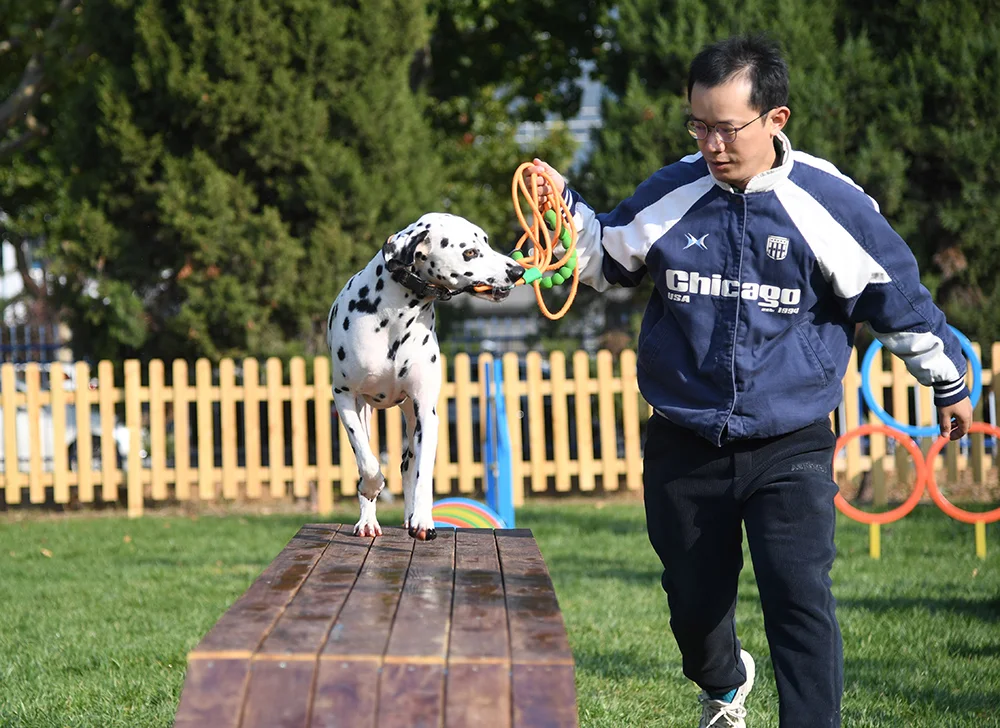

Shanghai pet gyms charge up to 2,000 yuan (£220) a month. As a result, debate grows over cost, city life, and modern dog care.
“Would you pay 2,000 yuan (£220) a month for a pet gym?” One user asked this on social media. As a result, it sparked a wide debate straight away. Soon after, the topic “a Shanghai pet gym costs nearly 2,000 yuan (£220) per month” shot up the trending charts on Weibo, the Chinese version of X.
This gym calls itself “China’s first dog exercise space”. According to The New Weekly, it charges 599 yuan (£66) for a single trial. Meanwhile, a land treadmill session costs 300 yuan (£33). A hydro treadmill costs 480 yuan (£53). A gait analysis costs 500 yuan (£55). In addition, a monthly pass costs 1,980 yuan (£218), while an annual pass costs 19,800 yuan (£2,180). By comparison, a standard personal training session at a typical commercial gym in Shanghai costs between 300 yuan (£33) and 600 yuan (£66).
Because of this, opinions quickly split. Some people said the prices were “ridiculous”. Others sighed that “pets now live better than people”. Still, some took a calmer view. They argued that “this clearly isn’t for people who already have time to walk their dogs”.
A post-90s office worker in Shanghai, Archie, said that her dog Tico only tried the land treadmill. However, it skipped swimming and the underwater treadmill, as it dislikes water. The machine is much smaller than a human treadmill. Even so, it allows speed and pace control.

At first, Tico resisted. However, with one-to-one guidance from staff, it adapted quickly. After about ten minutes, it could run on its own. During the session, staff supervised throughout. They adjusted Tico’s posture and, at the same time, discussed its body condition with Archie.
“This place was originally a pet rehab clinic. Also, they watch the dogs the whole time, so I feel it’s quite safe,” Archie said. Moreover, staff did not push any sales during the session. Instead, they explained the options. As a result, Archie had a good impression. In the end, she bought a 20-session treadmill package, which works out at about 100 yuan (£11) per session.
Meanwhile, Zhou, a programmer who lives in Xujiahui, owns a very energetic Abyssinian dog. At home, it dashes about wildly. Yet outside, it turns timid. Zhou often works overtime. Then, at weekends, he just wants to rest. As a result, the dog does not burn enough energy on walks. So, it releases that energy by wrecking the house.
At first, Zhou tried hiring a dog walker. However, reliable ones proved hard to find. In the end, he chose a daycare centre. He pays 300 yuan (£33) to 500 yuan (£55) per day so the dog can burn off energy. Meanwhile, he gets to work overtime without guilt. “Whichever way you look at it, it’s worth it,” he said.
This highlights a common but overlooked issue in city pet ownership. In fast-paced and crowded cities, many dogs lack enough time and space to exercise. As a result, dog walking shifts from a leisure activity to a burden. Therefore, outsourced exercise services find a market. However, not everyone can afford them.
At the same time, some anxious owners also form a core customer group. In their case, the anxiety comes from themselves. They feel they do not give their pets enough love. It does not come from the dog’s actual behaviour. As one comment put it, “they are really selling emotional value to the owner”. In short, that line captures the mindset well.
According to a report by Chengdu’s Consumer Quality News, Zhang Yongbing, Secretary-General of the Sichuan Pet Association, said that pets now enjoy better nutrition overall. However, city life still limits them. For example, they lack space and time for exercise. As a result, problems like obesity are becoming more common.
Therefore, although dedicated pet gyms are still rare, the market gap remains clear. In turn, this suggests strong growth potential in the future.
“The rise of pet gyms follows current market trends. It also reflects a shift in how people view pet ownership,” Zhang said. In the past, people focused on basic needs. Now, they care more about health management.
Moreover, pets now hold a higher status in families. As a result, more people treat them as family members. Consequently, they are willing to invest more in their well-being. Zhang also noted that pet supplements and functional pet foods rank among the top sellers on e-commerce platforms. Therefore, health has clearly become a core demand in pet ownership.
Written by Yi Shen.
If you liked this article, why not read: When the Wind Still Blows: Remembering Leslie Cheung 23 Years On