
Hélène Rollès reflects on her iconic 1993 hit “My Name Is Hélène”, a song that captured a generation in China and continues to resonate more than 30 years later.
When you hear the name Hélène Rollès, her face may not come to mind right away. But as soon as the opening notes of “Hélène, je m’appelle Hélène” play, thousands of Chinese fans start humming along instinctively.
Since the 1990s, this French-language hit has become a cult classic in China. It’s more than a pop song. For many, it’s a gentle memory of youth.
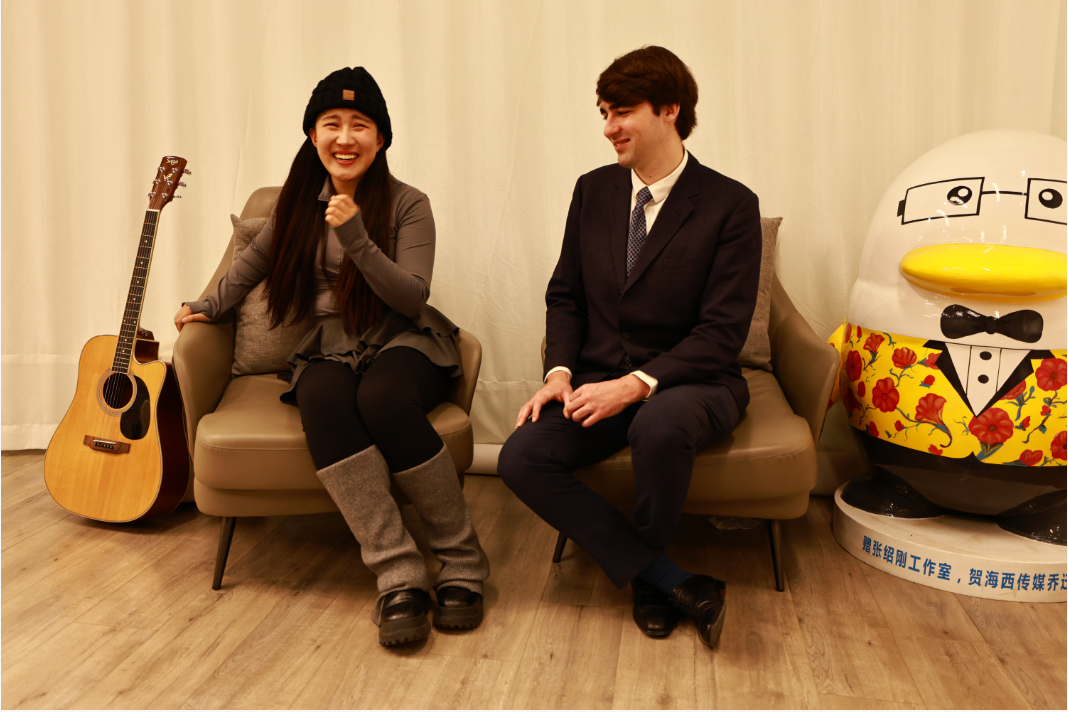

On February 13th, we met Hélène in Beijing. Over thirty years have passed, yet her blonde hair remains bright, her gaze calm and warm, and her voice clear.
“Hello, my name is Hélène. I have always been Hélène.”
Singing Her Own Name
Hélène started performing at the age of twelve. She first became known as an actress. In 1990, the TV series Premiers Baisers made her a youth idol in France. She later starred in Hélène et les Garçons, which turned her into a national star.
Her international breakthrough came with Je m’appelle Hélène. The single stayed at the top of the charts for 25 weeks, and the album sold 900,000 copies in France. Its delicate phrasing, intimate tone, and sincere lyrics — a simple longing for true love — crossed languages and cultures. The song spread to Russia, Japan, and Southeast Asia. For many Chinese listeners, it was their first encounter with French pop.
Looking back, Hélène admits she didn’t expect the song to become so popular.
“At first, I wasn’t convinced,” she says. “I asked my producer, ‘Are you sure? Je m’appelle Hélène?’ He said, ‘Yes, yes, it will be fine.’ What you can’t know in advance is how people will react.”
She believes Chinese students studying in Paris brought the song to China in 1993. That’s when it started gaining popularity.
“I wanted only one thing: to find true love,” she says. Its simplicity perfectly matched the dreams of young people in the 1990s. Then, the song spread “like a snowball,” passed from person to person.
For Hélène, this song carries special meaning.
“It is my name. I am really called Hélène… So I always enjoy singing it. It speaks about me.”
Returning to Beijing
This time, Hélène came to Beijing to join the recording of the Spring Festival Gala organised by China Media Group. It was her first appearance on the Gala stage. Yet her connection to China began more than thirty years ago.
In 1990, she performed in a 30,000-seat stadium — an experience she still remembers. In 2015, she toured China for the first time, visiting fifteen cities, including Guangzhou, Shenzhen, and Beijing. Each city left her with precious memories.
Chinese food also made an impression. Asked about her favourite dish, she answers simply: “I especially love breakfast congee. It’s soft and comforting. It makes you feel at ease.”
What moves her most, however, are the audiences. “I really love Chinese audiences. They are kind and warm.”
She recalls young fans at signing events, holding phones decorated with charms: “They are so cute, so lovely. It always warms my heart.”
Hélène revealed that she will return for another China tour at the end of 2026. She plans to perform several Chinese songs. Of course, Je m’appelle Hélène will be part of the setlist.
“I hope everyone will come and sing with me.”
A compilation of her greatest hits will also be released in China this year.
The Year of the Fire Horse: Freedom and Strength
2026 is the Year of the Horse in the Chinese lunar calendar — specifically the “Fire Horse” year. It is also Hélène’s zodiac year.
She was born in 1966, the previous Fire Horse year, in Le Mans in northwestern France. As a child, she loved animals, especially horses.
“When I was little, I rode horses a lot. I love the smell of horses.” Her eyes sparkle when she talks about them.
In Chinese culture, the horse symbolises ambition, strength, and freedom. Hélène identifies strongly with these qualities.
“I value freedom, my freedom, freedom itself, and strength.”
Perhaps it is this devotion to freedom and strength that keeps her music light yet determined, even after thirty years.
At the end of our interview, we asked her to sing a few lines a cappella. She did not hesitate.
“Hélène, je m’appelle Hélène. Je suis une fille, comme les autres (Hélène, my name is Hélène. I’m a girl, like the other girls)…”
Her voice was clear and pure — as if time had never passed.
Reporting by Lydia Wang, translated by Chen Wang.
If you liked this article, why not read: China’s Growing Cultural Presence on Social Media