
Chinese researchers built a human-like robotic finger that can lift fragile items like tofu and potato chips without breaking them, bringing robots closer to gentle, precise touch.
A team of researchers has unveiled a human-like robotic finger capable of lifting extremely delicate objects—such as tofu and potato chips—without causing any damage. The innovation could make robots safer and more precise in food processing, healthcare, and everyday service tasks, according to CNS.
The study was recently published in Nature Communications.
Robots That Can Be Gentle
While robots are typically strong and fast, handling soft, thin, or fragile items remains a major challenge. Even simple tasks, like picking up a piece of paper or a potato chip, can easily lead to breakage.
To overcome this, the researchers designed a new rigid–flexible–soft structure (HFRFSS) inspired by human fingers, which naturally combines strength and gentleness.
The finger consists of four main components:
- Rigid tubular bones that provide structural support
- Flexible joint springs that allow bending and self-reset
- A pneumatic membrane actuator that drives movement
- A soft silicone skin that mimics the compliance of human tissue
Together, these elements create a finger that is both strong and adaptive, capable of making gentle, precise contact with objects.
Implications for Humanoid Robots
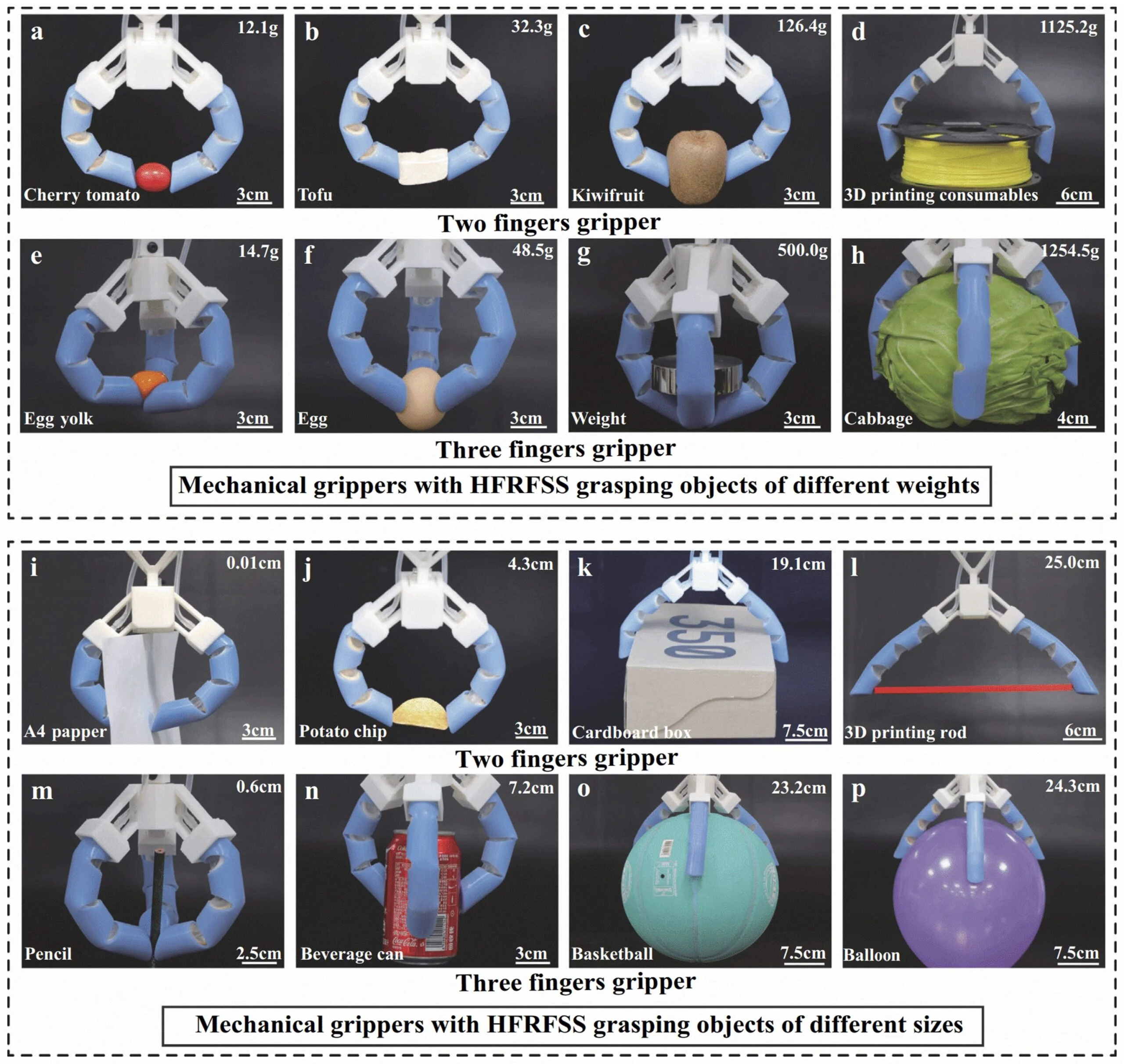
The team tested the finger with a variety of items:
- A 12-gram cherry tomato
- A 1-kilogram spool of 3D-printing material
- Eggs, cabbage, balloons, and 0.1 mm-thick A4 paper
For delicate items, the finger performed exceptionally well. During a tofu test, it picked up and set down a piece 20 times in a row without any cracks. In a potato chip test, the finger adjusted to the chip’s curved surface and lifted it cleanly, regardless of orientation.
These results show that the HFRFSS can handle both heavy and extremely fragile objects—a combination rare in existing robotic grippers.
As humanoid robots gradually enter homes, hospitals, and factories, their end-effectors (robotic “hands”) must be both precise and gentle to interact safely with people and objects.
Because this new robotic finger is simple, low-cost, and adaptable, it could be integrated into many types of humanoid robots. The researchers say it brings machines closer to performing everyday tasks with human-like dexterity.
If you liked this article, why not read: China Unveils Roadmap for Future Science and Technology Education