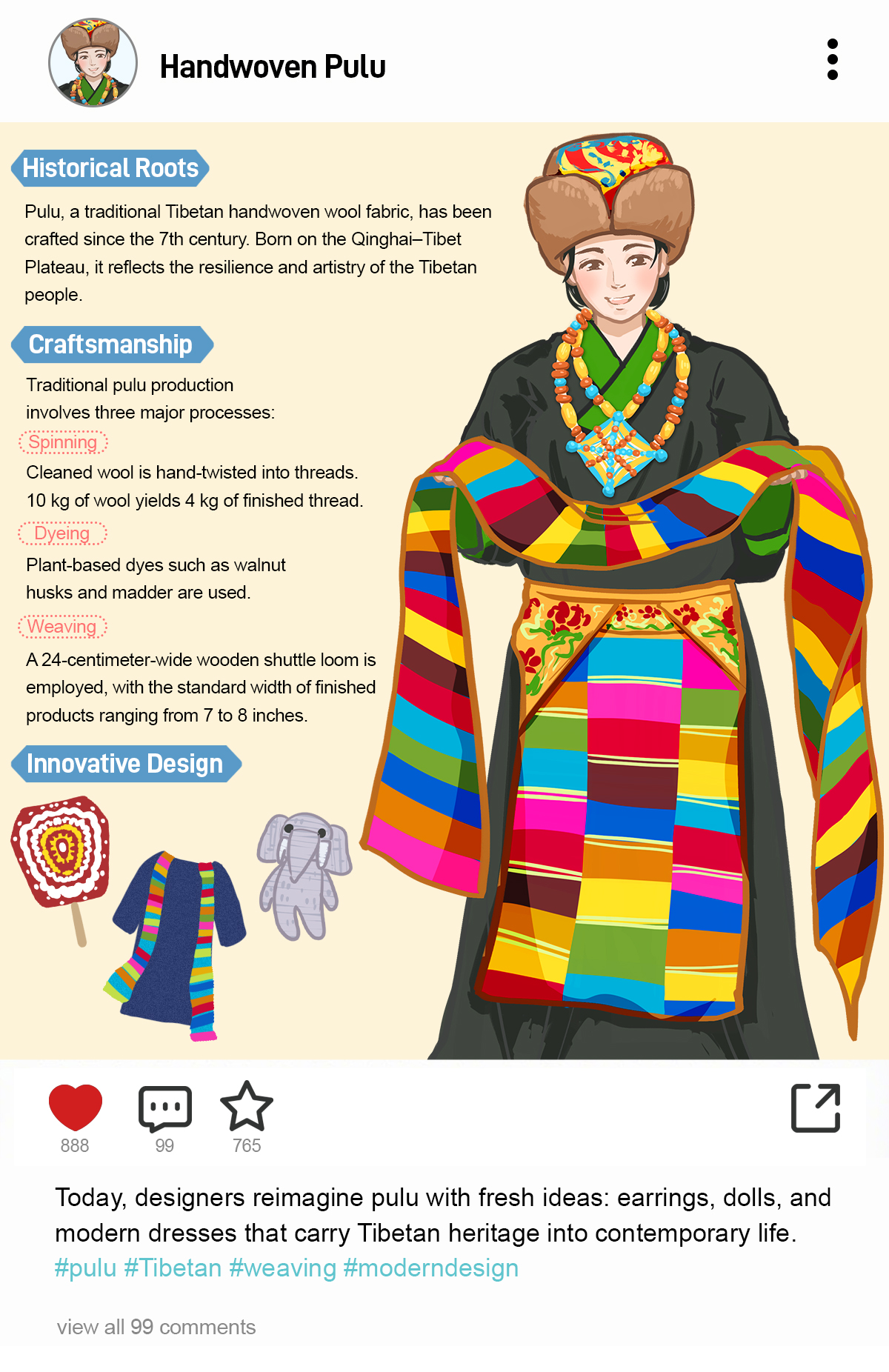

In the window of Le Bon Marché in Paris, a priceless cashmere vest draws attention. It beautifully embodies the unique spirit of the Qinghai-Tibet Plateau. This vest is made from pulu, a traditional Tibetan hand-woven woolen cloth. The word “pulu” comes from Tibetan transliteration. Local artisans in Tibetan regions weave it into a fabric that is durable, cold-resistant, windproof, and adorned with vivid, bright colors. In recent years, pulu has become a “new business card” of Tibetan handicrafts, thereby attracting global interest.
A 2,000-Year-Old Craft
Jiangzi pulu represents a 2,000-year-old craft and reflects the ethnic identity of Tibet’s snow-covered plateau. Among its varieties, Xiema pulu from Jiangzi County enjoys recognition as a regional intangible cultural heritage. Then, in January 2024, Jiangzi Pulu shone at the Paris Home & Gift Show, introducing its craftsmanship to the world.
Cashmere quality depends on fiber fineness and length. Fibers below 15 microns rank as top quality, and Jiangzi cashmere measures just 13.2 microns, making it the finest in the world. However, the craft once struggled. Traditional looms worked slowly, and patterns remained unchanged for centuries. As interest faded, artisans earned only tens of yuan a day, and the craft even faced the threat of disappearing.
Reviving an Ancient Tradition
Fortunately, the situation has changed. Alongside traditional looms, modern equipment now hums, and new patterns breathe life into the craft. Innovators apply technology upgrades, design improvements, and cooperative production models to boost Jiangzi Pulu. For example, the “enterprise + cooperative + farmer” model connects production with sales. A training base in Shanghai and a working center in Jiangzi County help develop skills and spark innovation, thus attracting designers worldwide.
In July 2024, Gesang Zhuoma, a local Tibetan woman, founded the Ajia Gesang Workshop, evolving from a farmers’ cooperative. Orders from a Shanghai company exceeded 9 million yuan, processing fees brought in 600,000 yuan, and net income reached 300,000 yuan, several times higher than before.
Today, Jiangzi Pulu blends ancient skills with modern design, and step by step, it reclaims its place on the world stage.
Written by Yi Shen, poster designed by Di Wang.
If you like this article, why not tread: Legendary Demon Hunter Zhong Kui Joins Black Myth Series