
Artificial intelligence (AI) tools have become efficient assistants at schools in China, but the trend has also sparked concerns.
“Confucius, does the phrase ‘To learn and constantly review what one has learned, isn’t that a delight?’ mean that we should frequently review our lessons?”
In a fourth grade classroom of Xinyilu Primary School, Qinhuangdao, north China’s Hebei Province, a student posed this question to a virtual figure on the screen. The digital “Confucius” dressed in traditional attire, nodded gently and replied, “Indeed. By revisiting what one has learned, one can gain new insights.”
A Modern Approach to Education
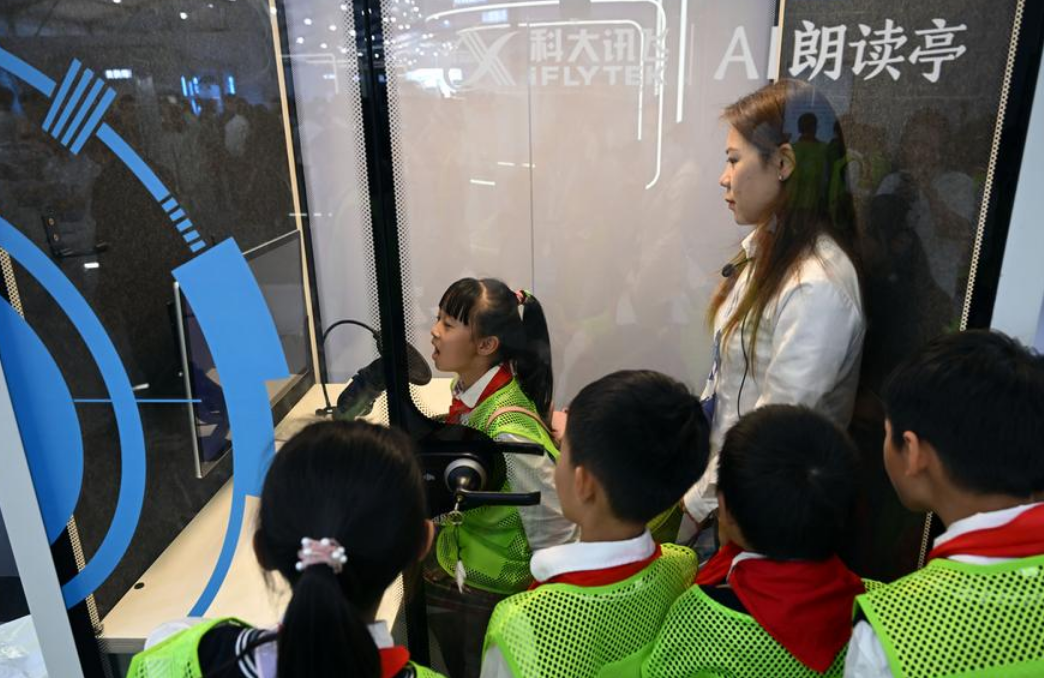
AI is becoming increasingly prevalent in primary and secondary school classrooms across China, providing a modern approach to education while fostering scientific thinking and innovative skills among students.
With the integration of AI-powered virtual teaching assistants, historical figures can now “come to life” in classrooms, offering students an immersive and interactive learning experience.
Tianjin Huiwen Middle School in the northern municipality has explored its AI education. At present, AI is serving as an assistant that helps teachers bring new experiences to traditional education at school.
Educators widely acknowledge AI’s transformative impact on classroom efficiency.
“As part of our school’s digital transformation, every classroom is now equipped with smart interactive boards and AI-powered virtual assistants, enabling real-time human-machine interactions,” said Principal Yao Hairong of Xinyilu Primary School, “This not only enhances teaching efficiency but also significantly boosts students’ engagement in learning.”
Policy Support
The recent and rapid development of AI has already impacted education on all levels in China, from primary and secondary schools to higher education. It has reshaped the sector by facilitating personalized and lifelong learning, more efficient teaching, as well as greater scientific evaluation and school management, experts said.
In December last year, the Ministry of Education of China released a guideline calling for increased efforts to strengthen AI education in primary and secondary schools, and stipulated that the technology should be prevalent by 2030.
The guideline aims to cultivate future-oriented talent, enhance students’ problem-solving abilities and digital skills, and foster a spirit of innovation. It underscored the need to develop a systematic AI curriculum and implement regular AI education.
In February last year, the ministry announced a list of 184 primary and secondary schools selected as AI education bases to facilitate the implementation of AI education.
Understanding the latest technology has become integral in the nation’s education system.
Concerns about relying on AI
However, the trend has also sparked concerns about AI’s growing role in education.
With just a few simple prompts, students can use AI tools such as DeepSeek or Kimi to tackle their schoolwork. Typical assignments in primary and secondary schools — ranging from solving math problems and writing essays to designing posters — can now be easily handled with generative AI.
“AI tools have saved me a lot of time tutoring my child,” said Su Min, a 40-year-old mother of a sixth grader in Beijing. However, Su emphasized that her daughter does not use AI tools for schoolwork on her own. “Simply copying the results generated by AI is not beneficial.”
Some teachers are also concerned about AI use, as students’ homework increasingly contains AI-generated content.
Although some universities have implemented strict guidelines for AI use in research and thesis writing, primary and secondary schools have largely lacked clear regulations.
“While AI is often touted as a tool to enhance education, its impact on children’s self-development could be more detrimental,” said Xiong Bingqi, director of the 21st Century Education Research Institute, “Relying on AI for knowledge acquisition hinders the development of their capabilities.”
Xiong said uniquely human skills such as imagination and creativity are becoming increasingly valuable in the face of rapid AI development.
Written by Liu Sha, additional reporting by Xinhua and China Daily.
If you liked this article, why not read: AI Meets TCM: Revolutionizing Diagnosis and Treatment