

Experts explain how a high-altitude glacier collapse developed into a powerful mudslide that devastated Gyirong Port on the China-Nepal border.
A massive mudslide that devastated the China-Nepal border region followed a high-altitude glacier collapse on the Nepalese side, experts said.
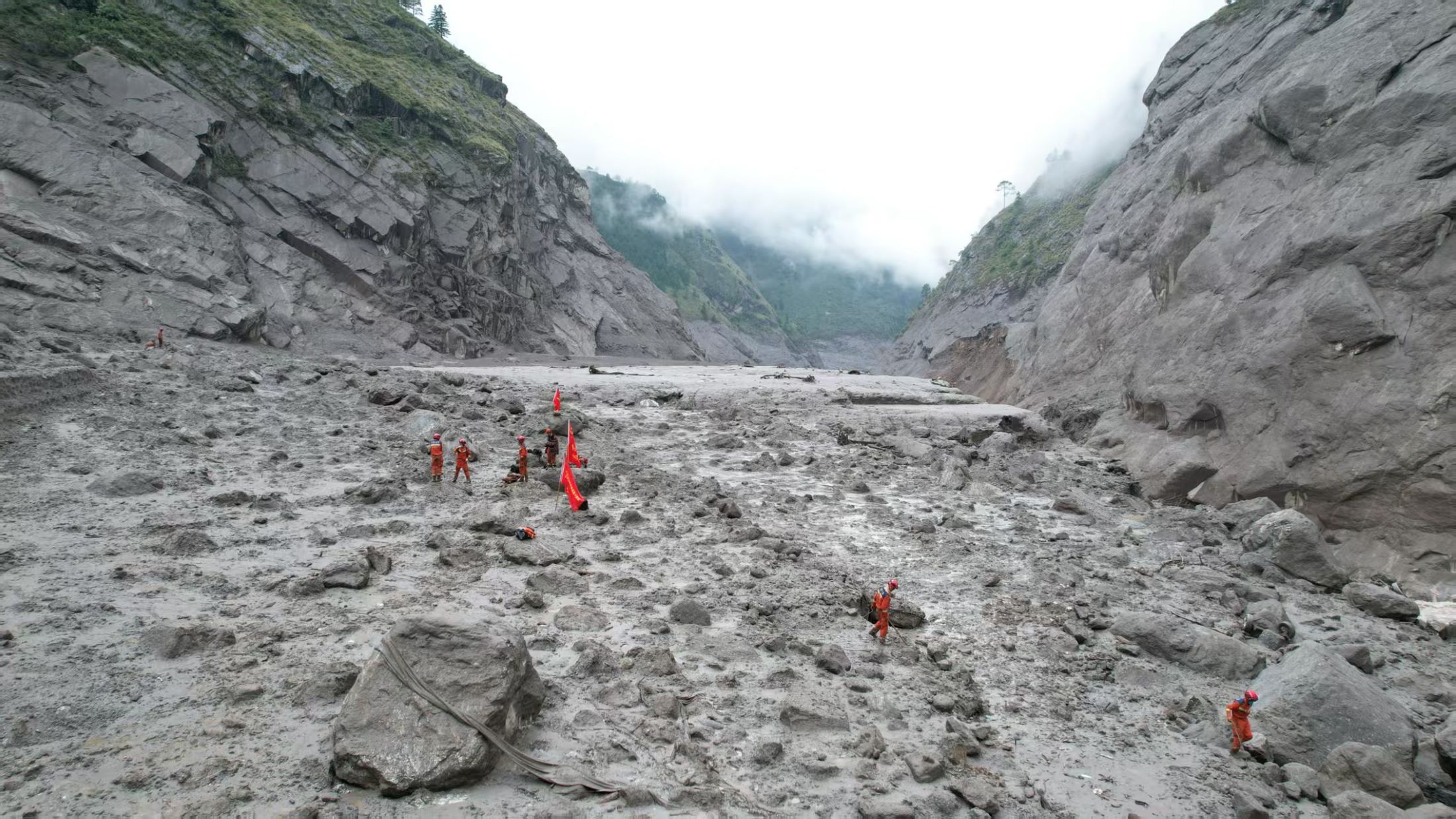
The mudslide struck Gyirong Port in southwest China’s Xizang Autonomous Region on Wednesday morning. As of 3 p.m. Aug. 28, five people had been confirmed dead, and 558 remained missing, according to the latest official figures. Among those missing were 260 foreign nationals.
The disaster has also left the core area of the port covered by more than 1.5 metres of silt. This has made searching for missing people even more difficult and dangerous.
Experts say the disaster was not caused by a single event. Instead, a high-altitude ice-rock avalanche developed into a debris flow and then a powerful mudslide as it moved downstream.
From Glacier Collapse to Mudslide
Satellite imagery and expert analysis indicate that the disaster began with the collapse of a glacier in Nepal at an elevation of about 5,200 to 5,400 metres.
Kang Shichang, a researcher at the Institute of Mountain Hazards and Environment under the Chinese Academy of Sciences, said satellite images showed that the end of the glacier had broken apart. The collapse also brought down rocks and other debris.
The material then rushed down the mountain channel at high speed. Along the way, it picked up loose debris and glacial deposits. It eventually entered the Guoba Xiaqu River, a China-Nepal border river, before flowing into the Donglin Zangbu River.
As a result, the event developed into a chain disaster involving an ice-rock avalanche, a debris flow and a mudslide.
Experts from China’s Ministry of Natural Resources described it as a cascading disaster that evolved continuously as the material moved from the high-altitude glacier to the lower river valleys.
The scale and terrain of the event also played an important role. The flow travelled about 20 kilometres while dropping nearly 3,300 metres in elevation.

Seven Minutes to Gyirong Port
The extreme speed of the flow was another key factor.
According to expert estimates, it took only about seven minutes for the disaster to travel from the initial glacier collapse to Gyirong Port. The debris flow reached speeds of around 50 metres per second, or about 180 kilometres per hour.
As it moved downhill, the flow continued to erode the surrounding rock and pick up loose material. This allowed it to maintain a high speed while increasing its volume and destructive force.
Ouyang Chaojun, a researcher at the Chinese Academy of Sciences, identified three major factors behind the severe impact.
First, the initial ice-rock avalanche was large and occurred at a high elevation. This gave the falling material substantial initial energy.
Second, the avalanche quickly developed into a highly mobile debris flow. As it travelled downstream, it continued to scour loose material from the river channel.
Finally, people and buildings in the area are largely concentrated on relatively flat land along the river valley. That left many communities and facilities directly exposed to the flow.
Gyirong Port is also an important land crossing for China-Nepal trade. The disaster struck during the daytime, when workers and other people were present in the area.
The combination of high speed, limited warning time and concentrated human activity left people with very little time to respond.
Meanwhile, the disaster has created a barrier lake upstream. Authorities and experts are monitoring the situation closely because a sudden release of water could create additional risks downstream. Experts have advised people to move towards higher ground or nearby slopes if they see floodwater coming from upstream.

Climate Change Raises Glacial Risks
The disaster also highlights the growing risks faced by high-altitude areas in a warming climate.
The Qinghai-Xizang Plateau and the surrounding Himalayas form the largest high-altitude glacial region outside the Arctic and Antarctic. Scientists have warned that rising temperatures are changing the stability of glaciers, snow and frozen ground in the region.
Kang said continued glacier melting could make glaciers less stable and more sensitive to external disturbances. This could increase the risk of ice avalanches and other cascading hazards.
At the same time, glacier retreat can contribute to the formation and expansion of glacial lakes. This raises the risk of glacial lake outburst floods, landslides, debris flows and other related hazards.
Tian Bingwei, an associate professor at Sichuan University’s School of Disaster Rehabilitation and Management, said global warming is an important background factor in the disaster. Rising temperatures can intensify freeze-thaw processes and reduce the stability of snow and glaciers at high elevations.
However, he noted that the disaster resulted from multiple factors, including the glacier collapse, the availability of loose material on the slopes and river channels, terrain and precipitation.
The disaster has also drawn attention in the UK because foreign nationals were among those reported missing. According to the BBC, British Foreign Office Minister Stephen Doughty said the number of British nationals reported missing in the region had been cited as 33 by Nepalese authorities, although he cautioned that the figure could change as the situation develops.
The UK government has also deployed a Rapid Deployment Team to Nepal to support British nationals and their families. The team is due to arrive in Kathmandu on Saturday and will work with the British Embassy and local authorities.
For rescuers, however, the immediate priority remains the search for those still missing. Difficult terrain, deep mud, damaged infrastructure and the risk of further flooding continue to complicate operations. By Friday morning, 681 Chinese fire and rescue personnel, along with 113 rescue vehicles, had reached the disaster-hit border area.

Additional reporting by Xinhua, HKCNA, CCTV.
If you liked this article, why not read: China Sends More Rescue Forces to Tibet as Hundreds Remain Missing


