
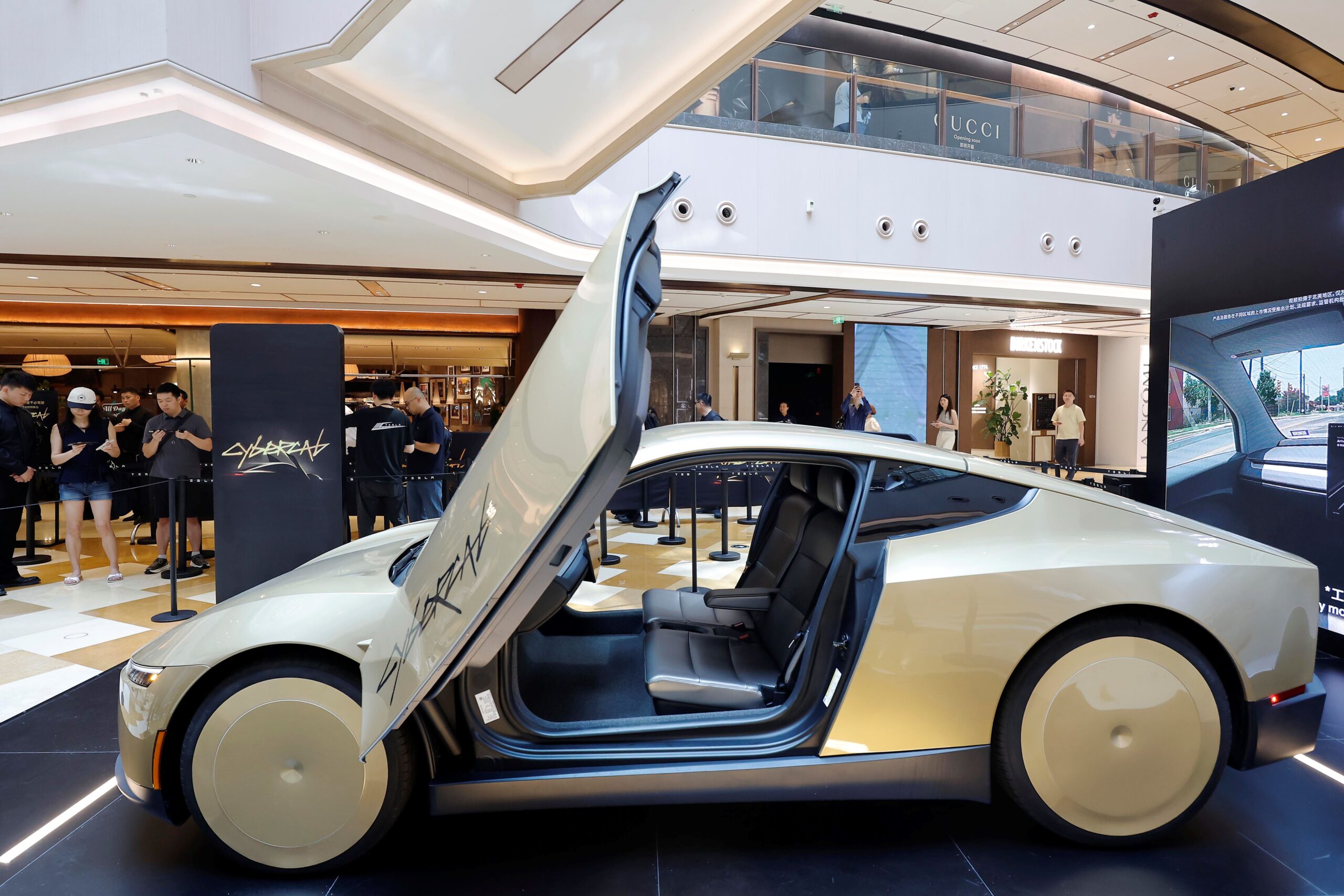

Tesla’s steering-wheel-free Cybercab is on display in Shanghai. Its arrival raises questions about autonomous driving, car ownership and future mobility.
A car without a steering wheel may sound like something from a science-fiction film. Yet on Sept. 17, Tesla’s Cybercab arrived in Shanghai for the first stop of its national tour.
The light-gold vehicle attracted visitors at Shanghai’s Taikoo Hui. People gathered around the car, taking photos and examining its unusual design.
The Cybercab is designed specifically for autonomous driving. Its interior has two bench-style seats and a 22-inch central screen. The vehicle does not have a steering wheel, pedals or conventional rear-view mirrors.
Tesla’s first production Cybercab rolled off the production line at its factory in Texas in February this year. The company began mass production in April. The vehicle on display in Shanghai is the first production Cybercab to be shown in the city.
The Cybercab is intended to become a core vehicle in Tesla’s robotaxi fleet. It is not currently available for individual purchase. Tesla also has no plans to launch related services in mainland China at this stage.

A Car Designed Without A Driver
For more than a century, the design of a car has centred on one basic assumption: someone inside must drive it.
The Cybercab challenges that arrangement.
The vehicle has a fastback-style body and two seats. It uses eight cameras and Tesla’s vision-based, end-to-end neural-network approach for autonomous driving. A light-up emergency stop button with Braille markings is installed on the ceiling of the cabin. If the vehicle detects an accident, it can automatically notify Tesla’s operations team.
Tesla says the vehicle is designed around the needs of autonomous ride-hailing. According to figures cited by staff at the Shanghai exhibition, more than 85 per cent of ride-hailing journeys in the United States involve two passengers or fewer.
That helps explain the two-seat layout. The design focuses on a specific use: moving one or two people from one place to another, rather than serving as a conventional family car.
China Is Exploring The Same Idea
The Cybercab is not the only vehicle in Shanghai exploring this idea.

At a testing site in Jiading district, a Chinese vehicle without a steering wheel was also undergoing road tests. The vehicle was developed using technology related to the latest IM LS6.
Unlike the Cybercab, it retains pedals. However, it has no steering wheel. During a test drive, the vehicle started, steered and avoided pedestrians without direct control from the person inside.
The vehicle relies on a steer-by-wire chassis. Cameras, lidar and other sensors collect information about the surrounding environment. Intelligent-driving algorithms then help the vehicle plan its next moves.
The two vehicles use different technical solutions. Nevertheless, they raise a similar question: if a car can drive itself, does it still need to be designed around a driver?
Wang Ning, the director of the Automotive Industry and Technology Strategy Research Centre and the Automotive Ecology Big Data Joint Laboratory at Tongji University, told China News Service that removing the steering wheel does not, by itself, determine a vehicle’s safety.
The real challenge, he said, lies in the complete system. This includes environmental perception, decision-making, route planning and vehicle control.

From Driving A Car To Using One
Wang said that autonomous driving at Level 4 would provide the basis for completely removing the steering wheel. He also suggested that the development of autonomous point-to-point shared transport could bring structural changes to the private-car market over the next five to 10 years.
In that future, he said, driving a car with a steering wheel might become an activity mainly for people who enjoy the experience of driving.
For more than 100 years, a car has been something people drive. What happens if it increasingly becomes something people simply use?
Written by Ronnie Yu.
If you like this article, why not read: New Chinese Carmaker LEPAS Announces Expansion into the UK


