
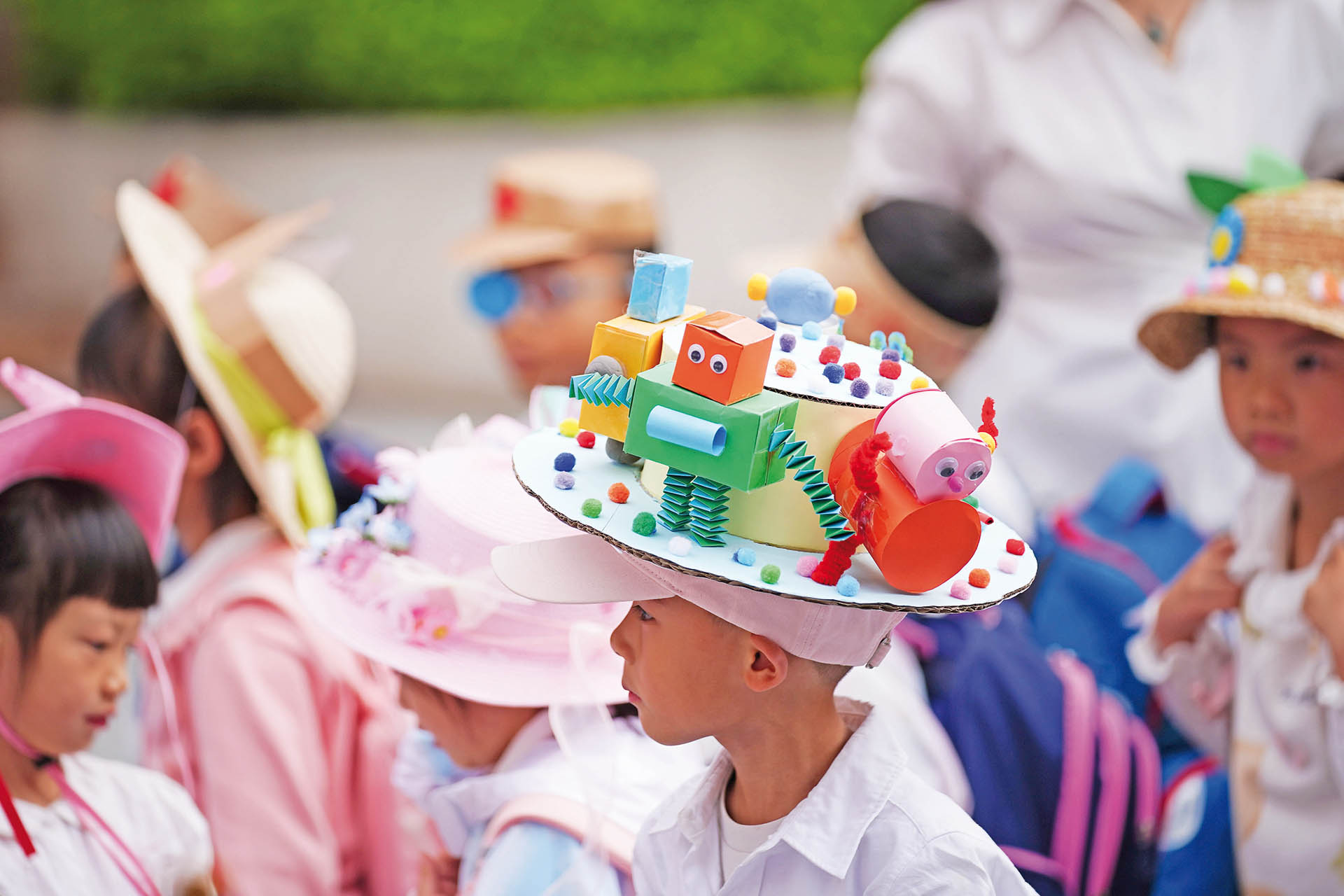

On September 1st, the new school year began across China. This year marked a new beginning: the first children born in the 2020s entered primary school.
Growing up with artificial intelligence (AI) from their earliest memories – and, for some, almost from birth – they are being described as the first generation of AI natives. How might this shape the way they learn, think and make sense of the world?
The First Generation of the AI Era
‘The biggest difference with this generation is that they are digital natives by nature, and they have access to a much wider range of ways of acquiring knowledge,’ said Cai Wei, a parent whose child started school this year, at Beijing Zhongguancun No. 2 Primary School’s Huaqing campus on September 1st.
AI natives may be a more accurate term than digital natives. For children born after 2020, the AI boom sparked by ChatGPT at the end of 2022 has been a defining feature of the world they have grown up in.
‘Children born in the 2020s are AI natives – the first generation of the AI era,’ said Xu Jilin, a professor of history at East China Normal University. ‘As they grow up, they will move away from the exam-oriented education that previous generations have taken for granted. With AI able to produce a standard answer within seconds, anyone can become a top student.’

Parents are already seeing signs that growing up with AI is influencing the way their children think.
Cai, whose child is part of this new generation, describes them as flexible thinkers who tend to express themselves more directly. ‘That could also challenge the way we educate our children,’ he said. ‘The traditional model of education, where adults simply pass knowledge on to children, may no longer work. We need to move towards guiding them and accompanying them as they explore the world.’
Another parent, Xu Yidan, said her daughter had already started learning some coding before entering school. ‘She absolutely loves it.’
Schools Bring AI into the Classroom
Children born in the 2020s are arriving at school already familiar with an increasingly AI-powered world. Schools, too, are adapting their approach to education, turning AI into another tool through which children can understand the world.
Fu Chunyuan, head of the Huaqing campus of Beijing Zhongguancun No. 2 Primary School, said the school offers AI classes from the first year of primary school. The campus is also equipped with intelligent devices, including robot learning companions.
‘Children can communicate not only with their classmates, but with robots as well,’ Fu said.
The school has a dedicated AI classroom where pupils can learn about and experiment with emerging technologies. They can also interact with AI-powered robots designed to support mental wellbeing, which can generate personalised psychological profiles for individual pupils.
‘We tried out a pair of smart glasses. There was an AI assistant in the glasses case, and we could talk to it,’ said Fan Xinan, a Year 5 pupil, after the activity on 1 September.

But does growing up with AI automatically mean that these children will be better at using and controlling it?
Not necessarily, Xu said.
‘This generation will not be more equal simply because they grow up with AI,’ he said. ‘People who can go beyond what AI offers – those with genuine imagination, creativity and intuition – will become increasingly rare. Those who are able to control AI will gain the greatest access to social resources and wealth.’
The result, he warned, could be a world marked by enormous disparities in wealth and status, with social tensions and global instability becoming even more acute. ‘Their relationship with AI could take two very different forms. They could become dependent on AI, turning themselves into its servants. Or they could take control of it and use it to open up an entirely new world.’
Chinese writer and media commentator Hou Hongbin takes a darker view of what lies ahead.
She believes AI could fundamentally reshape human cognition – and worries that children growing up with the technology may eventually lose the ability to distinguish reliable information from everything else.
‘The real world and the AI-generated world will become increasingly intertwined,’ Hou said. ‘Eventually, they may come to believe that reality itself is not that important any more. If something feels good, that is enough.’
She argues that only a small proportion of children may have early enough access to the information and resources needed to navigate an increasingly AI-mediated world.

The Question Is What It Means to Remain Human
Faced with such a future, parents of China’s first AI-native generation are thinking about more than whether their children will learn to use a new technology.
They are also asking how children can retain the qualities that make them human in a world where machines are becoming increasingly capable.
Guo Yue, a parent of a new pupil at Beijing Zhongguancun No. 2 Primary School’s Huaqing campus, hopes his child will retain her independence as technology continues to advance.
‘I hope she will learn to look for answers by reading and asking questions herself,’ Guo said.
Written by Estelle Tang. Additional reporting by Chinanews.com.cn and New Weekly Magazine.
If you liked this article, why not read: Is AI Co-Parenting a Generation of Children in China?


