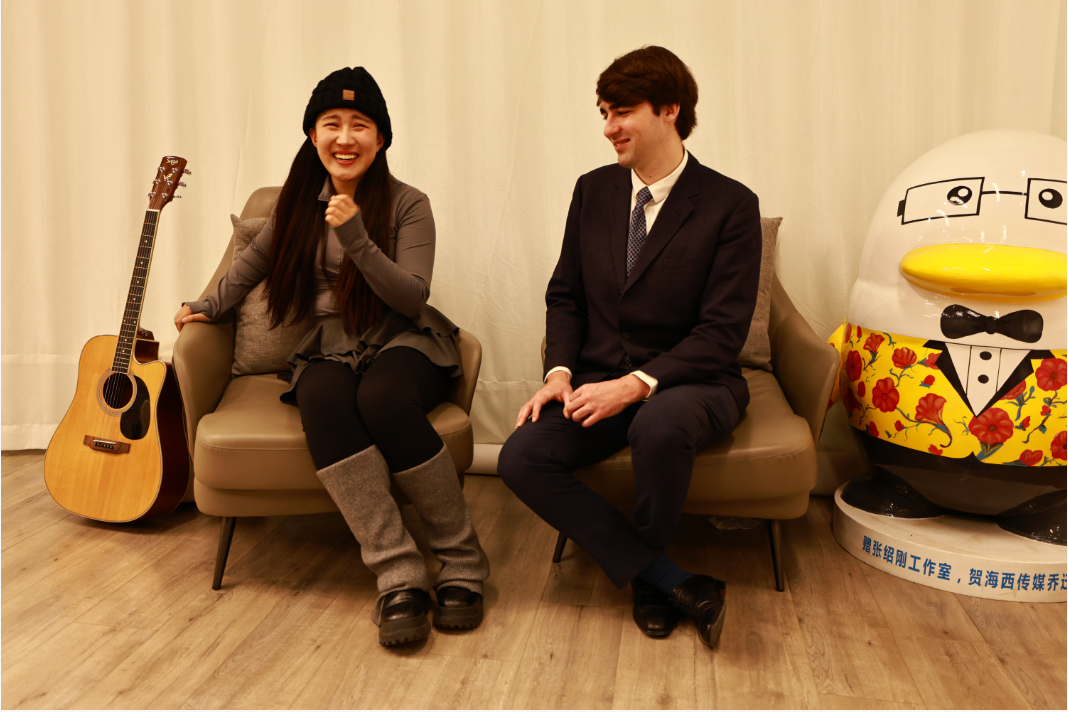

Beijing-based comedy duo Shu-Fu uses bilingual stand-up and humour to bridge cultures and connect audiences through laughter.
It’s winter in Beijing, and the air carries a crisp chill. Inside a rehearsal room at a creative park in Chaoyang District, a story about humour and cross-cultural communication begins—with a casual, unplanned meeting.
Afu (Fraser Sampson) arrived in a tailored suit and a Lei Feng hat, speaking fluent, effortless Chinese. Xiaoshu (Li Xinshu), all smiles, handed us two cups of coffee. Through casual conversation, we gradually got to know the Shu-Fu duo.
Encounter • Partnership
Chemistry often begins in the most unremarkable moments.
Afu had come to watch an open-mic show, and Xiaoshu happened to be the host. When the staff noticed a foreigner in the audience, they suggested that Xiaoshu go interact with him.
“I said, ‘Hello!’” Xiaoshu recalls with a smile. “He said, ‘您好’—perfect Chinese.”
During that period, Xiaoshu worked with several different comedy partners. “I asked Afu how long he wanted to do comedy,” she recalled. “He said, ten years.”
“That’s when I thought—this could be a partnership that lasts.”
Connection • Contrast
After nearly three years in stand-up, Shu-Fu set out to find a way to truly connect with their audience. Their first attempt was a particularly demanding form: manzai (a Japanese-style comedic performance art).
“Doing Japanese-style comedy with a British partner is really hard,” Xiaoshu admits. “It’s not just speed, but timing, reactions, and logic.”
Later, they experimented with bilingual hosting: Afu performed in Chinese, while Xiaoshu spoke English.
“We found the English element itself was funny,” Afu laughs. “When the audience sees a foreigner on stage, they tense up—like taking an English listening test in school. That tension itself becomes laughter.”
When Afu asks, “How are you?” the audience almost reflexively responds, “Fine, thank you, and you?” This small throwaway joke gradually became an inside gag shared between them and the audience.
After years of experimentation and small shows, Shu-Fu officially began performing together in 2024.
Looking back on his early days on stage, Afu describes himself as inexperienced and a little awkward—so much so that he still avoids watching those old videos. “Even though I studied drama in high school, I still got nervous on stage.”
At moments like that, Xiaoshu would encourage him from the side: “Trust yourself—you’re the most awkward one here.” It sounded like a joke, but it was also a form of companionship.
After more than fifty performances, Afu began to earn more and more laughter. “Maybe you just keep being awkward until you get through it,” Afu said lightly. Beneath that understatement was his constant effort to search for—and build—a connection with the audience.
By comparison, Xiaoshu considers herself “luckier.” From her early days as a newcomer, she received plenty of positive feedback. Even when a set fell flat, she remained composed. “Dead air is inevitable,” she said. “If you want to make something work, first, don’t be too concerned with saving face or what others think. Second, it’s really not the end of the world—you need a kind of fearless, all-in mindset.”
Today, from small theatres with a few dozen people to venues of over a thousand, their performances have grown increasingly confident. Audiences enthusiastically interact with Afu, guessing whether he’s from the U.S. or Australia, while laughter flows easily through the room.
Observation • Immersion
Language allows people from different countries to communicate, but humour brings them closer.
“I’ve always believed that humour must be rooted in the local culture,” Afu says. Having lived in Beijing for 24 years, he has fully immersed himself in the rhythms of the city.
For them, empathy, observation, and an active embrace of everyday life are essential paths to cultural connection.
During our conversation, it became clear that creating strong jokes and recurring gags has become a central part of their daily lives. Riding the subway, gathering with friends, playing basketball with fellow comedians—they observe closely, constantly refining their understanding of comedy.
In Xiaoshu’s stand-up, audiences often encounter her vivid portrayals of Beijing aunties (北京大妈)—bargaining at markets, gossiping about neighbours, and worrying about their children’s love lives. These characters feel familiar, as if they live right among us.
This style, known as observational comedy, magnifies everyday details and shared experiences, turning small, often overlooked moments into laughter through recognition.
When performing a routine about how socially bold Beijing aunties can be, Xiaoshu acts out a scene on stage: speaking on the phone with a “daughter” while shopping. “Our apartment costs tens of thousands per square meter, so the guy can’t be too bad. How much are these chives? That’s expensive!”
This grounded, highly relatable performance has become one of her signature stage traits.
Afu’s original intention, however, was simple. “I just want to build a bridge that lets the audience see the interesting sides of life,” he says. “What you see on the bridge depends on you.”
Once, he drew on his own experience to create a cross-cultural joke that resonated widely online: “Some Chinese students spend 300,000 yuan to study in the UK just to speak Chinese. Meanwhile, I—a ‘Beijing local’—spent 300,000 yuan in the UK studying Chinese and international trade.”
The joke doesn’t just provoke laughter; it captures the subtle ironies of cultural exchange.
Improv • Audience Interaction
In this climate, stand-up comedy in China has become increasingly diverse. Some performers rely on text and logic, others emphasise movement and timing, while some place audience interaction at the centre of their work.
Shu-Fu strongly prefers the latter.
Recently, they opened for comedian Chen Yinquan’s Beijing Dialect special—a show built around local Beijing speech patterns and everyday humour rooted in regional culture. With performance and interaction woven together, the atmosphere felt relaxed and unforced.
“Improv is something you accumulate over time,” Xiaoshu explains. “Like a musician—once your fundamentals are solid, spontaneity becomes a bonus.”
Afu shares one of his go-to audience interactions: “I ask people to guess my profession—‘English teacher? Model? Translator?’ Once someone shouted, ‘Chef!’ I replied, ‘Friends, I’m British…’”
The moment became a punchline in our casual conversation that afternoon—and one that continues to be replayed on their social media platforms.
Moreover, Xiaoshu particularly enjoys the “Yes, and” technique in improvisation. “For example, I ask Afu, ‘Do you think you’re not funny?’ He says, ‘Yes, I’m very unfunny.’ That’s Yes, and—not just responding, but staying open.”
For Afu, performance itself is a form of cross-cultural expression. “Chaplin’s films are loved worldwide because they are both universal and cross-cultural.”
Epilogue • Reflection
As the Lunar New Year approaches, Shu-Fu’s schedule grows increasingly packed. Recently, they completed a dating-themed sketch: a Brit “Beijing local” hopes to date a Chinese girlfriend, while a Chinese overseas returnee is set on finding a British partner. Each side misreads the other, leading to a chain of humorous misunderstandings.
The story begins with a simple greeting:
“Hello!” — “嘿! 你好!(Hey, what’s up?)”
At the end of the interview, Xiaoshu mentioned her admiration for legendary comedian Joan Rivers. During a performance in 2014, when Rivers was 81 years old, she once said, “I could go at any moment. I could lay here and go over… and it would be in the papers, and you all could look at each other and say, I was there the night Joan Rivers passed.”
The joke, tinged with dark humour, also serves as a reminder that many comedians choose to face ageing and mortality with humour rather than avoidance—a mindset that echoes Shu-Fu’s belief that laughter can bridge even the most universal human experiences.
When asked what they might be like on stage at 80, Afu laughed: “I’ll sit in a wheelchair and push her onstage, greeting everyone in authentic Beijing dialect.”
Xiaoshu added: “And then we’ll perform a falling-off-the-chair trick (掉凳儿).”
For Shu-Fu, humour is more than entertainment—it is a bridge between languages, cultures, and the shared realities of everyday life.
If you liked this article, why not read: Echo: The Chinese Comedian Letting Rural Chinese Women’s Stories be “Seen”