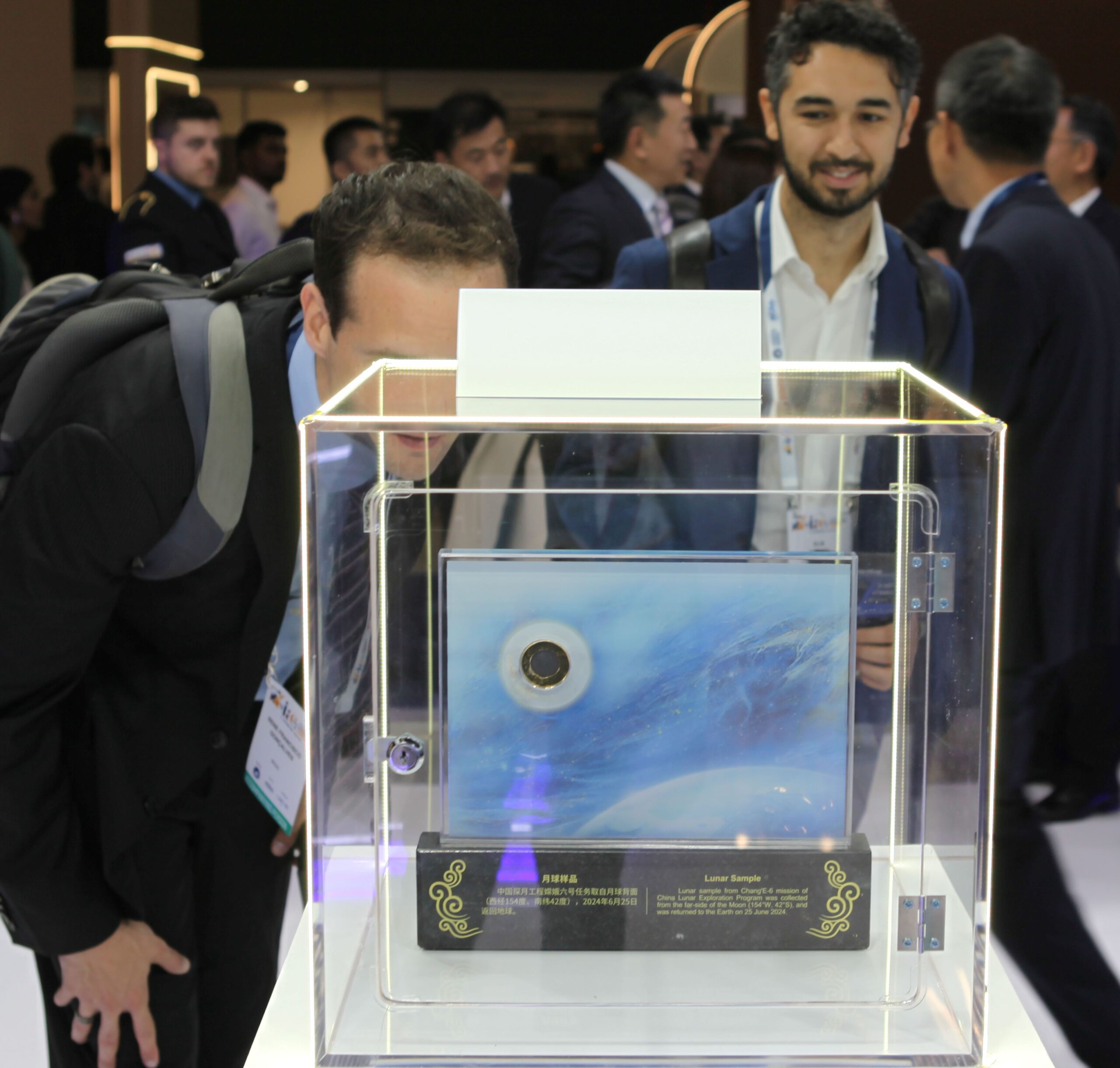

China’s Chang’e-6 mission found the Moon’s farside mantle is “colder” than the nearside, revealing new clues to lunar evolution.
China’s Chang’e-6 mission has provided scientists with the first-ever rock and soil samples from the far side of the Moon — and a new clue to why the two hemispheres of our lunar neighbour are so different.
Researchers analysing the returned samples found that the Moon’s farside mantle is colder than the nearside’s. The discovery adds a key piece to the puzzle of the Moon’s dual nature — the stark contrast between its smooth, dark volcanic plains on the nearside and the rugged, cratered highlands on the farside.
The study, published in Nature Geoscience, was carried out by scientists from the Beijing Research Institute of Uranium Geology, Peking University, and Shandong University. Using mineral analyses and thermal modelling, the team determined that the farside basalts from the Chang’e-6 samples crystallised at around 1,100 °C — roughly 100 °C lower than basalts from the nearside collected by the Apollo and Chang’e-5 missions.
To confirm their findings, the scientists also reconstructed the chemical composition of the farside mantle and compared it with data from satellite remote sensing. Across broader regions, they found that the farside mantle’s potential temperature was about 70 °C lower than that of the nearside. This consistency between sample analysis and orbital data strengthens the case for a colder farside mantle.
Why does this matter?
The difference in mantle temperature supports the idea that the Moon’s farside crust is thicker and poorer in heat-producing elements. This uneven heat distribution may explain why volcanic activity was more intense and longer-lasting on the nearside.
The results give scientists fresh insight into the Moon’s thermal evolution and the origin of its hemispherical asymmetry — a long-standing mystery in planetary science. With more missions like Chang’e-6 planned for the coming decade, researchers expect to learn even more about how the Moon formed, cooled, and became the two-faced world we see today.
Additional reporting by CNS, Global Times.
If you liked this article, why not read: China Looks to the Moon: 20 Years of Exploration in Focus