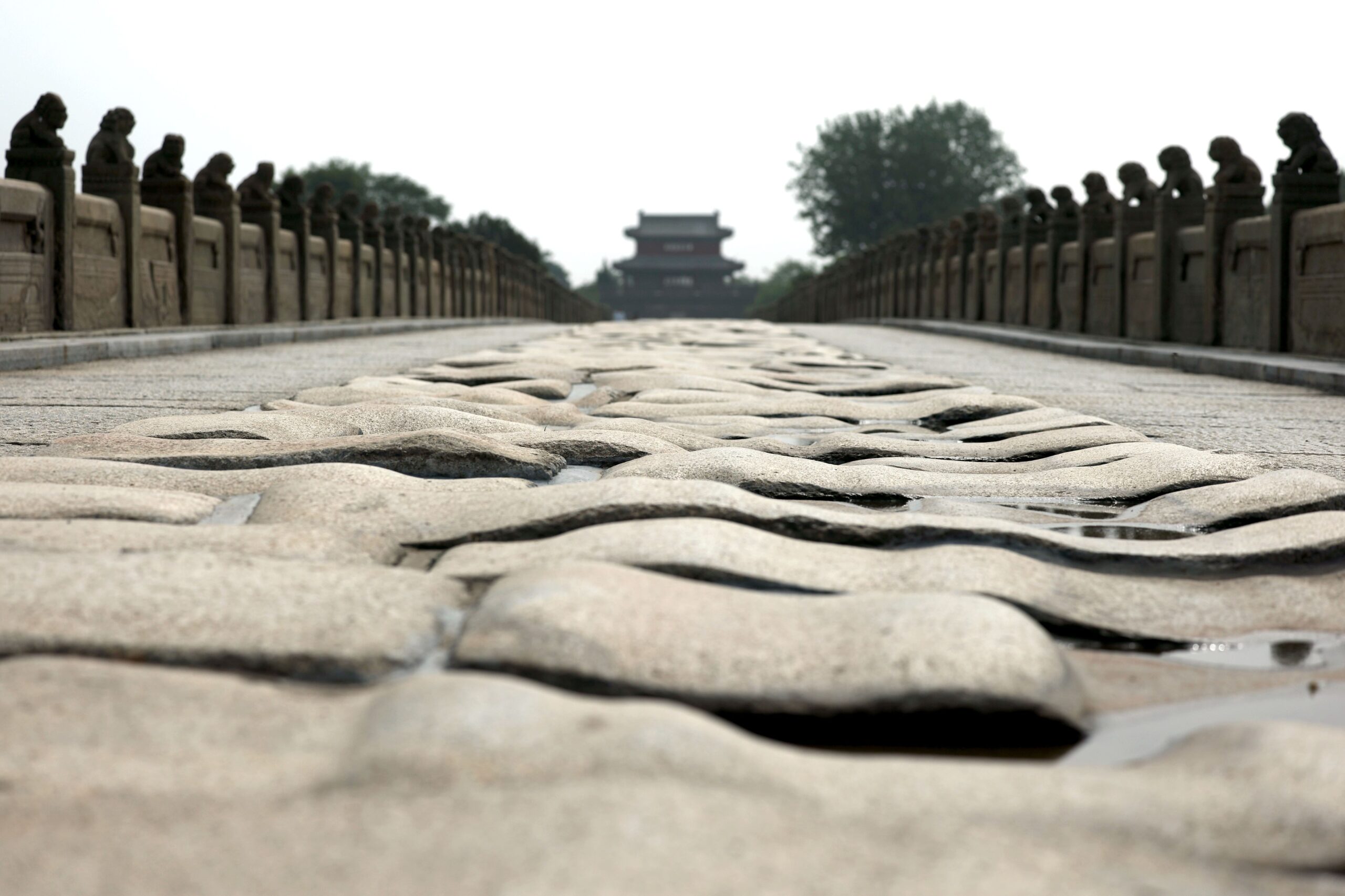

Discover Lugou Bridge in Beijing, where the July 7th Incident sparked China’s War of Resistance against Japan.
In the southwest of Beijing, the Yongding River flows quietly. Spanning the river is the Lugou Bridge, with the Wanping Fortress standing nearby. Stone lions on the bridge bear scars of bullets, and shell craters mark the fortress walls. They remind visitors of the battle that erupted here 88 years ago — the beginning of China’s War of Resistance against Japan.

From Ancient Bridge to Battlefield
The Lugou Bridge was first constructed in 1189 and has a history spanning over 800 years. The Italian traveller Marco Polo once called it “the finest and most unique bridge in the world.”
On July 7, 1937, Japanese forces provoked the “Lugou Bridge Incident,” known in China as the “July 7th Incident.” It marked the start of Japan’s full invasion of China. Chinese soldiers fought back, firing the first shots of the nationwide resistance. From that moment, the bridge became a landmark in the global fight against fascism.

A Family’s Memory
“My grandfather was only six when gunfire broke the silence of the night. The next morning, a shell exploded near his house. A playmate from the day before was killed instantly,” recalled Zheng Ran.
Her grandfather, Zheng Fulai, was a witness to the battle. Starting in 1951, he volunteered as a storyteller, sharing the history of Lugou Bridge with visitors from more than 70 countries. He did so for decades, reaching tens of thousands of people.
Today, his granddaughter continues his work. On the bridge, she tells tourists about the battles and the spirit of resistance that prevailed during that time. For children, she begins with the bridge’s stone lions—each different in size and shape—before connecting them to the history they witnessed.

History Meets Modern Life
At the eastern end of the 266-meter bridge lies Wanping Fortress. Within the old city, museums sit alongside cafés and bookstores, where daily life and history blend.
North of the bridge once ran the Pinghan Railway, a site of fierce battles. Today, the Beijing–Guangzhou high-speed railway passes nearby, trains rushing forward as a symbol of modern China. To the south, the Beijing–Hong Kong–Macau Expressway carries a constant flow of traffic. Along the river, Xiaoyue Lake Park offers green paths for residents to walk, run, and relax.
Lugou Bridge is the oldest stone arch bridge in Beijing. It is also the place where the nationwide resistance began. As both cultural heritage and a symbol of courage, it reminds people that peace was hard-won—and memory must be preserved.
Written by Chen Wang, additional reporting by CNS.
If you like this article, why not read: Sihang Warehouse: Defiance Marked by Bullet Holes