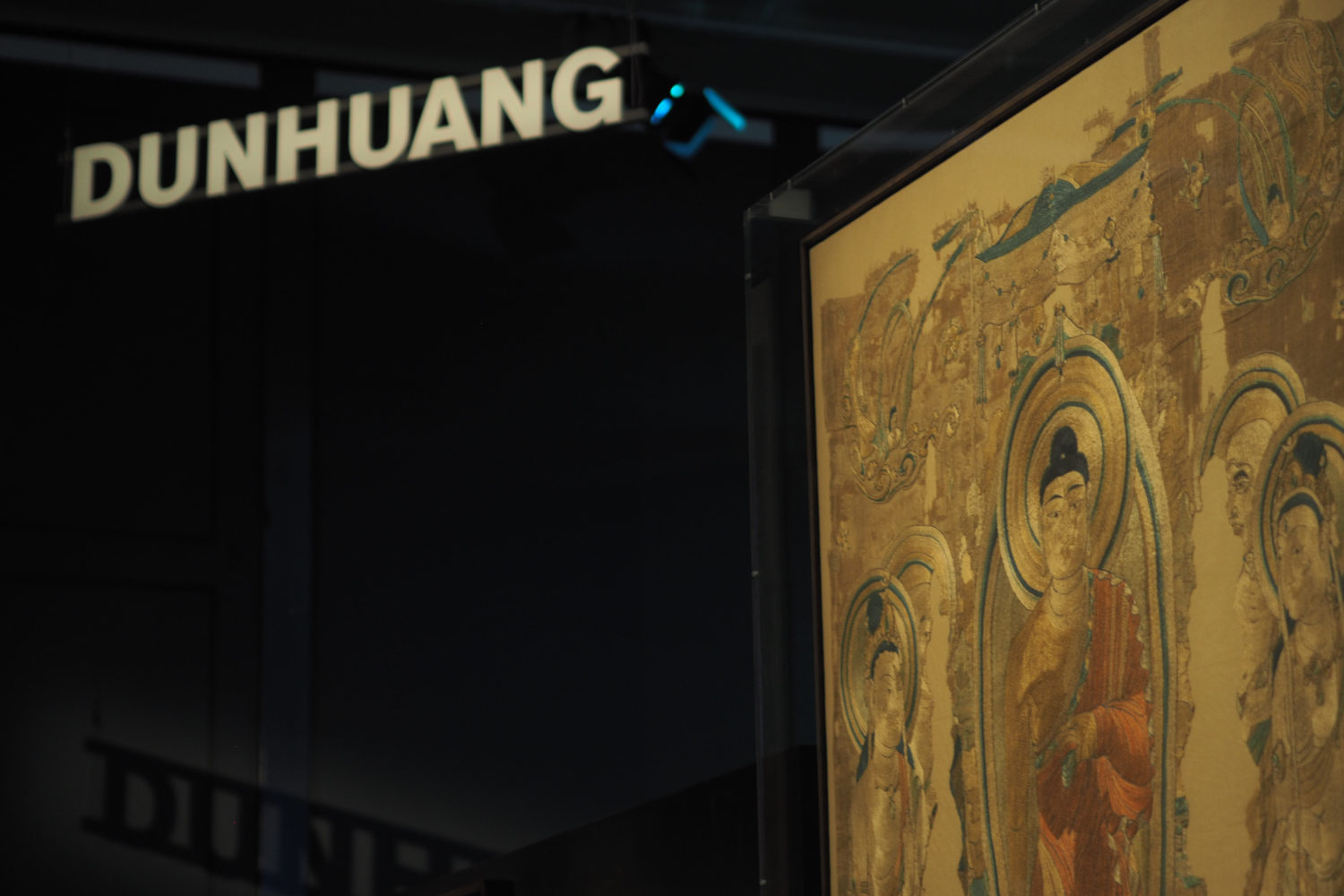

The new British Museum exhibition showcases the Silk Road as an interconnected web of trade routes from China to England.
The new Silk Road exhibition at the British Museum opens on the 26th of September, showcasing the famous trade route in a new light.
Nestled in the back of the British Museum, beyond the bright Great Court, is a darkened room holding over 300 artifacts from Asia, the Middle East, and Europe.
They vary from early Qurans to Byzantine clothing, and tiny Buddha statues to giant painted murals. The objects come from 29 national and international institutions. From Central Asia, several objects from Uzbekistan and Tajikistan that have never been seen in the UK before are on display.
The Silk Road exhibition’s focus is more than just showcasing these wonderful artifacts from across the world. It intends to challenge the stereotypical view of the Silk Road itself.
It is not a trade route from Asia to the Middle East. Primarily dominated by silk and spices. Rather, as the exhibition successfully showcases, the Silk Road was a network of connections bringing together Europe, the Middle East, and Asia closer than you’d expect. The exhibition focuses on one comparatively short period of the Silk Road’s history, from 500-1000AD.

Yu-ping Luk, who co-curated the exhibition along with Sue Brunning, explained that “there is a lot of interest in the Silk Road through writings about travels into exotic lands and images of bazaars with spices”.
However, this is not the complete story.
“We’re not saying those things aren’t true. There were spices, there were silks, and there were camels. But it is also a much richer story than that.
“There are many other kinds of goods, ideas, and also people that are moving across the continents of Asia, Africa, and Europe. These networks perhaps spanned much wider and further then people expect and were already intensively connected several centuries before the period of Marco Polo.”
This is showcased by the very first artifact that greets visitors to the exhibition. A tiny Buddha statue that was unearthed on the tiny Swedish island of Helgo. Dating from around 500-600AD, it was made some 5,000 miles away in Pakistan.
Amongst the many artifacts, Yu-ping Luk wanted to show off several loaned from the Asian Civilisations Museum in Singapore.
“This is a really magnificent selection of objects,” she explained.
Dating from 830AD. The objects are a collection of artifacts found on a shipwreck just off the coast of Indonesia.
The ship was on its journey from Tang China to ports in the Middle East. However, in Southeast Asia it encountered some form of difficulty and sunk.
On it were over 60,000 objects. The majority of which were Chinese ceramics but there were also personal belongings and metalwork.

“I think this group of objects highlights quite surprisingly the sheer scale of the connection by maritime routes already in the 9th century. There are also examples of Chinese craftsmen creating ware specifically for export. This blue and white dish at the time was not popular in Tang China and the design was unpopular in Tang China. The belief is this was an experience of Chinese potters designing a piece specifically for export. It’s a really interesting aspect of connections and the scale of them in this period.”
The exhibition opens on the 26th of September 2024 and will continue until 23rd February 2025.
It is located at the British Museum in central London.
The British Museum is free to enter. However, the special Silk Road exhibition costs £22 per person.
If you liked this article why not read: One of China’s oldest paintings goes on display in London